


















Lesson 44 of 49 · Projects and Practice
Case study: choosing a process for an aluminum bracket
A worked process-selection project: compare CNC machining, laser powder bed fusion, sand casting and die casting for one aluminum bracket across volumes, then add weight value and a weighted decision matrix.
Process selection is the moment where everything in this course comes together. You are given a part, a number to make and a deadline, and you must decide how to make it. There is rarely one obvious answer. The cheapest process at ten parts is rarely the cheapest at ten thousand, the best process for strength may be the worst for lead time, and the best technical answer may fail on a requirement nobody wrote down. In this project you will work through a realistic case, in the way an engineer would, with numbers and judgment.
What you will learn
- How to turn a part description into requirements for process selection.
- How to model total cost as fixed cost plus variable cost, and find break-even quantities.
- How value that is not in the unit cost (such as weight) can change the answer.
- How to use a weighted decision matrix and test how sensitive it is to the weights.
Key terms
Process selection: choosing the manufacturing process that best meets technical, cost and schedule requirements.
Fixed cost: cost that does not depend on quantity, such as tooling, programming and fixtures.
Variable cost: cost per part, such as material, machine time and labor.
Break-even quantity: the quantity at which two processes have equal total cost.
Decision matrix: a table scoring each option against weighted criteria.
The part and the requirements
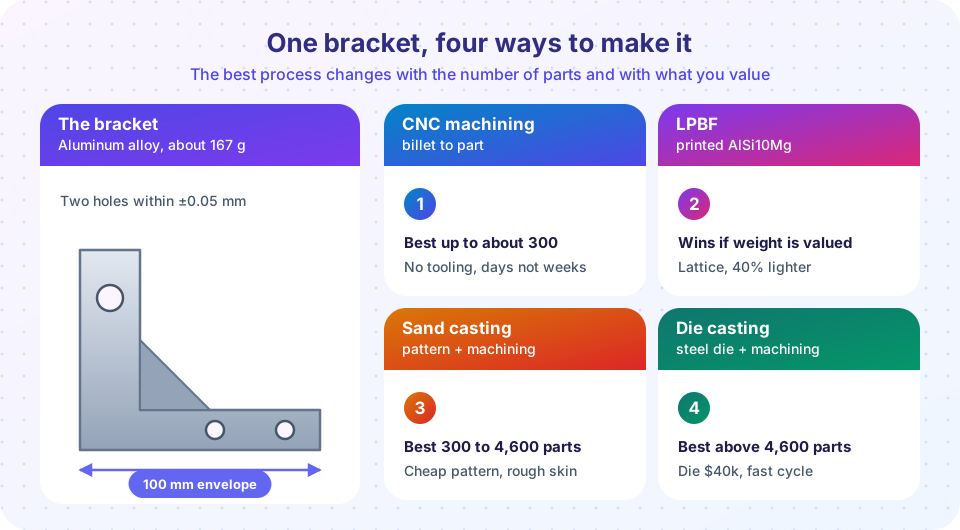
The bracket is an L-shaped support for a sensor on a vehicle. Its facts:
- Material: aluminum alloy (6061 for machining, a casting alloy for casting, AlSi10Mg for printing).
- Envelope 100 × 60 × 40 mm; finished volume 62 cm³, mass about 167 g.
- Two 8 mm mounting holes that must be located within ±0.05 mm; other features are not critical.
- Loads: moderate static load and vibration; no special fatigue requirement.
- Volume: unknown. The product could sell 20 units in a pilot run or 50,000 over its life.
- Lead time: pilot parts needed in two weeks.
The first message from this list is that volume is the dominant unknown, so the analysis must be done as a function of quantity.
Candidate processes
- CNC machining from billet (the machining chapter). No tooling; a setup, a fixture and a program. Machining the pockets and holes takes time and wastes most of the block (the buy-to-fly ratio from the first lesson of that chapter was 3.9).
- Laser powder bed fusion (the metal AM lesson). No tooling, free geometry, so the bracket can be topology-optimized; but each part is expensive and needs post-processing.
- Sand casting plus machining of the critical faces. A pattern is relatively cheap; each casting needs fettling and machining. Tolerances as cast are loose.
- High-pressure die casting plus finish machining. A steel die is very expensive but each part is cheap and fast, and surface and detail are good.
A cost model
With fixed cost F and variable cost c, the total cost for Q parts is F + c Q, and the cost per part is F/Q + c. The illustrative numbers below are the kind of estimates you would get from a first round of quotes or from the cost-model methods of the previous lessons. They are assumptions for teaching, not market prices:
| Process | Fixed cost F ($) | Variable cost c ($ per part) |
|---|---|---|
| CNC machining | 300 (programming, fixture) | 31 |
| LPBF | 150 (build preparation) | 125 |
| Sand casting + machining | 3,000 (pattern) | 22 |
| Die casting + machining | 40,000 (die) | 14 |
Break-even between two processes with (F₁, c₁) and (F₂, c₂) is Q* = (F₂ − F₁) / (c₁ − c₂) when process 2 has the higher fixed cost and the lower variable cost.
- CNC vs sand casting:
(3000 − 300) / (31 − 22) = 300 parts. - Sand vs die casting:
(40,000 − 3,000) / (22 − 14) = 4,625 parts.
So on cost alone: machine up to about 300 parts, sand cast between 300 and about 4,600, and die cast above that. LPBF never wins on unit cost in this scenario: it is more expensive than CNC from the second part onward.
What the unit cost leaves out
If this bracket is on an aircraft or a racing car, every gram has value. Topology optimization of the printed bracket might remove 40 percent of the mass (67 g). If the value of weight saved is $1,500 per kilogram (values from about a thousand to ten thousand dollars per kg are quoted for aerospace; this is an illustrative figure), the saving is 0.067 × 1,500 ≈ $100 per part, so LPBF's effective variable cost is 125 − 100 = $25, which beats CNC at $31. In an automotive vehicle with weight valued at a few dollars per kg, the credit would be a few cents and the conclusion would not change. The "best" process depends on what you value.
Other factors outside the unit cost: lead time (CNC and LPBF can deliver parts in days; a die takes weeks to months), design change risk (a change after die manufacture is expensive), tolerance and finish (as-cast and as-printed surfaces need machining), material properties (cast alloys have lower ductility; printed parts need heat treatment), and supply chain (who can actually make it).
A decision matrix
When criteria are mixed, a weighted decision matrix helps make the reasoning explicit. Score each option from 1 to 5 on each criterion, multiply by a weight and add up. The danger is false precision: the weights are opinions, so always test how the answer changes when they do.
Putting it together
For this bracket a sensible recommendation could be:
- Pilot run (20 units, two weeks): CNC machining. No tooling, fast, tight hole location, and design changes are easy.
- If the volume grows into the hundreds or low thousands: a sand-cast blank with machined critical faces, once the design has frozen.
- If the product will reach tens of thousands: invest in die casting and finish machining.
- If weight is critical: evaluate LPBF with topology optimization and compare the value of the weight saved.
Notice that the answer is a plan that changes with volume, not a single process.
Common misconceptions
"One process is best for a part." The best process depends on quantity, and a product often moves through several processes during its life: prototype, pilot, production.
"Cost models are exact." Fixed and variable costs are estimates with wide error. Test the break-even points against a range of values to see how robust the conclusion is.
"The cheapest quote wins." Quotes may leave out inspection, finishing, scrap, shipping and the cost of late delivery.
Try it
First, run the cost model: cost per part for each process across quantities, the break-even points and the effect of weight value.
Press Run (or Ctrl + Enter) to see the result here.
Program input · what you'd type while the program runs
Type the answers before you press Run, one per line. Each time the program reads a line (with input()), it gets the next line from this box.
Second, a weighted decision matrix you can adjust. Change the weights to see whether the ranking is robust.
Check your understanding
Quick check · 4 questions
of 4 answered You scored / 4 · perfect!
-
1. Process A has F = $2,000 and c = $10 per part. Process B has F = $500 and c = $25. At what quantity do they cost the same?
Q* = (F_A − F_B) / (c_B − c_A) = 1,500 / 15 = 100 parts. Below that B is cheaper in total; above it A is cheaper. -
2. Why can the printed bracket win in the weight-critical scenario even though it costs more per part?
If every kilogram saved is worth a lot, a lighter part can have a lower effective cost than a heavier but cheaper one. -
3. What is the main weakness of a weighted decision matrix?
Always test the ranking against different weights. If a small change flips the winner, the decision is not clear-cut. -
4. A die costs $60,000 and saves $12 per part compared with a process with no tooling. What is the break-even quantity?
Q* = 60,000 / 12 = 5,000 parts.
Summary
- Process selection starts from requirements, and the quantity often matters most.
- Total cost is
F + c Q; break-evenQ* = ΔF / Δctells you where the preferred process changes. - Unit cost leaves out value (weight, lead time, risk, finish); include what matters to the product.
- A decision matrix makes judgments explicit but must be tested for sensitivity.
- The answer is often a plan: prototype by one process, scale by another.
Track your progress
Create a free account to tick off lessons and pick up where you left off on any device.
of Manufacturing Processes lessons completed