


















Lesson 8 of 49 · Overview and Materials
Material Families and Process Fit
Match metals, polymers, ceramics and composites to casting, forming, machining, welding and molding, and use homologous temperature to tell hot working from cold working.
A recipe that works for bread does not work for glass. In the same way, every manufacturing process has a set of materials it was invented for and a set it handles badly or not at all. This lesson builds a map from materials to processes. You will see why aluminum is a darling of die casting, why titanium frustrates machinists, why thermoplastics dominate injection molding, and how one simple ratio, the homologous temperature, separates hot working from cold working.
What you will learn
- Choose plausible processes for a given material family.
- Explain the difference between thermoplastics and thermosets in processing.
- Compute homologous temperature and decide whether a deformation is hot or cold working.
- Name the material properties that control castability, machinability and weldability.
Key terms
Castability: how well a molten material fills a mold and solidifies without defects.
Machinability: how easily a material can be cut, judged by tool life, surface finish and cutting force.
Weldability: how well a material can be joined by fusion without cracking or losing properties.
Recrystallization: the formation of new, strain-free grains when a cold-worked metal is heated.
Homologous temperature: the working temperature divided by the melting temperature, both in kelvin.
A first map
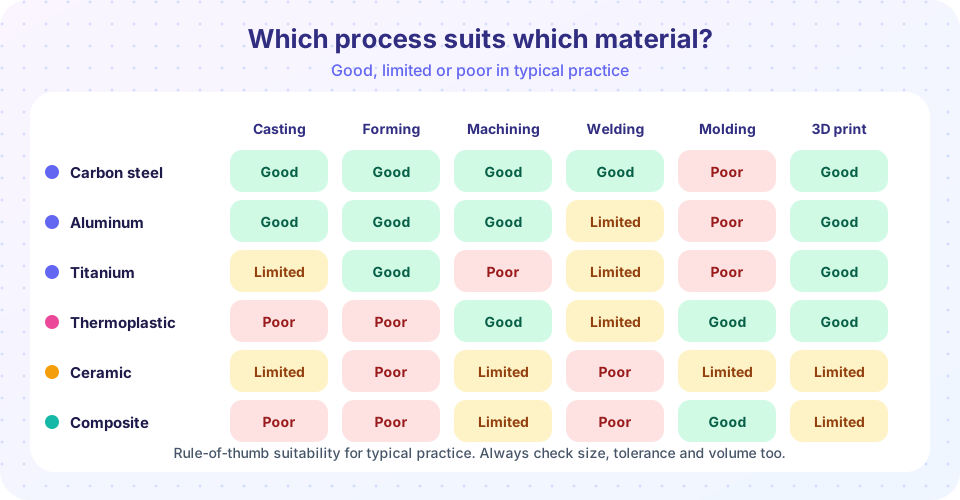
The table summarizes typical suitability. "Good" means the process is common and works well; "Limited" means it works with care, special equipment or for special cases; "Poor" means it is rarely used.
| Material | Casting | Forging and rolling | Sheet forming | Machining | Welding | Molding or sintering |
|---|---|---|---|---|---|---|
| Carbon steel | Good | Good | Good | Good | Good | Limited |
| Aluminum | Good (die casting) | Good | Good | Good | Good with care | Limited |
| Copper alloys | Good | Good | Good | Good | Limited | Limited |
| Titanium alloys | Limited (investment) | Good (hot) | Limited | Poor to limited | Good in inert gas | Limited |
| Thermoplastics | Poor | Poor | Thermoforming | Good | Plastic welding | Good (injection) |
| Thermosets | Resin casting | Poor | Poor | Limited | Poor | Good (compression) |
| Ceramics | Slip casting | Poor | Poor | Grinding only | Poor | Good (sintering) |
| Fiber composites | Poor | Poor | Poor | Limited | Poor | Layup, molding |
Use it as a first filter, never as a final answer; real choices also depend on size, tolerance and volume.
Metals: castability, formability, machinability
Castability depends on three things: a liquid that flows well (fluidity), a melting point the foundry can reach, and modest shrinkage. Aluminum alloys melt near 660 °C, a modest temperature, and flow well, which is why the housing of a gearbox or an engine block is so often aluminum or cast iron. Steel melts above 1,400 °C, so foundries need more energy and more robust molds.
Formability relies on ductility and strain hardening, which you met in the last lesson. Low-carbon steel, aluminum and copper form easily. Magnesium, with its hexagonal crystal structure, forms best when warm. Titanium forms readily when hot, but at room temperature it tends to crack and spring back.
Machinability is a rating that combines tool life, surface finish and power. Free-cutting brass is the usual reference for easy cutting: it breaks into short chips. Stainless steels and titanium have low thermal conductivity, so heat concentrates at the cutting edge and wears tools quickly. We return to this in Chapter 5.
Weldability drops as steel's carbon content rises: high-carbon steel hardens in the heat-affected zone next to a weld and can crack. Engineers use a carbon-equivalent formula to judge the risk. Aluminum welds well but needs protection from its oxide skin and shows high thermal expansion and conduction.
Polymers: the processing window
A thermoplastic has a window between "soft enough to flow" and "hot enough to degrade". Polypropylene melts near 165 °C and is processed near 200 to 250 °C. Heated too much, long chains break and the plastic discolors and loses strength. Cooled too fast, the part can warp.
Thermoplastics split into amorphous types (ABS, polycarbonate), which soften gradually above their glass transition temperature, and semi-crystalline types (polypropylene, nylon), which melt more sharply. Both can be injection molded, extruded, blow molded and 3D printed.
Thermosets (epoxy, phenolic, polyester resins) are shaped before they cure. Mixing resin and hardener, or heating in a mold, triggers cross-linking that is irreversible, so scrap cannot be remelted. Thermosets resist heat and creep better than most thermoplastics, which is why they appear in electrical parts, circuit boards and composite structures.
Ceramics and composites
Ceramics melt at very high temperatures and are brittle, so casting a ceramic like metal is impractical. The usual route is powder: shape the powder (pressing, slip casting, injection molding of ceramic powder), then sinter it by heating to just below its melting point so the particles fuse. The part shrinks noticeably during sintering, often by 15 to 20 percent in linear dimensions, so the pressed shape must be oversized. Finishing is done by diamond grinding.
Composites are made rather than formed: layers of fiber cloth or tape are laid in a mold and impregnated with resin (hand layup, vacuum bagging, autoclave curing), or fibers are wound or pulled through a die. Machining composites needs sharp tools and dust control; welding does not apply, though thermoplastic composites can be fused.
Hot working versus cold working
Whether a metal strain-hardens or softens during deformation depends on temperature relative to its melting point. Engineers use the homologous temperature:
T_h = T / T_m (both in kelvin)
Roughly speaking, cold working happens below about 0.3 T_m, where strain hardening dominates. Hot working is above about 0.5 T_m (and above the recrystallization temperature), where new strain-free grains form as fast as the metal is deformed, so it stays soft. In between is warm working.
Worked example
Convert melting points to kelvin: aluminum 660 °C is 933 K; pure iron 1,538 °C is 1,811 K; lead 327 °C is 600 K.
- Aluminum:
0.5 × 933 = 466 K = 193 °C. Forming aluminum above roughly 200 °C is hot working. - Iron (steel):
0.5 × 1,811 = 906 K = 633 °C. In practice steel forging happens at 1,000 to 1,250 °C, well into the hot-working range. - Lead:
0.5 × 600 = 300 K = 27 °C. Room temperature is already hot working for lead, which is why lead never strain-hardens at room temperature.
Hot working lowers the force and lets you make big changes in shape, but the surface oxidizes and tolerances are looser. Cold working gives better finish and higher strength, but needs more force and eventually annealing.
Common misconceptions
"Plastic is one material." The family contains hundreds of polymers with very different processing temperatures, stiffness and chemical resistance.
"Hot working means the metal is red hot." The definition depends on the melting temperature: for lead, room temperature qualifies; for tungsten, a white-hot glow is still cold working.
"Any metal can be welded." Weldability varies with composition; some alloys crack or lose strength next to the weld.
Try it
Pick a material and process to see how the matrix rates them, with a reason. It is a lookup aid built from the table above.
The second example computes the hot-working threshold and the homologous temperature for several metals.
Press Run (or Ctrl + Enter) to see the result here.
Program input · what you'd type while the program runs
Type the answers before you press Run, one per line. Each time the program reads a line (with input()), it gets the next line from this box.
Check your understanding
Quick check · 5 questions
of 5 answered You scored / 5 · perfect!
-
1. Why can thermoset scrap not be remelted?
Curing creates permanent chemical cross-links, so a thermoset will not soften into a melt again. -
2. Which metal is the best fit for a high-volume die-cast housing?
Aluminum melts at a modest temperature and flows well, which suits die casting. -
3. Lead melts at 327 °C (600 K). At about what temperature does hot working begin by the 0.5 rule?
0.5 × 600 K = 300 K, which is about 27 °C, so room temperature is hot working for lead. -
4. Why is sintered ceramic oversized when pressed?
Powder compacts densify and shrink during sintering, so the pressed shape is made larger. -
5. Which material typically has poor machinability because it concentrates heat at the cutting edge?
Titanium's low thermal conductivity traps heat at the tool edge and wears it quickly.
Summary
- Each process suits particular materials: castability, formability, machinability and weldability are the key tests.
- Thermoplastics remelt; thermosets cure permanently; ceramics are shaped from powder and sintered; composites are laid up.
- Homologous temperature
T / T_mseparates cold working (below about 0.3), warm and hot working (above about 0.5). - Hot working lowers force but loosens tolerance; cold working strengthens and finishes better.
Next: Steel and Heat Treatment
Track your progress
Create a free account to tick off lessons and pick up where you left off on any device.
of Manufacturing Processes lessons completed