


















Lesson 12 of 49 · Casting and Molding
Chapter 3 Overview: Casting and Molding
A big-picture tour of casting and molding: the basic steps, expendable versus permanent molds, the heat needed to melt metal, and a map of the Chapter 3 lessons.
Casting is one of the oldest manufacturing ideas and still one of the most powerful: make a hollow shape, fill it with liquid, wait until the liquid becomes solid, and open the mold. Bronze tools, church bells, engine blocks, pump housings, jewelry and plastic bottle caps all follow that idea. Its great strength is that a liquid takes the shape of almost any cavity, so complex outer shapes and even internal passages can be made in one step. Its great challenge is that liquids shrink as they freeze, and a mold must feed that shrinkage.
What you will learn
- List the basic steps of a casting process and name the parts of a mold.
- Distinguish expendable-mold from permanent-mold processes and give examples of each.
- Estimate the heat needed to melt and pour a metal.
- Preview the lessons of this chapter.
Key terms
Pattern: a replica of the part (slightly oversized) used to make the cavity in an expendable mold.
Cavity: the hollow space in the mold that gives the casting its shape.
Gating system: the channels (pouring basin, sprue, runner, gate) that lead metal into the cavity.
Riser: a reservoir of molten metal that feeds the casting as it shrinks.
Core: a separate insert that forms an internal hollow in the casting.
The basic steps
Five steps of casting
- Pattern
- Mold
- Pour
- Solidify
Then finish
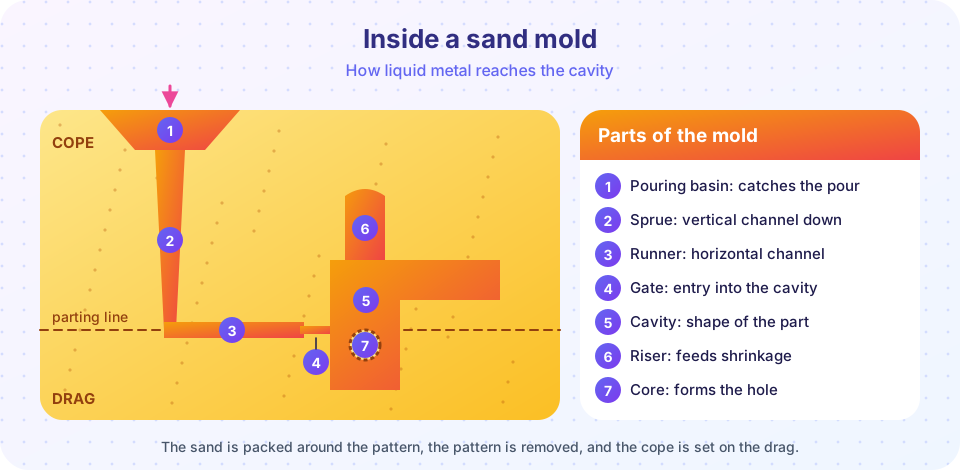
- Make the mold. In sand casting the mold is made by packing sand around a pattern and then removing the pattern. A mold for a typical part has two halves: the cope (top) and the drag (bottom).
- Melt the metal in a furnace and raise it above its melting point by a small superheat, so that it stays liquid long enough to fill the cavity.
- Pour it into the pouring basin; it runs down the sprue, along the runner, through the gate and into the cavity. Air and gases leave through vents.
- Solidify. The metal cools from the mold wall inward. Thin sections freeze first, thick ones last.
- Shake out, clean and inspect. Remove the casting, cut off the gating system and risers, grind off rough spots and check for defects.
Two big families
Expendable-mold casting uses a mold that is destroyed to remove the part. Sand casting, shell molding, investment ("lost-wax") casting and plaster casting belong here. The mold is cheap and can be any shape, but a new one is needed for every part, so the cycle is slow and the accuracy modest.
Permanent-mold casting uses a reusable metal mold. Gravity permanent-mold casting, low-pressure casting and die casting belong here. The mold is expensive but can produce thousands to hundreds of thousands of parts quickly, with good accuracy and surface finish. Molds can only be as complex as the part can be extracted from.
Molding is the same idea for plastics: injection molding forces molten polymer into a steel mold, which is opened after the plastic cools. We study it in lesson 5 of this chapter.
How much heat does it take?
Pouring metal costs energy. The heat required per kilogram is the sum of three parts: heating the solid to its melting point, melting it (the latent heat of fusion), and heating the liquid to the pouring temperature:
Q = m [c_s (T_m - T₀) + H_f + c_l (T_p - T_m)]
Rough values: aluminum has c_s ≈ 0.90 kJ/kg·K, H_f ≈ 397 kJ/kg, c_l ≈ 1.08 kJ/kg·K, T_m = 660 °C. Heating 1 kg from 20 °C to a pouring temperature of 720 °C needs 0.90 × 640 + 397 + 1.08 × 60 = 576 + 397 + 65 = 1,038 kJ, about 0.29 kWh, in an ideal furnace. Real furnaces lose heat, so foundries use two or three times that. The same arithmetic for iron-based metals gives more than 1,200 kJ/kg, and because iron is denser, the energy per cubic meter of casting is several times larger. Melting is a major part of a foundry's electricity or gas bill.
Why choose casting?
- Complex shapes in one step, including internal cavities made with cores.
- A huge range of sizes, from grams to hundreds of tonnes.
- Many metals, including ones hard to forge or machine.
- Near-net shape, so little material is wasted compared with machining a block.
The price paid is a lower strength than a forged part of the same alloy (casting porosity and coarse grains), rougher dimensional accuracy, and a lot of defects to control. Later lessons explain the physics that makes these trade-offs appear.
In this chapter
- Sand casting and gating: Chvorinov's rule, pouring and gating design.
- Shrinkage, risers and casting defects: why castings shrink and how to feed them.
- Permanent-mold, die and investment casting.
- Plastic injection molding: cycle time, cooling and clamp force.
- Chapter 3 review.
Common misconceptions
"Casting means pouring into a simple block." Gating, venting, shrinkage control and solidification direction decide whether the part is sound.
"A cast part is as strong as a forged one." Coarse grain and porosity usually make castings weaker than forgings of the same alloy.
Try it
Step through a pour and see which region solidifies where in this simplified animation. It is a cartoon of the sequence, not a heat-flow simulation.
The second example calculates the heat needed to melt and pour three metals, using approximate property values.
Press Run (or Ctrl + Enter) to see the result here.
Program input · what you'd type while the program runs
Type the answers before you press Run, one per line. Each time the program reads a line (with input()), it gets the next line from this box.
Check your understanding
Quick check · 5 questions
of 5 answered You scored / 5 · perfect!
-
1. What does a riser do?
A riser is a reservoir of molten metal that compensates for solidification shrinkage. -
2. Which is an expendable-mold process?
Investment casting destroys its ceramic shell to remove the part. -
3. Which part of the gating system is the vertical channel from the pouring basin?
The sprue is the vertical channel that leads down from the basin. -
4. Why is superheat added when pouring?
Extra temperature above the melting point gives time for the metal to fill thin sections. -
5. Which is a main advantage of casting?
A liquid fills almost any cavity, so complex shapes can be made in one step.
Summary
- Casting fills a cavity with liquid that solidifies; the steps are pattern, mold, melt, pour, solidify and clean-up.
- Expendable molds suit complex, low-volume parts; permanent molds suit high volume.
- Melting takes roughly 1 MJ/kg for aluminum and more for iron-based metals.
- Casting gives complex near-net shapes but lower strength and accuracy than forging or machining.
Next: Sand Casting and Gating
Track your progress
Create a free account to tick off lessons and pick up where you left off on any device.
of Manufacturing Processes lessons completed