


















Lesson 2 of 49 · Getting Started
What Is Manufacturing? Families of Processes
Learn what manufacturing is, how processes are grouped into shaping, property-enhancing, surface and joining families, and why most of a part's life is spent waiting.
Manufacturing is the making of useful physical things from raw materials, using machines, tools, energy and human skill. The word comes from Latin roots meaning "made by hand", which is ironic, because most of what we call manufacturing today is done by machines that people design, set up and supervise. In this lesson you will learn the vocabulary that every later lesson depends on: the families of processes, the idea of a process chain, and the surprising fact that a part is usually being processed for a tiny fraction of the time it spends in a factory.
What you will learn
- Define manufacturing and distinguish it from design and from assembly.
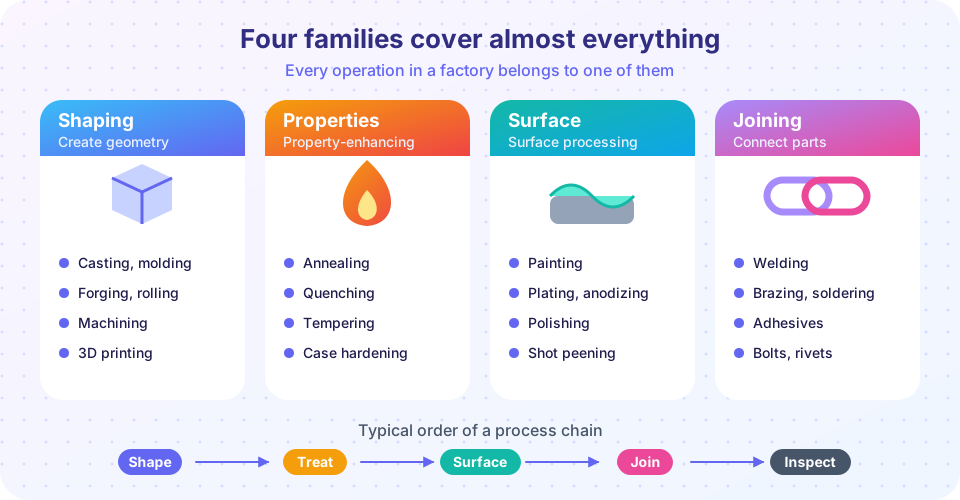
- Name the four families of processes and give two examples of each.
- Explain what a process chain is and why order matters.
- Compute the value-added fraction of a part's time in a factory.
- Describe, in broad strokes, how manufacturing has changed since about 1800.
Key terms
Shaping process: gives a material its geometry. Casting, forming, machining and additive manufacturing are shaping processes.
Property-enhancing process: changes the material's internal structure without changing the shape, for example heat treatment.
Surface processing: cleans, coats or finishes the surface, for example painting, plating or polishing.
Joining: permanently or temporarily connects parts, for example welding, brazing, riveting or bonding.
Process chain: the ordered list of operations from raw material to finished product.
Manufacturing in the product story
A product starts as an idea, becomes a design, and only then reaches the factory floor. Manufacturing sits in the middle of that story. It receives drawings, specifications and a bill of materials, and it returns physical parts that meet them. The link between design and manufacturing is so important that engineers have a name for the habit of designing with production in mind: design for manufacturing, abbreviated DFM. A designer who knows that a casting needs a draft angle, or that a sheet-metal bend needs a minimum radius, saves weeks of rework later.
It helps to separate three words that beginners mix up. Manufacturing is the whole activity of making goods. A process is one particular method inside it, such as die casting. An operation is one step performed on one workpiece at one workstation, such as "drill four holes". A process chain is a sequence of operations, and the whole chain is what a routing sheet on the shop floor lists.
The four families
Most textbooks group processes into a handful of families. We use four, and every chapter of this course lives in one of them.
Shaping processes
Shaping processes create geometry. They themselves divide into four groups according to the state of the material at the moment it takes shape:
- From a liquid or semi-liquid: casting and molding. Molten metal, plastic melt or slurry fills a cavity and solidifies (Chapter 3).
- From a solid that is deformed: forging, rolling, extrusion, drawing and sheet-metal forming. The volume stays the same while the shape changes (Chapter 4).
- From a solid that is cut: machining, grinding and similar processes. Material leaves as chips (Chapter 5).
- From powder, wire or resin added layer by layer: additive manufacturing, often called 3D printing (Chapter 7). Powder metallurgy is a related older route.
Property-enhancing processes
A steel shaft can leave a machine shop with exactly the right diameter and still be too soft for its job. Heat treatment changes the internal structure so that the same shape becomes harder, tougher or more stable. Annealing, quenching and tempering are the best-known examples. We meet them in Chapter 2. Notice that these processes change properties, not geometry.
Surface processing
Surfaces fight the world: corrosion, wear, friction and appearance. Cleaning, painting, anodizing, electroplating, shot peening and polishing all work on the surface layer. Many of them add a thin coating measured in micrometers, so they hardly change dimensions, although tight tolerances must allow for the coating thickness.
Joining and assembly
Very few products are one piece. Welding, brazing and soldering fuse parts with heat. Adhesives bond them. Bolts and rivets hold them mechanically. Chapter 6 treats the joining processes; the larger topic of assembly systems appears again in Chapter 8.
Why order matters
A process chain is not arbitrary. Consider a steel gear. A sensible chain is: forge a blank, machine the teeth, heat treat for hardness, then grind the teeth to final accuracy. Reverse the last two steps and you are grinding the teeth before heat treatment distorts them, and the gear will not run true. Reverse the first two and you waste time machining a block that forging would have shaped cheaply. Chains follow some rules of thumb:
- Do the high-volume, rough shaping early, when the material is cheap to remove or move.
- Do precision operations late, after steps that could distort the part.
- Do heat treatment before final grinding, because heating warps parts.
- Coat last, unless the coating needs a very smooth base.
Many problems in real factories come from chains that ignore these rules.
Where does the time go?
Here is a fact that surprises most beginners. Imagine a metal bracket that takes 3 minutes to machine and 2 minutes to inspect. The factory schedules it in a batch with other jobs. After machining it waits for the paint shop, then for a truck, then for assembly. Its total lead time is 12 days, which is 17,280 minutes. Only 5 minutes of that is value-added work. The value-added fraction is 5 divided by 17,280, which is about 0.03 percent.
This is not an exaggeration. Studies of job shops routinely find parts spend the great majority of their time queued, moving or waiting for the next machine. That insight is the starting point of lean manufacturing in Chapter 8: shortening waiting often boosts output far more than speeding up the machine.
When you meet a new process in this course, ask two questions. How long does the operation itself take? And how long does the part wait before and after it? Both numbers matter for the cost.
A short history in six steps
- Before 1800: craftspeople made each part by hand and fitted parts to each other.
- Around 1800: machine tools such as the screw-cutting lathe allowed accurate metal parts; Eli Whitney and others promoted interchangeable parts, which let one part replace another without filing.
- Late 1800s: steel became cheap and abundant, and standard sizes and gauges spread.
- 1900s: Frederick Taylor's time studies and Henry Ford's moving assembly line cut assembly times dramatically. Ford's Model T chassis assembly fell from more than twelve hours to about an hour and a half in the first years of the moving line.
- 1950s onward: numerical control, then computer numerical control (CNC), let a program rather than a skilled hand guide the cutter. Toyota developed lean production in the same period.
- Since about 2000: industrial robots, networked sensors and additive manufacturing reshaped how short runs and customized parts are made.
Common misconceptions
"Manufacturing and assembly are the same thing." Assembly is one part of manufacturing, the joining of already-made components. Many factories make parts and ship them elsewhere to be assembled.
"A process that is fast is a productive process." Machine time is often tiny compared with waiting and setup time, so a fast machine inside a poor schedule may barely improve output.
Try it
Click a process to see which family it belongs to and a one-line reason. This is a classification aid, so some processes (like laser welding) legitimately sit between families in practice.
The second example computes the value-added fraction for a small routing. The times are made-up classroom numbers.
Press Run (or Ctrl + Enter) to see the result here.
Program input · what you'd type while the program runs
Type the answers before you press Run, one per line. Each time the program reads a line (with input()), it gets the next line from this box.
Check your understanding
Quick check · 5 questions
of 5 answered You scored / 5 · perfect!
-
1. Heat treating a steel shaft to make it harder belongs to which family?
Heat treatment changes the internal structure and properties without changing the shape. -
2. Why is final grinding of a hardened gear normally done after heat treatment?
Heat treatment distorts parts slightly. Precision grinding afterwards removes that distortion. -
3. A part needs 5 minutes of work and spends 12 days in the factory. About what fraction of its time is value-added?
12 days is 17,280 minutes. 5 divided by 17,280 is about 0.0003, or 0.03 percent. -
4. Which is the best example of an operation (not a whole process)?
An operation is a single step on a workpiece at a workstation, such as drilling four holes. -
5. Which pair contains only shaping processes?
Forging deforms and milling cuts, so both create geometry. Anodizing is surface processing and welding is joining.
Summary
- Manufacturing turns design into physical parts; DFM is designing with production in mind.
- The four families are shaping, property-enhancing, surface processing and joining.
- A process chain's order matters: rough shaping first, precision after heat treatment, coating last.
- Parts typically spend well over 99 percent of their time waiting rather than being processed.
- Interchangeable parts, the moving line, CNC and lean production shaped modern practice.
Track your progress
Create a free account to tick off lessons and pick up where you left off on any device.
of Manufacturing Processes lessons completed