


















Lesson 1 of 49 · Getting Started
Course Map: How Things Get Made
Start here: what manufacturing processes are, who this course is for, how to study it, and a visual map of all nine chapters from materials to lean production.
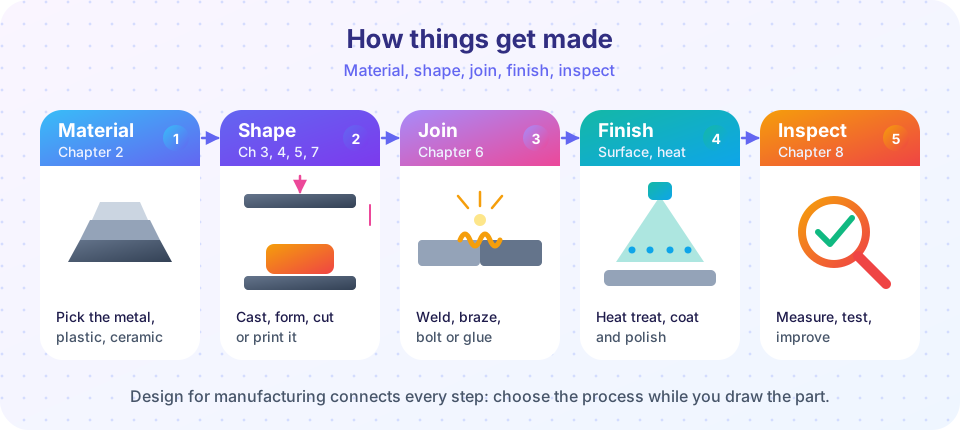
Look at the nearest object on your desk. A pen, a phone, a mug, a screw. Every one of them was made by a chain of deliberate steps: someone chose a material, gave it a shape, joined parts together, finished the surface and checked the result. That chain is manufacturing, and this course teaches you how each link works, why engineers choose one link over another, and how to put numbers on the choice.
What you will learn
- What the main families of manufacturing processes are and what each one is good at.
- How to estimate forces, times, shrinkage and costs with short, honest formulas.
- How to choose a process for a part from its shape, material and quantity.
- How quality, automation and lean thinking keep a factory productive.
- How to run small simulations in Python and interactive widgets in your browser.
Key terms
Manufacturing process: a method that changes the shape, properties or assembly of a material to make a product.
Workpiece: the piece of material being processed at a given moment.
Tooling: the molds, dies, cutters and fixtures that give the process its shape and accuracy.
Tolerance: the allowed variation in a dimension, such as 25.00 mm plus or minus 0.05 mm.
Throughput: how many good parts leave the process per unit of time.
Who this course is for
The course suits students of about 16 and older, first-year engineering and technology students, makers who want to move from hobby to production, and anyone curious about how the physical world is built. You need arithmetic, basic algebra, and a feel for units. When a formula needs a logarithm or a square root, we show the calculation. No prior workshop experience is assumed. Where chemistry or metal physics matters, we explain it from scratch in Chapter 2.
If you are comfortable with forces and stress, the sister tracks on statics and strength of materials will deepen the mechanics behind forming and machining, but you can start without them. The tone throughout is practical: every chapter has worked examples with real magnitudes, a diagram you can study, and runnable code you can change.
The nine chapters at a glance
Chapters 1 and 2
Chapters 3 and 4
Chapters 5 and 6
Chapters 7 and 8
Chapter 9
Chapters 1 to 4 form the first half of the course. They give you the vocabulary, the materials and the two big families of shape-making that start from a liquid or a solid billet: casting, molding and forming. The second half covers cutting, joining, additive manufacturing and the systems that make a factory reliable.
How to study this course
Read each lesson once for the big picture, then work the examples with a calculator. Change the numbers in every TryIt and predict the result before you press Run. Prediction is the habit that turns formulas into judgment. After the quiz, write the lesson's summary in your own words in a notebook.
A good rhythm is one lesson per sitting, with the chapter review a few days later so your memory has to work for the answers. Chapter overview lessons are short; content lessons take 30 to 45 minutes. If a lesson seems dense, jump to its worked example and then come back to the text.
What is real and what is a model
Every simulation here is a short model of a process, not a digital twin of a factory. Formulas such as Chvorinov's rule or the bending force equation are classroom-grade estimates: good for choosing a process and sizing equipment roughly, not for signing off a safety-critical design. When we use a stand-in, we say so. Real shops add safety factors, test runs and measurement.
Common misconceptions
"Modern manufacturing is all robots and 3D printers." In fact most mass-produced metal and plastic parts still come from casting, forging, stamping, molding and machining, which you will study first.
"The cheapest process per part is the best." Not necessarily: the cheapest process at 100 parts is often the most expensive at 100,000.
Try it
The first widget lets you pick a product and see a typical chain of processes. It is a simplified teaching table, not a recipe.
The second example tracks how much of the purchased material ends up in the finished part. Engineers call the ratio of purchased mass to finished mass the buy-to-fly ratio (borrowed from aerospace). The numbers are illustrative.
Press Run (or Ctrl + Enter) to see the result here.
Program input · what you'd type while the program runs
Type the answers before you press Run, one per line. Each time the program reads a line (with input()), it gets the next line from this box.
Check your understanding
Quick check · 4 questions
of 4 answered You scored / 4 · perfect!
-
1. Which item is tooling?
Tooling means the molds, dies, cutters and fixtures that give the process its shape and accuracy. -
2. A bracket needs 10 kg of billet to produce a 2.5 kg part. What is its buy-to-fly ratio?
10 kg divided by 2.5 kg is 4. Four kilograms are bought for every kilogram that ends up in the part. -
3. Why is the cheapest process at 100 parts often not the cheapest at 100,000 parts?
Fixed tooling cost divides by the number of parts, so processes with expensive tooling and cheap parts win at high volume. -
4. What is a tolerance?
A tolerance such as 25.00 mm plus or minus 0.05 mm states how much a dimension may vary and still be acceptable.
Summary
- Manufacturing is the chain of steps that turns material into a finished, checked product.
- The course runs from materials through casting, forming, machining, joining and additive processes to quality and lean production.
- The formulas are classroom estimates that help you choose and size processes.
- Process choice depends on shape, material, tolerance and above all quantity.
Next: What Is Manufacturing?
Track your progress
Create a free account to tick off lessons and pick up where you left off on any device.
of Manufacturing Processes lessons completed