


















Lesson 5 of 49 · Getting Started
Chapter 1 Review: Getting Started
Review Chapter 1: the four process families, volume classes, break-even cost, takt time and OEE, with a recap table, a one-page picture and a ten-question quiz.
Chapter 1 gave you the language and the arithmetic that the rest of the course leans on. You learned that manufacturing is a chain of operations, that the chain splits into four families, that quantity decides which process is economical, and that a handful of simple ratios (takt time, utilization, OEE) tell you whether a plant can keep up with demand. This review pulls the chapter onto a single page, lists the formulas you must be able to use, and then tests you.
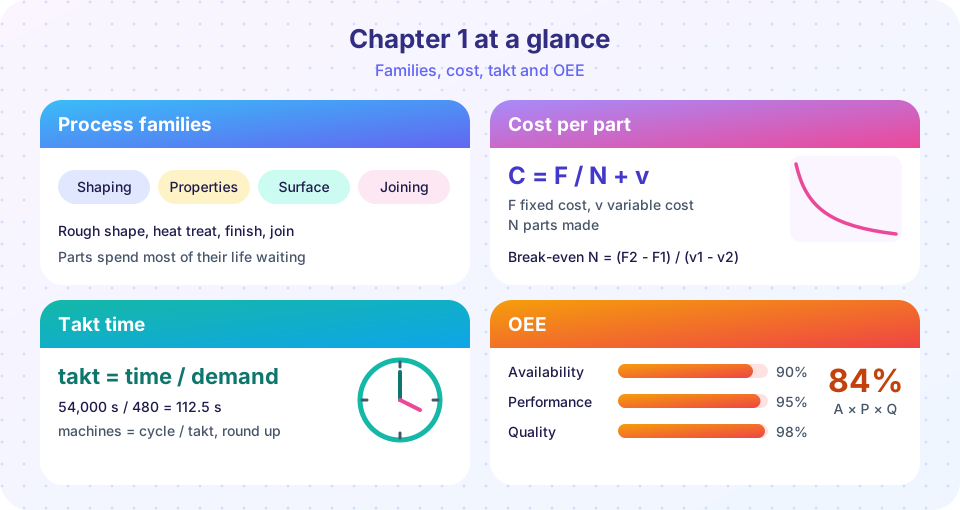
The chapter in one table
| Topic | The idea | The tool |
|---|---|---|
| Course map | Material, shape, join, finish, inspect | The nine chapters |
| Process families | Shaping, property-enhancing, surface, joining | Classify any operation |
| Process chain | Rough shaping early, precision late, coating last | Routing sheet |
| Lead time | Parts mostly wait | Value-added fraction = work time / total time |
| Volume | One-off, batch, mass, continuous | Match layout to volume |
| Cost per part | Fixed cost spread over quantity | C = F / N + v |
| Break-even | Where two processes cost the same | N = (F2 - F1) / (v1 - v2) |
| Takt time | Customer pace | available time / demand |
| Machines needed | Capacity | cycle time / takt (round up) |
| OEE | Real efficiency | availability × performance × quality |
Five questions to ask about any part
- Which family? Does the next step shape, change properties, treat the surface or join?
- What order? Does this step risk distorting something already finished?
- How many? What is the total quantity, and how sure are we?
- What does it cost? Which fixed and variable costs does each candidate process have?
- Can the line keep up? Is cycle time at or below takt, and what is the bottleneck?
If you can answer these for a part, you can start a sensible process plan.
Common mistakes to avoid
Beginners tend to repeat the same handful of errors, so it is worth naming them before the quiz.
- Mixing up tolerance and plus-or-minus. A part dimensioned 25.00 ± 0.05 mm has a tolerance band of 0.10 mm.
- Comparing processes at one quantity only. A cost comparison is a curve, not a number; always ask where the lines cross and whether your forecast quantity lies safely on one side of the crossing.
- Forgetting the waiting time. When someone says a part "takes three minutes to make", ask how long it takes to get through the plant. The two numbers can differ by a factor of thousands.
- Using takt time as a speed limit for machines. Takt is the pace the customer needs. A machine with a cycle time far below takt is idle much of the time, which is fine if it is cheap and flexible but wasteful if it is a costly dedicated line.
- Quoting OEE without its three parts. An OEE of 84 percent can hide poor quality or frequent stops; the three ratios show where the loss really is.
Keep these in mind as you read the quiz questions; several of them are built around exactly these traps.
Try it
Use the all-in-one calculator to revisit the chapter's key formulas. It is a calculator that applies the formulas, not a simulation of a factory.
Press Run (or Ctrl + Enter) to see the console output here.
No output.
Check your understanding
Quick check · 10 questions
of 10 answered You scored / 10 · perfect!
-
1. Which family does anodizing belong to?
Anodizing builds an oxide layer on the surface, so it is surface processing. -
2. Why is precision grinding usually done after heat treatment?
Heat treatment warps parts slightly, so the precision step comes afterwards. -
3. A part needs 4 minutes of work and spends 8 days (11,520 minutes) in the factory. The value-added fraction is about:
4 / 11,520 = 0.000347, about 0.035 percent. -
4. Process A has F = 2,000 and v = 8. Process B has F = 10,000 and v = 4. The break-even quantity is:
2000 + 8N = 10000 + 4N gives 4N = 8000, N = 2000. -
5. Which production class suits dedicated flow lines?
Mass production makes enough identical parts to justify dedicated lines. -
6. Available time is 27,000 s per day and demand is 300 parts per day. Takt time is:
27,000 / 300 = 90 seconds. -
7. With a cycle time of 135 s and takt of 90 s, how many machines are needed?
135 / 90 = 1.5, which rounds up to 2 machines. -
8. What is the OEE for availability 0.92, performance 0.90 and quality 0.99?
0.92 × 0.90 × 0.99 = 0.820, about 82 percent. -
9. Which statement about the bottleneck is true?
The slowest station limits the whole line, so improving it is what raises output. -
10. Which cost is spread over the parts in a batch?
Setup is done once per batch, so its cost divides by the batch size.
Summary
- Four families, a sensible order, and a lot of waiting define the manufacturing landscape.
- Quantity picks the process through
C = F / N + vand break-even calculations. - Takt, cycle time, utilization and OEE tell you whether a plant can meet demand.
- Chapter 2 turns to the materials that every process works on.
Track your progress
Create a free account to tick off lessons and pick up where you left off on any device.
of Manufacturing Processes lessons completed