


















Lesson 36 of 49 · Additive Manufacturing
Time, cost and economics of additive manufacturing
Estimate additive manufacturing build time and cost per part, see why nesting cuts cost, and calculate the break-even volume against injection molding and machining.
When engineers ask "should we print it?", the real question is about money and time. A printed part has no tooling cost, which is a huge advantage at quantity one. But the machine is slow and expensive to run, the material costs far more per kilogram than bar stock or pellets, and post-processing is manual. The right answer depends on volume, complexity and what counts as value: a part that saves 40 percent weight in an aircraft may be worth printing at any price.
This lesson builds a simple cost model you can use for first estimates, shows why filling the build chamber matters so much, and calculates the break-even volume against injection molding.
What you will learn
- How to break the cost of a printed part into machine time, material, post-processing and setup.
- Why nesting parts in a build reduces cost per part.
- How to compute the break-even quantity between additive manufacturing and tooled processes.
- Which non-cost factors (lead time, weight, consolidation) can tip the decision.
Key terms
Machine rate: the hourly cost of running a machine, covering depreciation, maintenance, energy, floor space and operator.
Build rate: volume of material added per hour.
Nesting: arranging multiple parts in one build volume so they print together.
Break-even quantity: the number of parts at which two processes cost the same.
Yield: the fraction of parts that pass inspection.
Where the time goes
Build time has two parts. First, the processing time for the material itself, which grows with part volume: for LPBF it is volume / build rate. Second, the per-layer overhead: recoating powder, lowering the plate, heating, which is the same whether the layer holds one part or twenty. It depends only on the height of the build:
Build time ≈ (V_total / build rate) + (build height / layer thickness) × t_layer
For example, a 40 mm tall build at 30 µm layers has 40 / 0.03 = 1,333 layers. At 8 s of overhead per layer, that is 1,333 × 8 = 10,667 s ≈ 3.0 hours whether the plate holds one part or fifteen.
This is the central economic fact of powder bed processes: the overhead is shared, so a full plate gives cheaper parts. For FDM the build time is dominated by extruded volume, so nesting helps much less, but batch preparation still saves setup time.
The cost model
Cost per part = machine rate × (build time / parts per build)
              + material cost
              + post-processing
              + (setup and file preparation) / parts per build
then divide by yield if some parts fail. Each term can be measured or estimated.
Worked example 1: nesting in LPBF
A stainless steel part has volume 20 cm³ (mass 160 g at 8.0 g/cm³) and a build height of 40 mm. Assume a build rate of 10.8 cm³/h, an overhead of 8 s/layer, a machine rate of $75/h, material at $80/kg plus 20 percent for powder losses, post-processing of $60 per part and $150 job setup shared by the parts in the build.
- Scan time per part:
20 / 10.8 = 1.85 h. - Overhead:
3.0 hshared.
With one part per build: time = 1.85 + 2.96 = 4.81 h, machine cost = 75 × 4.81 = $361; total about $361 + 15 + 60 + 150 = $586.
With 12 parts: time per part = 1.85 + 3.0/12 = 2.10 h, machine cost = $157; setup 150/12 = $12.5; total about $157 + 15 + 60 + 12.5 = $245.
Nesting 12 parts cut the cost per part by almost 60 percent. The script below calculates it exactly and plots the curve. Notice what remains: post-processing and scan time do not shrink, which is why metal AM stays expensive per part even with full plates.
Break-even against tooled processes
A process with tooling has a fixed cost F (the mold or die) and a lower variable cost c. Additive has a roughly constant cost per part c_AM and no tooling. The quantity at which total costs are equal is:
Q* = F / (c_AM − c)
Worked example 2
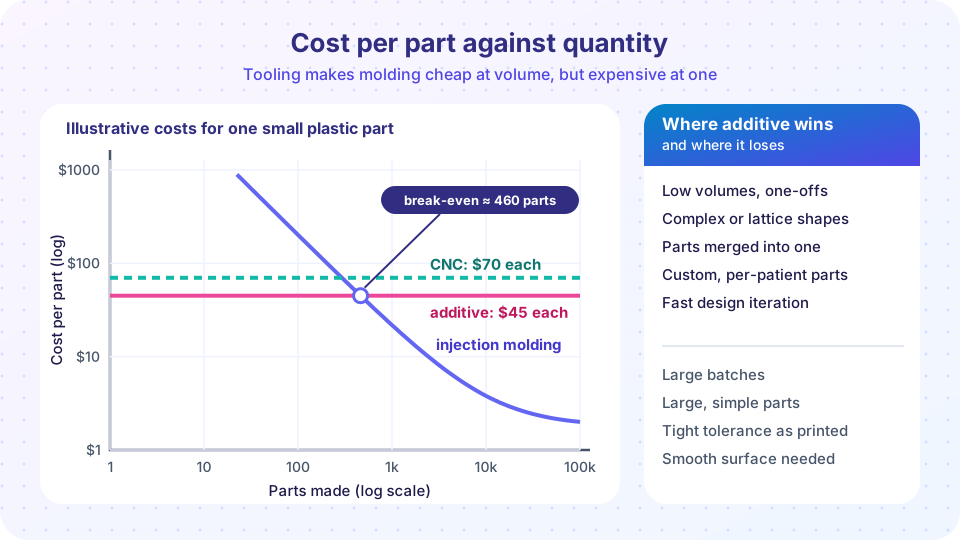
Injection molding a plastic housing needs a mold of $20,000 and costs $1.80 per part. A printed housing (SLS nylon) costs $45 per part.
Q* = 20,000 / (45 − 1.80) = 463 parts.
Below about 460 parts, printing is cheaper in total; above, molding wins, and the gap grows fast: at 10,000 parts the molded cost per part is $3.80 against $45. The same calculation against CNC machining at $70 per part (no tooling) shows AM winning at any volume for that part, if the cost numbers hold. Always check the numbers. A simple part that can be machined from bar in five minutes beats AM at almost any volume.
Beyond direct cost
- Lead time. A mold takes weeks to make; a printed part starts tomorrow. A product that must reach the market a quarter earlier can justify a high unit cost.
- Design iteration. Changing a mold costs thousands; changing a file costs nothing. During development, many designs are printed.
- Weight and function. Lightweight lattices, integrated channels and consolidated assemblies can be worth a fortune in aerospace, motorsport or medical use, so cost per kilogram saved can be the right metric.
- Mass customization. When every part is different (hearing aid shells, dental aligners, orthopedic implants), tooling cannot be amortized, and AM wins regardless of volume.
- Inventory. Printing spare parts on demand, from a digital warehouse, avoids holding stock of rarely used parts.
- Risks. Yield, rework, certification and inspection costs can dominate for critical parts. Include them.
How sensitive is the answer?
Every number in these models is an estimate, so test how much the conclusion moves when the inputs change. In the nesting example, a machine rate of $100 per hour instead of $75 raises the single-part cost noticeably, but the shape of the curve and the benefit of nesting stay the same. In the break-even example, a mold that costs $30,000 instead of $20,000 moves the crossing from about 460 to about 690 parts: still in the hundreds, so the decision "print for short runs, mold for thousands" is robust. A conclusion that survives a change of 30 to 50 percent in each input is trustworthy; one that flips with a small change needs better data before anyone commits money. Also look for hidden costs: file preparation, inspection of each printed part, scrap from failed builds, powder that cannot be reused and the cost of certifying a new process for critical parts.
Common misconceptions
"Printing is cheap because there is no tooling." There is no tooling cost, but machine time, powder and post-processing are significant, and the cost per part does not fall much with volume.
"A full build plate has the same cost per part as a single part." For powder bed processes, the shared per-layer overhead makes a nested build much cheaper per part.
"The cheapest process is always the best choice." Lead time, weight, performance and risk change the value of a part. Cost per part is a starting point, not the answer.
Try it
First, a break-even calculator. Change the tooling cost and unit costs to see where the crossing moves.
Next, run the nesting cost model of worked example 1, and see how cost per part falls as the plate fills.
Press Run (or Ctrl + Enter) to see the result here.
Program input · what you'd type while the program runs
Type the answers before you press Run, one per line. Each time the program reads a line (with input()), it gets the next line from this box.
Check your understanding
Quick check · 5 questions
of 5 answered You scored / 5 · perfect!
-
1. Why does nesting many parts in one LPBF build reduce the cost per part?
Recoating time depends on the build height, not on the number of parts, so a full plate spreads that overhead and the setup over more parts. -
2. A mold costs $15,000 and parts cost $2 each. A printed part costs $32. What is the break-even quantity?
Q* = F / (c_AM − c) = 15,000 / (32 − 2) = 500 parts. -
3. Which situation favors additive manufacturing regardless of volume?
When each part is unique, there is no volume over which to spread tooling, so a tool-free process wins. -
4. A build takes 10 hours on a $60/h machine and holds 5 parts. What is the machine cost per part?
Machine cost = 60 × 10 = $600 for the build, shared by 5 parts: $120 each. -
5. For which cost term does nesting NOT help much in LPBF?
Support removal, heat treatment and machining are done for each part individually, so they do not shrink with a fuller plate.
Summary
- Powder bed build time is volume divided by build rate plus a per-layer overhead set by build height; nesting shares the overhead.
- Cost per part adds machine time, material, post-processing and shared setup, divided by yield.
- Break-even against tooled processes is
Q* = F / (c_AM − c); additive wins at low volume or for custom parts. - Lead time, weight savings, consolidation and customization can outweigh unit cost.
Track your progress
Create a free account to tick off lessons and pick up where you left off on any device.
of Manufacturing Processes lessons completed