


















Lesson 18 of 49 · Forming and Forging
Chapter 4 Overview: Forming and Forging
A tour of metal forming: why solid metal can be squeezed into shape, the constant-volume rule, bulk versus sheet processes, hot versus cold forming, and the Chapter 4 lesson map.
A blacksmith heats a bar until it glows orange, hammers it flat, folds it and hammers again. The bar changes shape completely, yet nothing is cut away and nothing is melted. This is the key idea of forming: solid metal is pushed past its yield point so that it flows into a new shape and stays there. Modern forming plants do the same thing with presses a hundred times stronger than any hammer, making crankshafts, wrenches, bolts, cans, car doors and aircraft frames. Forming is the main way the world makes strong metal parts quickly and with almost no waste.
What you will learn
- State the constant-volume rule and use it to find a new dimension after deformation.
- Distinguish bulk forming from sheet forming and name the main processes in each.
- Explain how forming improves strength through grain flow and strain hardening.
- Preview the lessons of this chapter.
Key terms
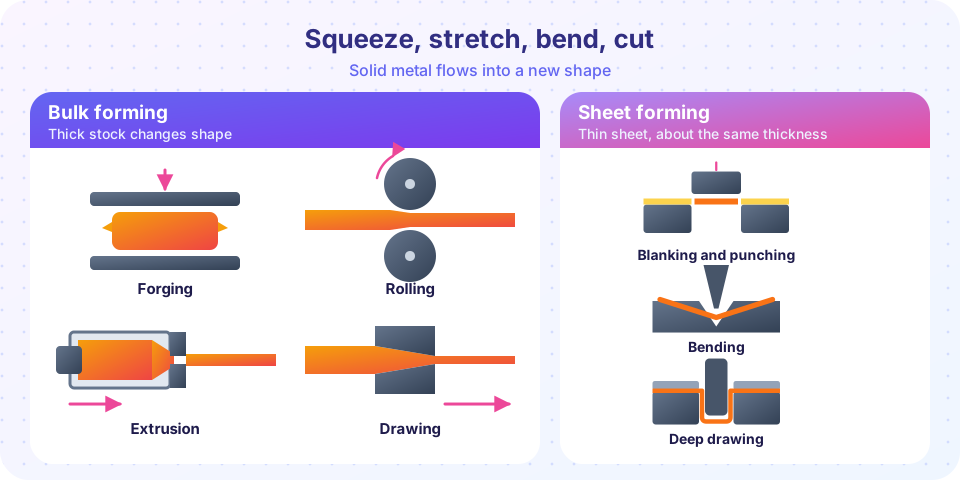
Bulk forming: processes that deform thick workpieces so their volume and shape change significantly, such as forging, rolling, extrusion and drawing.
Sheet forming: processes that shape thin sheets by bending, stretching, drawing or shearing.
Die: a hardened tool that shapes the workpiece as it is pressed or pulled through.
Flash: excess metal squeezed out between die halves in forging.
Grain flow: the alignment of the metal's internal grains and inclusions along the shape of the part.
The constant-volume rule
Plastic deformation does not change the volume of metal (the elastic change is tiny). This gives the first and most useful formula in forming:
V₀ = V₁, or for a cylinder (π/4) d₀² h₀ = (π/4) d₁² h₁.
Worked example
A steel cylinder of diameter 50 mm and height 80 mm is squashed (upset) to a height of 40 mm. Its new diameter satisfies 50² × 80 = d₁² × 40, so d₁² = 5,000 and d₁ = 70.7 mm. Halving the height multiplies the diameter by √2 = 1.414. The same rule says that if you roll a 20 mm plate down to 10 mm and the width stays the same, the length must double.
Two worlds: bulk and sheet
Bulk forming
Sheet forming
Bulk forming works on billets, slabs and bars whose thickness is comparable in all directions. Sheet forming works on thin sheets, where the thickness stays almost constant while the surface area is reshaped. Bulk processes need large forces; sheet forming needs much lower force but careful control of thinning and wrinkling.
Hot, warm and cold
Chapter 2 introduced the homologous temperature T / T_m. Forming is classed by it:
- Hot forming (above about
0.5 T_m, above recrystallization). Metal is soft and ductile, forces are low and huge reductions are possible. Surfaces oxidize and scale, and dimensional accuracy is moderate. Most forgings and almost all steel rolling start hot. - Cold forming (near room temperature). Forces are higher, but surface finish and accuracy are better, and the metal strain-hardens and comes out stronger. Bolts, nails and sheet-metal parts are cold formed.
- Warm forming sits between, trading off the two.
Cold working strengthens metal and can be quantified with the flow curve σ_f = K ε^n. A 30 percent reduction of area is a true strain of ε = ln(1 / 0.70) = 0.357, and for low-carbon steel the flow stress at that strain is 530 × 0.357^0.26 = 405 MPa, well above the annealed yield strength of about 250 MPa. Too much cold work uses up ductility, so an anneal between stages restores softness.
Why forming gives strong parts
A cast part has randomly oriented grains and may contain porosity. A forged part has had its grains refined and its voids closed, and its grain flow follows the shape, much like the fibers in wood. Crankshafts, connecting rods and wrenches are forged for this reason: the grain lines run along the highest stresses instead of across them, so fatigue resistance is far better than that of a machined or cast part of equal shape.
Forming also wastes little material. A bolt headed from wire turns nearly all of its wire into the bolt, while the same bolt turned from bar would throw away more than half the metal as chips.
The limits
Forming cannot make everything. Intricate internal cavities are difficult. Dies are expensive and wear, so volumes must justify them. Metals must be ductile enough not to crack, and the required press force grows with the size and strength of the part. These limits are the reason some parts are cast or machined instead.
In this chapter
- Forging and flow stress: open- and closed-die forging, force estimates and friction.
- Rolling, extrusion and drawing: draft, contact length, extrusion ratio and drawing stress.
- Sheet-metal forming: blanking, bending, springback and deep drawing.
- Chapter 4 review.
Common misconceptions
"Forming removes material." Forming only moves material; the volume is constant. Flash that is trimmed away is the exception.
"Hot forming means the metal is melted." The metal stays solid; it is simply hot enough to be soft and to recrystallize.
"Cold working makes metal weaker because it is damaged." Plastic deformation hardens and strengthens metal, at the expense of ductility.
Try it
Use the constant-volume widget to see how the diameter of an upset cylinder grows as the press squeezes it. The model assumes uniform deformation (no barreling).
The second example shows how cold work raises the flow stress of low-carbon steel as the area is reduced, using the Hollomon equation with classroom constants.
Press Run (or Ctrl + Enter) to see the result here.
Program input · what you'd type while the program runs
Type the answers before you press Run, one per line. Each time the program reads a line (with input()), it gets the next line from this box.
Check your understanding
Quick check · 4 questions
of 4 answered You scored / 4 · perfect!
-
1. A cylinder 40 mm in diameter and 60 mm high is upset to 30 mm high. The new diameter is:
d₁ = 40 × √(60/30) = 40 × 1.414 = 56.6 mm. -
2. Which of these is a sheet-forming process?
Deep drawing pulls sheet into a cup shape. The others are bulk processes. -
3. Why are crankshafts usually forged?
Forging aligns grain lines with the stress paths and closes porosity. -
4. Cold working a metal generally:
Strain hardening raises strength and uses up ductility.
Summary
- Forming deforms solid metal plastically; volume stays constant, so
V₀ = V₁. - Bulk forming (forging, rolling, extrusion, drawing) changes thick stock; sheet forming reshapes thin sheet.
- Hot forming lowers force; cold forming strengthens and improves accuracy.
- Forged parts have strong grain flow and little waste, but need costly dies.
Next: Forging and Flow Stress
Track your progress
Create a free account to tick off lessons and pick up where you left off on any device.
of Manufacturing Processes lessons completed