


















Lesson 6 of 49 · Overview and Materials
Chapter 2 Overview: Materials for Manufacturing
A tour of the four material families, why material and process must be chosen together, and a map of what Chapter 2 covers, from stress-strain to heat treatment.
You cannot choose a process without knowing the material, and you cannot choose a material without knowing how it will be made. A steel that is easy to machine may be impossible to cast cleanly. A plastic that is perfect for molding will melt in a hot engine bay. Engineers therefore choose material and process as a pair. This chapter gives you the material knowledge that every later chapter assumes.
What you will learn
- Name the four material families and the main property pattern of each.
- Compare materials by density, stiffness and melting temperature.
- Explain why a process only works for materials with the right behavior.
- Preview the five lessons of this chapter.
Key terms
Metal: a crystalline solid with free electrons, typically strong, ductile and a good conductor.
Polymer: a material made of long molecular chains; includes thermoplastics (they remelt) and thermosets (they cure permanently).
Ceramic: a hard, brittle compound of metal and non-metal atoms such as oxides and carbides.
Composite: two or more materials combined, such as carbon fibers in an epoxy matrix.
Specific stiffness: stiffness divided by density; a measure of how stiff a part is for its weight.
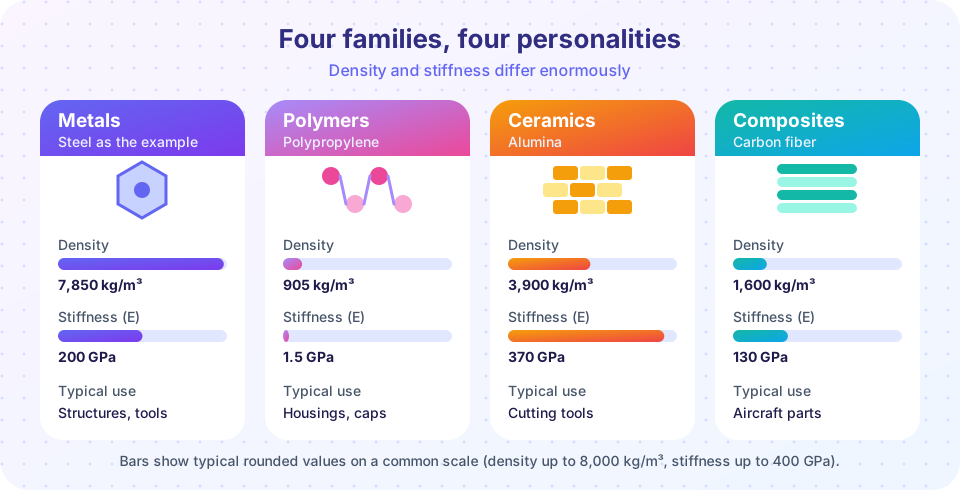
The four families
Metals
Polymers
Ceramics
Composites
Metals
Metals dominate structural manufacturing because they combine strength with ductility, the ability to deform without cracking. That ductility is exactly what forging, rolling and bending exploit. Metals are divided into ferrous (iron-based: steels and cast irons) and nonferrous (aluminum, copper, titanium, magnesium, nickel and others). Most metals can be cast, formed and machined, though each family has favorites.
Polymers
Polymers are lightweight, corrosion-resistant and easy to shape. Thermoplastics such as polypropylene, ABS and nylon soften when heated, so they suit injection molding and extrusion. Thermosets such as epoxy and phenolics cure by chemical cross-linking and cannot be remelted. Their weakness is temperature: most common plastics soften well below 200 °C, far below the melting points of metals.
Ceramics
Ceramics such as alumina, silicon carbide and zirconia are extremely hard, wear-resistant and stable at high temperature, but they are brittle: they crack instead of bending. They are usually shaped as powder and then fired, a process called sintering, because melting and casting them is difficult.
Composites
A composite combines a strong, stiff reinforcement (glass or carbon fibers) with a matrix (often epoxy). Along the fibers the material can be exceptionally stiff and light. The trade-off is that properties depend on direction, and production is often slow and labor-intensive.
How the families compare
The following typical values are rounded handbook-style numbers. Real values depend on alloy, treatment and temperature.
| Material | Density (kg/m³) | Young's modulus E (GPa) | Melting or softening point |
|---|---|---|---|
| Carbon steel | 7,850 | 200 | about 1,450 to 1,530 °C melts |
| Aluminum | 2,700 | 69 | 660 °C |
| Titanium alloy (Ti-6Al-4V) | 4,430 | 114 | about 1,650 °C |
| Polypropylene | 905 | 1.5 | about 165 °C melts |
| ABS | 1,050 | 2.3 | softens near 105 °C |
| Alumina | 3,900 | 370 | 2,072 °C |
A surprising pattern appears when you divide stiffness by density. Steel, aluminum and titanium all come out near 25 GPa per (g/cm³). That means a part made of aluminum is no stiffer per kilogram than one made of steel; aluminum wins only when thickness can grow, because bending stiffness depends strongly on section size.
Why process and material must match
Every process makes demands on the material:
- Casting needs a metal that flows when molten and does not shrink catastrophically.
- Forging and rolling need ductility; brittle ceramics crack.
- Machining needs a material that cuts cleanly; very soft or very hard materials cause trouble.
- Injection molding needs a polymer that melts at a reasonable temperature and flows.
- Welding needs a metal whose structure survives local melting and cooling.
What the chapter covers
- Mechanical properties for manufacturing: stress, strain, strength, ductility, hardness and flow stress.
- Material families and process fit: which processes suit which materials, and why.
- Steel and heat treatment: the iron-carbon system and how heating and cooling change properties.
- Tolerances and surface finish: how accurate a part must be and how rough its surface may be.
- Chapter 2 review.
Common misconceptions
"Lighter material always means a lighter part." A part's weight depends on both density and the volume required to be stiff and strong enough.
"Plastics are weak." Some engineering plastics and composites outperform metals per unit weight; they are weak only relative to metals at high temperature.
Try it
Compare materials by specific stiffness (E divided by density) and see which family leads.
Press Run (or Ctrl + Enter) to see the result here.
Program input · what you'd type while the program runs
Type the answers before you press Run, one per line. Each time the program reads a line (with input()), it gets the next line from this box.
The second example is a quick property lookup card. Pick a material to see its numbers, then use them in later chapters.
Check your understanding
Quick check · 4 questions
of 4 answered You scored / 4 · perfect!
-
1. Which material family is generally brittle and hard, shaped by sintering powder?
Ceramics are hard but brittle, and are usually formed from powder and fired (sintered). -
2. Why can thermoplastics be injection molded repeatedly?
Thermoplastics soften on heating and harden on cooling reversibly, unlike thermosets. -
3. Which two materials have almost the same specific stiffness?
Steel is about 25.5 MJ/kg and aluminum about 25.6 MJ/kg, nearly equal. -
4. Which process requires ductility?
Forging deforms solid metal, which must be ductile to avoid cracking.
Summary
- Four families: metals, polymers, ceramics and composites, each with a characteristic pattern of properties.
- Specific stiffness (E / density) is similar for steel, aluminum and titanium.
- Each process asks the material for specific behavior, so material and process are chosen together.
- Chapter 2 covers mechanical properties, process fit, steel heat treatment and tolerances.
Track your progress
Create a free account to tick off lessons and pick up where you left off on any device.
of Manufacturing Processes lessons completed