


















Lesson 15 of 49 · Casting and Molding
Permanent-Mold, Die and Investment Casting
Compare permanent-mold, hot- and cold-chamber die casting, and investment (lost-wax) casting: how each works, what it costs, what accuracy it gives, and how to size clamp force.
Sand casting throws away its mold after every pour. That is perfect for one-off engine blocks, but hopeless if you need a million phone frames or lawn-mower housings. Two ideas fix this. One is to make the mold out of metal so it can be used again and again: permanent-mold and die casting. The other is to make an extremely detailed disposable mold from ceramic: investment casting, also called the lost-wax process. This lesson explains how they work, what each is best for, and how to compute the clamping force a die-casting machine needs.
What you will learn
- Describe permanent-mold casting and what it gains over sand casting.
- Distinguish hot-chamber from cold-chamber die casting and name suitable metals.
- Compute die-casting clamp force from injection pressure and projected area.
- List the steps of investment casting and when it is worth its cost.
- Compare the four main casting processes by volume, accuracy and finish.
Key terms
Die: a reusable, usually steel, mold in two halves.
Shot: the quantity of molten metal injected in one cycle.
Projected area: the area of the casting and runner system as seen along the direction in which the die opens.
Clamp force: the force that holds the die halves shut against the injection pressure.
Lost-wax process: casting in a ceramic shell formed around a wax pattern that is melted out.
Permanent-mold casting
In gravity permanent-mold casting liquid metal is poured into a metal mold under gravity, just as into sand. The mold is made of tool steel or cast iron, usually in two halves with metal or sand cores for hollow shapes, and is coated with a refractory wash that controls heat flow and lets the casting release. Because metal conducts heat far better than sand, the casting freezes faster, producing a finer grain and better strength than a sand casting of the same alloy. Surfaces are smoother and tolerances tighter, and cycle times are short.
The trade-off is mold cost and limits: molds are costly and wear out, the shape must allow the part to be withdrawn, and the process suits metals with moderate melting points, mainly aluminum, magnesium, zinc and copper alloys (cast iron and steel are possible but harsh on molds). Typical uses are automotive pistons, cylinder heads and wheels, usually in runs from thousands up to hundreds of thousands.
Die casting
Die casting forces molten metal into a steel die under high pressure and holds it there until it solidifies. Pressure fills thin walls and fine detail and gives an excellent surface. The cycle takes from a few seconds for small zinc parts to a minute or so for large aluminum parts. There are two machine types.
Hot-chamber
In the hot-chamber machine, the injection mechanism (a gooseneck and plunger) sits submerged in the molten metal holding pot. A plunger pushes metal up the gooseneck into the die. It is fast and simple, but only works for low-melting alloys that do not attack the submerged steel parts, chiefly zinc, magnesium and lead-tin alloys. Injection pressures are typically in the range of roughly 10 to 35 MPa.
Cold-chamber
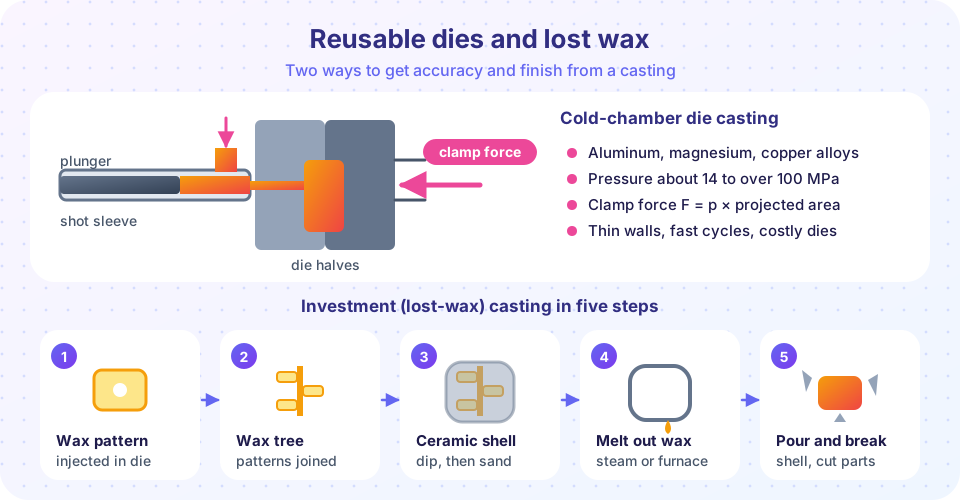
In the cold-chamber machine, each shot of metal is ladled (or pumped) from a separate furnace into a shot sleeve, and a hydraulic plunger drives it into the die. This keeps the injection hardware out of the hot bath, so it suits aluminum, magnesium and copper alloys, which would dissolve or damage submerged parts. Pressures are higher, from roughly 14 to well above 100 MPa, and cycles are slower than the hot chamber.
Clamp force
During injection the pressurized metal pushes the die halves apart. The machine must clamp them shut with a force larger than the separating force:
F = p × A_p
where p is the injection pressure and A_p is the projected area of casting plus runner. For example, A_p = 150 cm² = 15,000 mm² and p = 50 MPa = 50 N/mm² give F = 50 × 15,000 = 750,000 N = 750 kN, which is about 76 tonnes-force. Machine sizes are specified in tonnes of clamp force (from about 100 up to thousands), so you choose the next size above the calculated force plus a margin of 20 percent or so. A larger projected area or higher pressure demands a bigger, more expensive machine.
Strengths and limits
- Thin walls (down to about 1 mm in aluminum and less in zinc) and fine details.
- Excellent dimensional accuracy and surface finish, little or no machining.
- Very high production rates; tooling life of tens or hundreds of thousands of shots.
- Die costs are high (often tens to hundreds of thousands of currency units), so volume must be large.
- Air can be trapped and rapid filling creates porosity, so most die castings cannot be heat treated or welded easily (the gas expands and blisters). Vacuum-assisted dies reduce this.
Investment casting
Investment casting produces parts with complex shapes and delicate details in almost any alloy, from stainless steel to titanium and nickel superalloys. The steps are:
- Make wax patterns by injecting wax into a metal die.
- Assemble a tree: several patterns are attached to a central wax sprue.
- Build the shell. Dip the tree repeatedly in ceramic slurry and coat with fine sand (stucco), letting each layer dry, until the shell is a few millimeters to a centimeter thick.
- Melt out the wax in a steam autoclave or furnace, leaving a hollow ceramic mold. Fire the shell at high temperature to harden it.
- Pour the metal into the hot shell, let it solidify, then break off the shell, cut the parts off the tree, and finish them.
Because the mold is one piece with no parting line and is poured hot, the process produces thin sections, fine detail and good surface finish with little or no draft. Typical roughness is on the order of 1 to 3 µm Ra, much better than sand casting. It is slower and costs more per part, so it is used when shape complexity or difficult alloys justify it: turbine blades, surgical implants, golf club heads, jewelry and small valve bodies. Jet-engine turbine blades even use controlled cooling to grow a single crystal.
Which one to use?
| Process | Tooling cost | Typical volume | Typical tolerance (small features) | Typical Ra (µm) |
|---|---|---|---|---|
| Sand casting | Low | 1 to thousands | About ±0.5 to ±1.5 mm | 12 to 25 |
| Permanent mold | Medium to high | Thousands to 100,000+ | About ±0.2 to ±0.5 mm | 3 to 6 |
| Die casting | High | 10,000 to millions | About ±0.1 to ±0.3 mm | 0.8 to 3.2 |
| Investment casting | Medium | 10 to tens of thousands | About ±0.1 to ±0.25 mm | 1.6 to 3.2 |
The figures are broad rules of thumb for comparing processes, not specifications. Other processes complete the set: centrifugal casting spins a mold so that centrifugal force pushes metal against the wall (pipes, tubes and rings), and continuous casting feeds molten steel through a water-cooled mold to make an endless slab or billet, which is how most steel starts its life.
Common misconceptions
"Die casting works for steel." Steel's melting point is too high for ordinary dies; die casting is used for zinc, aluminum, magnesium and copper alloys.
"Investment casting is only for jewelry." It is used for aircraft engines and medical implants as well.
"A bigger clamp force is always better." An oversized machine wastes money and energy; you want enough force with a modest margin.
Try it
Answer four questions and the helper suggests a casting process. It encodes the rules of thumb above, so treat it as a first guess.
The second example computes clamp force for several parts and picks a machine size. The machine list is illustrative.
Press Run (or Ctrl + Enter) to see the result here.
Program input · what you'd type while the program runs
Type the answers before you press Run, one per line. Each time the program reads a line (with input()), it gets the next line from this box.
Check your understanding
Quick check · 5 questions
of 5 answered You scored / 5 · perfect!
-
1. Which metal is typically die cast in a hot-chamber machine?
Zinc melts at a low temperature and does not attack the submerged injection parts. -
2. Injection pressure 40 MPa and projected area 200 cm². What is the clamp force?
200 cm² = 20,000 mm²; 40 × 20,000 = 800,000 N = 800 kN. -
3. Why do permanent-mold castings tend to be stronger than sand castings?
Rapid cooling against metal produces finer grain and better properties. -
4. What is removed in the 'lost' step of lost-wax casting?
The wax is melted out of the ceramic shell before pouring. -
5. Which process suits a million zinc housings with thin walls?
High volume and thin, detailed walls in a low-melting alloy are exactly what die casting is for.
Summary
- Permanent molds give finer grain, better finish and faster cycles than sand, at higher tooling cost.
- Die casting injects metal under high pressure; hot-chamber suits zinc and magnesium, cold-chamber suits aluminum and copper alloys.
- Clamp force
F = p × A_p; size machines with a margin. - Investment casting builds a ceramic shell around wax patterns for complex shapes in nearly any alloy.
- Pick the process from volume, metal, detail and size.
Track your progress
Create a free account to tick off lessons and pick up where you left off on any device.
of Manufacturing Processes lessons completed