


















Lesson 34 of 49 · Additive Manufacturing
Polymer additive processes: FDM, SLA and SLS
How material extrusion (FDM), vat photopolymerization (SLA, DLP) and powder bed fusion (SLS) build plastic parts, with flow-rate, cure-depth and build-time calculations.
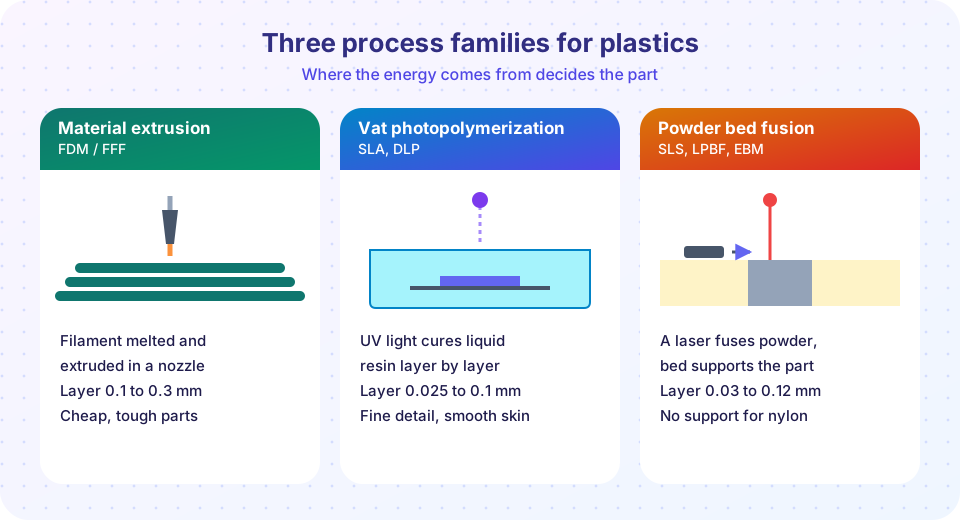
Three families of additive processes make most plastic parts. They differ in where the energy comes from: a heated nozzle that melts a filament, a beam of ultraviolet light that hardens liquid resin, or a laser that fuses powder. Each choice sets the layer thickness, the surface finish, the strength and, importantly, how build time scales with the part. Understanding that scaling is the key to choosing a process for a real job.
What you will learn
- How FDM works, why prints are weaker between layers, and how to estimate print time from flow rate.
- How SLA and DLP cure resin, and how the cure depth depends on exposure.
- How SLS builds without supports and why the unused powder matters.
- Which process fits which job, and how build time scales for each.
Key terms
Layer height: thickness of each deposited layer; it sets the vertical resolution.
Infill: the internal pattern and density that fills the inside of an FDM part.
Photopolymer: a liquid resin that hardens when exposed to light of the right wavelength.
Anisotropy: a property that differs by direction, such as strength along the layers versus across them.
Nesting: packing many parts into the build volume of one run.
Material extrusion (FDM, FFF)
In fused deposition modeling (a trademark; the generic name is fused filament fabrication) a spool of thermoplastic filament, typically 1.75 mm in diameter, is pushed into a heated nozzle, melted, and laid down in lines. The platform lowers (or the nozzle rises) by one layer, and the next layer bonds to the one below while the plastic is still warm.
Materials. PLA (easy to print, stiff, softens around 60 °C), PETG (tougher, more heat and chemical resistant), ABS and ASA (need an enclosure because they warp), nylon (tough, absorbs moisture), TPU (flexible), and composites with carbon or glass fiber.
Typical settings. A 0.4 mm nozzle, a layer height of 0.1 to 0.3 mm (up to about 75 percent of the nozzle diameter), a line width close to the nozzle diameter.
Strength is directional. The bond between layers is formed by plastic that partly cooled before the next line arrived, so it is weaker than the line itself. The tensile strength across layers is typically well below the strength along them, often between about a third and four fifths, depending on temperature, speed and cooling. A bracket should therefore be printed so the main load runs along the lines, not across layers. The walls (perimeters) carry more load than the infill, so adding two more walls often increases strength much more than raising infill from 20 to 40 percent.
Warping comes from thermal shrinkage: as each layer cools it shrinks and pulls on the layers below, lifting the corners. Heated beds, enclosures and wide first layers combat it.
Print time from flow rate
The extruder delivers a volume per second equal to the line cross-section times the speed:
Q = w × h × v (mm³/s)
with line width w, layer height h and print speed v.
Worked example 1. w = 0.4 mm, h = 0.2 mm, v = 60 mm/s: Q = 0.4 × 0.2 × 60 = 4.8 mm³/s. A part that needs 20,000 mm³ of plastic (walls, infill and top layers) takes 20,000 / 4.8 ≈ 4,170 s ≈ 1.2 h. Real prints are slower, since the nozzle accelerates, travels without extruding and slows on corners; adding 30 percent is a reasonable guess. Notice that FDM time scales with volume of plastic, so hollow, lightweight parts are fast.
A standard hotend can melt only so fast; many are limited to something like 10 to 15 mm³/s for common filaments, which caps how much you gain by raising speed or layer height.
Vat photopolymerization (SLA, DLP, LCD)
A vat holds liquid photopolymer, a resin of small molecules (monomers and oligomers) plus a photoinitiator. Light of the right wavelength (commonly 365 to 405 nm, near ultraviolet) splits the photoinitiator into radicals that link the monomers into a solid network.
- In SLA a laser beam scans each layer as a point.
- In DLP a projector exposes a whole layer at once, and in LCD printing a masked UV panel does it.
- The platform hangs from above in the usual "bottom-up" machines and lifts one layer at a time after each exposure.
Resolution. Layers of 25 to 100 µm give smooth surfaces and fine details; the XY detail is set by the laser spot or pixel size, typically tens of micrometers. That is why SLA is popular for dental models, jewelry masters and miniatures.
Cure depth
Light is absorbed as it travels into the resin, so the hardened thickness depends on the dose. The working curve of Jacobs describes it:
Cd = Dp × ln(E / Ec)
Cd is the cure depth, Dp the penetration depth of the resin (the depth at which the light intensity falls to 1/e of its surface value), E the exposure (energy per area at the surface, mJ/cm²) and Ec the critical exposure, the minimum dose that starts to gel the resin.
Worked example 2. For Dp = 0.15 mm, Ec = 10 mJ/cm² and an exposure E = 60 mJ/cm²: Cd = 0.15 × ln 6 = 0.15 × 1.79 = 0.27 mm. To print 0.1 mm layers, the cure depth should exceed the layer thickness (typically by a factor of 1.5 to 3) so the new layer bonds to the previous one. Because the dependence is logarithmic, doubling the exposure adds only Dp × ln 2 = 0.10 mm to the cure depth.
Post-processing is essential: wash away uncured resin (usually with isopropanol), remove supports, and post-cure under UV to complete the reaction. Many resins are skin irritants, so gloves, ventilation and careful disposal of waste are required. SLA parts are accurate but can be brittle and degrade slowly in sunlight unless formulated for it.
Powder bed fusion of polymers (SLS, MJF)
In selective laser sintering a thin layer of polymer powder (most often polyamide 12, "nylon 12") is spread over the build area. The bed is warmed to just below the melting point, so a CO₂ laser needs to add only a little extra energy to fuse the particles where the part is. The platform lowers one layer (about 0.1 mm) and a recoater spreads new powder.
The most important feature: the loose powder supports the part, so no support structures are needed, and many parts can be stacked in three dimensions in one build. The cost per part therefore falls as the chamber fills (nesting). Parts are strong, ductile and fairly isotropic (similar in all directions), which makes SLS a favorite for functional prototypes and low-volume end-use parts. HP's Multi Jet Fusion uses inkjet heads to print a fusing agent and infrared lamps to fuse it, which is a different way of delivering the energy.
Limits: a grainy surface, porosity at microscopic level, shrinkage that must be compensated in the file, long cooling times, and powder "aging", since the unfused powder spends hours near its melting temperature. Operators mix used and fresh powder, often about half and half, to keep part quality consistent.
Choosing a process
| FDM | SLA / DLP | SLS | |
|---|---|---|---|
| Layer height | 0.1 to 0.3 mm | 0.025 to 0.1 mm | about 0.1 mm |
| Surface | Visible layer lines | Very smooth | Grainy matte |
| Supports | Needed for overhangs | Needed, with contact marks | Not needed |
| Strength | Anisotropic | Brittle to tough, by resin | Strong, nearly isotropic |
| Cost of machine | Low | Low to medium | Medium to high |
| Build time depends on | Volume of plastic | Height of the stack | Height of the stack (many parts at once) |
Common misconceptions
"A higher infill percentage always means a much stronger part." Walls and the orientation of the load matter more. Beyond a moderate infill, extra plastic adds weight and time for little gain.
"Finer layers always make a better part." They make smoother slopes but triple the build time when the layer height is a third as thick, and they do not remove the weak interlayer bond.
"SLS parts need supports like FDM." The surrounding powder acts as the support, which is a major benefit of powder bed processes.
Try it
Estimate the print time for an FDM job and see the effect of the nozzle flow limit.
Then plot the Jacobs working curve for a resin, and see how little extra depth you get from more light.
Press Run (or Ctrl + Enter) to see the result here.
Program input · what you'd type while the program runs
Type the answers before you press Run, one per line. Each time the program reads a line (with input()), it gets the next line from this box.
Check your understanding
Quick check · 5 questions
of 5 answered You scored / 5 · perfect!
-
1. An FDM printer lays a 0.45 mm wide, 0.25 mm high line at 80 mm/s. What is the volumetric flow rate?
Q = w × h × v = 0.45 × 0.25 × 80 = 9.0 mm³/s. -
2. Why are FDM parts usually weakest across the layers?
The new line bonds to plastic that has already cooled somewhat, so the interlayer bond is weaker than the line itself. -
3. For a resin with Dp = 0.2 mm and Ec = 12 mJ/cm², what is the cure depth at E = 60 mJ/cm²?
Cd = Dp ln(E/Ec) = 0.2 × ln 5 = 0.2 × 1.609 = 0.32 mm. -
4. What supports an overhang in SLS?
In powder bed processes the loose powder holds each layer in place, so no support structures are needed. -
5. Which process's build time depends mainly on the volume of plastic extruded?
FDM must extrude every cubic millimeter through a nozzle at a limited flow rate. DLP and SLS time depends mainly on the number of layers.
Summary
- FDM extrudes a heated thermoplastic; time scales with plastic volume (
Q = w h v); parts are weaker across layers. - SLA, DLP and LCD cure liquid resin with light; resolution and surface are excellent; the cure depth follows
Cd = Dp ln(E/Ec). - SLS fuses nylon powder in a heated bed; the powder supports the part, so many parts can be nested.
- Choose by surface, strength, supports and how the build time scales: with volume (FDM) or with height (SLA, DLP, SLS).
Track your progress
Create a free account to tick off lessons and pick up where you left off on any device.
of Manufacturing Processes lessons completed