


















Lesson 45 of 49 · Projects and Practice
Project: a should-cost model for a turned part
Build a should-cost model for a turned steel shaft from the formulas of this course: machining time, Taylor tool cost, material, setup and overhead, then explore batch size and cutting-speed sensitivity.
When a buyer receives a quote for a machined part, how can they tell whether it is fair? Experienced buyers and engineers build a should-cost model: an estimate of what the part ought to cost, built up from the physics and economics of the process. It is the same skill used in design-to-cost work, in negotiation and in deciding whether to make or buy. In this project you will build one from scratch with the formulas you learned in the machining chapter, and use it to answer practical questions: how much does batch size matter, which cost is largest, and what happens when you cut faster?
What you will learn
- How to break a part's cost into material, machine time, tool wear, handling, setup and overhead.
- How to apply the speed, feed, time and Taylor tool-life formulas in a working model.
- How batch size, machine rate and cutting speed change the cost.
- How to sanity-check a model against a quote.
Key terms
Should-cost: an independent bottom-up estimate of what a part ought to cost.
Machine rate: the hourly (or per-minute) cost of a machine including the operator and the machine's share of overhead.
Tool cost per part: the share of a cutting edge consumed per part, computed from how much of the tool life one part uses.
Setup cost: the one-off cost of preparing the machine for a batch, divided across the parts in that batch.
The part
A steel shaft: finished diameter 40 mm and length 150 mm, turned from 45 mm round bar, surface finish about Ra 0.4 µm on the main diameter. The steps of the project follow the cost model below, and every number you see is an assumption you can change.
Step 1: Material
The bar needs extra length for the chuck grip and parting off: 10 mm in this model, so the cut length is 160 mm.
mass = π/4 × D² × L × ρ = π/4 × 45² × 160 × 7.85×10⁻³ g/mm³ ≈ 2.00 kg
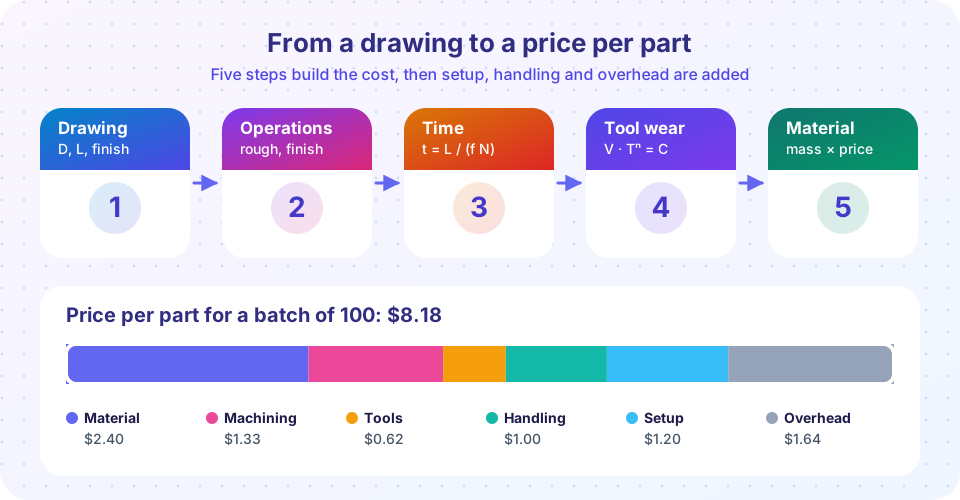
At an assumed bar price of $1.20/kg, material is $2.40 per part.
Step 2: Operations and machining time
Two turning operations remove the 2.5 mm radial stock:
| Operation | Diameter (mm) | V (m/min) | Feed f (mm/rev) | Depth |
|---|---|---|---|---|
| Roughing | 45 | 180 | 0.25 | 2.0 mm |
| Finishing | 40 | 220 | 0.10 | 0.5 mm |
For each, use the formulas of the machining chapter: N = 1000 V / (π D) and t = L / (f N). For roughing, N = 1,273 rpm and t = 150 / (0.25 × 1273) = 0.47 min. For finishing, N = 1,751 rpm and t = 150 / (0.10 × 1751) = 0.86 min. A finishing feed of 0.10 mm with a nose radius of 0.8 mm gives an ideal roughness Ra = 0.1² / (32 × 0.8) = 0.39 µm, which meets the requirement.
With a machine rate of $1.00 per minute (that is $60 per hour, including the operator), machining costs (0.47 + 0.86) × 1.00 = $1.33.
Step 3: Tool cost
Use Taylor's equation from the tool-life lesson with C = 406 and n = 0.262, the values fitted for a carbide insert on steel in that lesson. Tool life is T = (C/V)^(1/n):
- Roughing at 180 m/min:
T = 22.3 min; one part uses0.47 / 22.3 = 2.1%of an edge. - Finishing at 220 m/min:
T = 10.4 min; one part uses0.86 / 10.4 = 8.2%of an edge.
An edge costs $4.00 and each tool change takes 2 minutes at the machine rate, so each edge used costs 4 + 2 × 1.00 = $6.00. Tool cost per part is 0.021 × 6 + 0.082 × 6 ≈ $0.62.
Step 4: Handling, setup and overhead
Loading and unloading takes 1.0 min = $1.00. A batch needs $120 of setup (programming, offsets, first-article inspection), divided by the number of parts. Finally, a markup of 25 percent covers overhead, inspection, packaging and margin.
price = (material + machining + tools + handling + setup / Q) × 1.25
For a batch of 100 parts: (2.40 + 1.33 + 0.62 + 1.00 + 1.20) × 1.25 = $8.18. For one part, setup dominates and the price is about $157; for 1,000 parts it is about $6.83.
What the model teaches
- Batch size matters most at small quantities. The cost drops from $157 for one part to $22 for ten and $8 for a hundred. After that the curve is flat, because the per-part costs dominate.
- Material is the biggest per-part cost in this example, larger than machining. For a short, simple part this is common; that is why bar stock is chosen carefully.
- Tool cost is small but sensitive to speed. Raising the roughing speed shortens the cut but eats tool life fast.
- There is an economical speed. Roughing cost (machine time plus tool wear) is lowest near 190 to 200 m/min in this model and rises on either side, a numerical echo of the economic-speed result from the tool-life lesson.
Extend the project
Try these changes in the code below, one at a time, and predict the result before you run it:
- Raise the bar price to $3/kg (steel prices change). Which step is now the largest?
- Cut the setup time in half. At what batch size does it stop mattering?
- Use a cheaper insert at $2 per edge with a shorter tool life (a lower
C). Is it worth it? - Add a drilling operation (a 10 mm hole, 40 mm deep) using the drilling formulas.
- Compare the price with a quote. If a supplier quotes much higher, what could explain it: setup, inspection, different material, lower machine utilization, or a different process plan?
Check the model against physics
A good habit is to cross-check one part of the model with an independent calculation. The roughing pass removes the layer between the 45 mm bar and a 41 mm diameter: π/4 × (45² − 41²) × 150 = 40,500 mm³. The material removal rate at the roughing settings is 180 × 0.25 × 2 × 1000 = 90,000 mm³/min, so the cut should take 40,500 / 90,000 = 0.45 min. The model gave 0.47 min, which is within about 5 percent: the small difference comes from the way the cutting speed was fixed at the largest diameter. Had the two numbers differed by a factor of two, you would know to look for a unit error. Also compare the final price with experience: a short steel shaft that costs a few dollars in batches of a hundred is believable; one that costs several hundred dollars is not.
Common misconceptions
"A model gives the real price." It gives a defensible estimate to check quotes and to guide design decisions. Real prices include market conditions, capacity and supplier strategy.
"Cutting faster always lowers the cost." Past the economic speed, tool wear raises the cost more than the time savings reduce it.
"Machining time is the only cost." Material, setup, handling and tools can add up to more than the cutting time.
Try it
Run the full model: it prints the breakdown, then plots the price against batch size and the roughing cost against cutting speed.
Press Run (or Ctrl + Enter) to see the result here.
Program input · what you'd type while the program runs
Type the answers before you press Run, one per line. Each time the program reads a line (with input()), it gets the next line from this box.
And an interactive version, where you can change the batch size, machine rate and bar price and see the breakdown.
Check your understanding
Quick check · 4 questions
of 4 answered You scored / 4 · perfect!
-
1. Setup costs $200 per batch and the other costs are $10 per part. What is the cost per part for a batch of 50 (before overhead)?
Setup per part = 200 / 50 = $4, so the total is 10 + 4 = $14. -
2. A roughing pass takes 0.60 min and the tool life at that speed is 30 min. What fraction of an edge does one part use?
0.60 / 30 = 0.02, or 2 percent of an edge. -
3. An edge costs $5 and a tool change takes 3 minutes at a machine rate of $1.50 per minute. What does one used edge cost in total?
Cost per edge = tool cost + change time × rate = 5 + 3 × 1.5 = $9.50. -
4. Why does the cost per part flatten out for large batches?
As Q grows, setup/Q approaches zero, leaving only the per-part costs.
Summary
- A should-cost model builds a part's price bottom-up from material, machine time, tool wear, handling, setup and overhead.
- Machining time comes from
t = L / (f N), tool wear from Taylor's equation, and setup is divided by batch size. - Batch size dominates cost at small quantities; there is a cheapest cutting speed at which time and tool wear balance.
- Use the model to question quotes and to test design and process choices, not as the price itself.
Track your progress
Create a free account to tick off lessons and pick up where you left off on any device.
of Manufacturing Processes lessons completed