


















Lesson 21 of 49 · Forming and Forging
Sheet-Metal Forming: Blanking, Bending and Deep Drawing
Calculate blanking force and clearance, bend allowance, bending force and springback, and blank size, draw ratio and force for deep drawing of sheet-metal parts.
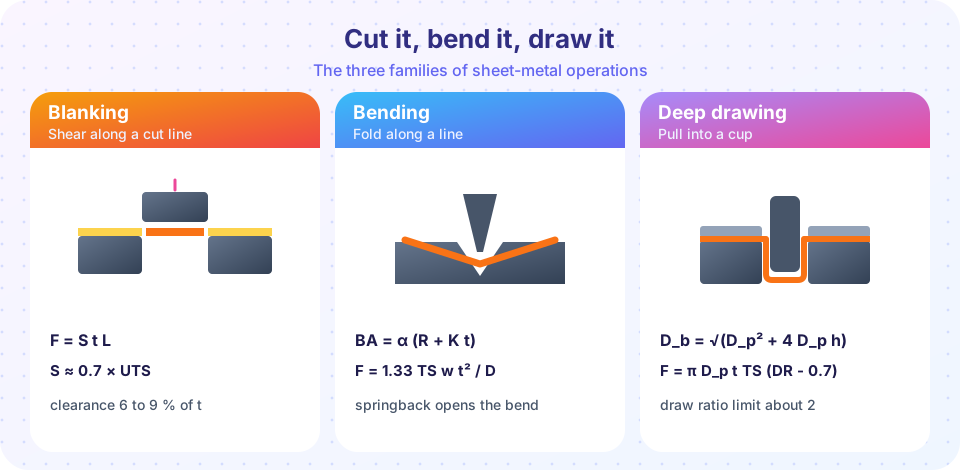
Car doors, beverage cans, kitchen sinks, computer cases, aircraft skins and washing-machine drums all start as flat sheet metal. Sheet forming is the most widely used of all forming families because sheets are cheap, light, easy to transport and can be pressed at very high rates. A typical press line hits a part every few seconds. The main operations fall into three groups: cutting the sheet (shearing, blanking, punching), bending it along straight lines, and drawing it into cups and other hollow shapes. This lesson gives you the standard formulas for each, so you can estimate the size of the press, flatten a part to find the blank, and predict why a bent part never quite stays where you left it.
What you will learn
- Compute blanking force and choose the die clearance.
- Calculate bend allowance, flat blank length, bending force and springback.
- Find the blank diameter, draw ratio and drawing force for a cylindrical cup.
- Recognize typical defects: burrs, wrinkling, tearing and earing.
Key terms
Blanking: cutting a flat piece (the blank) out of sheet; the piece is the product.
Punching: cutting a hole; the cut-out slug is scrap.
Bend allowance (BA): the length of the neutral axis in the bend, used to compute the flat blank length.
Springback: the partial elastic recovery of a bent part when the load is removed.
Draw ratio: blank diameter divided by punch diameter.
Shearing, blanking and punching
In blanking, a punch pushes the sheet into a die opening and the metal shears along the cut line. The cut edge shows four zones: a rounded rollover where the punch first enters, a smooth burnish where metal sheared cleanly, a rougher fracture zone where it tore, and a burr at the end. Clean parts need the right clearance between punch and die: too small, and the cracks do not meet, so the metal is cut twice and the tool wears fast; too large, and rollover and burrs grow. Clearance per side is usually written c = a × t, with a ≈ 0.06 for soft metals, 0.075 for medium and 0.09 for hard metals, t the sheet thickness.
The press force to cut is the shear strength of the sheet times the area of the cut surface:
F = S × t × L
where S is the shear strength (about 0.7 times the tensile strength for many metals) and L is the length of the cut edge (the perimeter). The force acts for the thickness distance, and the work is F × t times a factor of about 0.5, since the force falls once the fracture starts.
Worked example
Blank a 60 mm diameter disc from 1.5 mm steel sheet with UTS 400 MPa. Take S = 0.7 × 400 = 280 MPa. The cut length is the circumference L = π × 60 = 188.5 mm. Then F = 280 × 1.5 × 188.5 = 79,200 N = 79 kN, about 8 tonnes-force. The clearance (medium steel) is 0.075 × 1.5 = 0.11 mm per side, so the die opening is about 0.22 mm larger in diameter than the punch.
To cut thicker or longer parts with a smaller press, dies use a shear angle on the punch face so that only part of the cut is shearing at any moment. This lowers peak force but increases stroke.
Bending
A straight bend stretches the outside of the sheet and compresses the inside, with a neutral axis in between that stays at its original length. Its position is roughly K_ba × t from the inside surface, with K_ba ≈ 0.33 when the inside radius R is less than twice the thickness and 0.5 when R is larger. The length of the neutral axis around a bend through angle α (in radians) is the bend allowance:
BA = α (R + K_ba t)
The flat blank length equals the sum of the straight sections plus the bend allowances. This is how every sheet-metal CAD program flattens a part.
Worked example: bend allowance
A 90° bend (α = π/2 = 1.571 rad) in 2 mm sheet with inside radius R = 4 mm. Since R ≥ 2t, K_ba = 0.5: BA = 1.571 × (4 + 0.5 × 2) = 1.571 × 5 = 7.85 mm.
Minimum bend radius
Bending too sharply cracks the outside. Each material has a minimum bend radius, often expressed as a multiple of thickness: soft aluminum or annealed steel can bend to nearly zero, while hard or thick material may need 2 to 4 t or more. Bend lines should run across the rolling direction of the sheet when possible, because the grain makes the sheet less ductile along the rolling direction.
Bending force
For V-bending in a die with opening width D, the force is:
F = K_bf × TS × w × t² / D
with K_bf ≈ 1.33 for V-bending (and about 0.33 for edge bending in a wiping die), TS the tensile strength and w the bend length. For the 2 mm sheet above with TS = 400 MPa, w = 100 mm and a die opening of D = 16 mm (about eight times the thickness, a common choice), F = 1.33 × 400 × 100 × 4 / 16 = 13,300 N = 13.3 kN.
Springback
When the bending load is released, elastic stresses relax and the bend opens slightly. The final radius R_f is related to the tool radius R_i by:
R_i / R_f = 4 (R_i Y / (E t))³ - 3 (R_i Y / (E t)) + 1
with Y the yield strength and E Young's modulus. For steel (Y = 250 MPa, E = 200 GPa) at R_i = 4 mm and t = 2 mm: R_i Y / (E t) = 1000 / 400,000 = 0.0025, so R_i / R_f = 0.9925 and R_f = 4.03 mm. The effect is small here but grows for high strength, low modulus and large radius-to-thickness ratio; high-strength steels and aluminum alloys spring back much more. Tool makers overbend by a calculated amount, or coin the bend by pressing the sheet harder at the bottom of the stroke.
Deep drawing
In deep drawing a flat blank is pushed by a punch through a die opening and formed into a cup. The flange of the blank slides inward under a blank holder that prevents wrinkling. Beverage cans, sinks, pots and fuel tanks are drawn.
For a plain cylindrical cup of diameter D_p and height h, the blank diameter follows from equal area (neglecting thinning):
D_b = √(D_p² + 4 D_p h)
The draw ratio is DR = D_b / D_p. A single draw of most steels is limited to DR ≈ 2, which is a reduction of 50 percent. For taller cups, the cup is redrawn through further dies, often with annealing. The drawing force is approximately:
F = π D_p t TS (D_b / D_p - 0.7)
and the blank-holder force is typically about one third of it.
Worked example
A cup with D_p = 60 mm and h = 40 mm from 1.0 mm sheet with TS = 350 MPa.
D_b = √(3,600 + 4 × 60 × 40) = √13,200 = 114.9 mm.DR = 114.9 / 60 = 1.92, just inside the limit of about 2.F = π × 60 × 1.0 × 350 × (1.92 - 0.7) = 80,000 N = 80 kN.
Defects. Wrinkling occurs in the flange when the holder force is too low; tearing occurs near the punch radius when the draw is too deep or the holder too tight; earing is a wavy rim caused by directional (anisotropic) properties in the sheet. Thinning of the wall is inevitable and must stay within limits.
Other sheet processes
Stretch forming pulls the sheet over a form block (aircraft skins). Spinning forms round shapes over a rotating mandrel. Hydroforming uses fluid pressure instead of a rigid die. Progressive dies perform several operations (pierce, bend, blank) at successive stations as the strip advances, producing a finished part at every press stroke, and are the workhorse of high-volume brackets and connectors.
Common misconceptions
"Cutting force depends on the area of the blank." It depends on the length of the cut edge and the thickness, not on the area.
"A bend radius of zero is always possible." Hard or thick metals crack; each material has a minimum bend radius.
"The flat length is the sum of the outer dimensions." Outer dimensions overcount; use bend allowance or bend deduction.
"Springback only matters for steel." Aluminum and high-strength steels spring back more.
Try it
Compute the flat length of a U-bracket from its straight segments and bends. It uses the bend allowance formula above.
The second example evaluates the chapter's worked numbers and compares springback of three metals at different radius-to-thickness ratios, using classroom properties.
Press Run (or Ctrl + Enter) to see the result here.
Program input · what you'd type while the program runs
Type the answers before you press Run, one per line. Each time the program reads a line (with input()), it gets the next line from this box.
Check your understanding
Quick check · 5 questions
of 5 answered You scored / 5 · perfect!
-
1. A rectangular blank 100 mm × 50 mm is cut from 2 mm sheet with S = 300 MPa. The blanking force is:
L = 2 × (100 + 50) = 300 mm; F = 300 × 2 × 300 = 180,000 N = 180 kN. -
2. A 90° bend in 3 mm sheet with R = 3 mm. K_ba = 0.33 (R < 2t). The bend allowance is about:
BA = 1.571 × (3 + 0.33 × 3) = 1.571 × 3.99 = 6.27 mm, about 6.3 mm. -
3. A cup of diameter 50 mm and height 30 mm needs a blank diameter of about:
D_b = √(2,500 + 4 × 50 × 30) = √8,500 = 92.2 mm. -
4. What causes wrinkling in deep drawing?
An under-restrained flange buckles inward as it is drawn. -
5. Which material tends to show more springback for the same R/t?
Springback grows with Y/E, so a high-yield, low-modulus alloy springs back more.
Summary
- Blanking force is
S t LwithS ≈ 0.7 UTS; clearance per side is about6 to 9 percent of t. - Bend allowance
BA = α (R + K_ba t)gives the flat length; V-bending force is1.33 TS w t² / D. - Springback follows
R_i / R_f = 4x³ - 3x + 1withx = R_i Y / (E t); compensate by overbending. - Deep drawing blank
D_b = √(D_p² + 4 D_p h); draw ratio limit near 2; forceπ D_p t TS (DR - 0.7).
Next: Chapter 4 Review
Track your progress
Create a free account to tick off lessons and pick up where you left off on any device.
of Manufacturing Processes lessons completed