


















Lesson 29 of 49 · Joining and Welding
Arc welding: processes, heat input and weld strength
How arc welding works: stick, MIG/MAG, TIG and submerged arc, shielding gas, power sources, the heat input formula, deposition rate and fillet weld strength with examples.
An electric arc is a continuous spark: a column of ionized gas, or plasma, carrying a current of tens to hundreds of amperes across a gap of a few millimeters. The core of an arc is hotter than the surface of the Sun, which is why a welder can melt steel in a fraction of a second. Arc welding uses this arc as the heat source. It is the most widely used fusion welding method in the world, from shipyards and bridges to the frame of a garden gate.
In this lesson you will meet the four main arc processes, learn the single most important number for describing a weld (the heat input) and calculate how much load a fillet weld can carry.
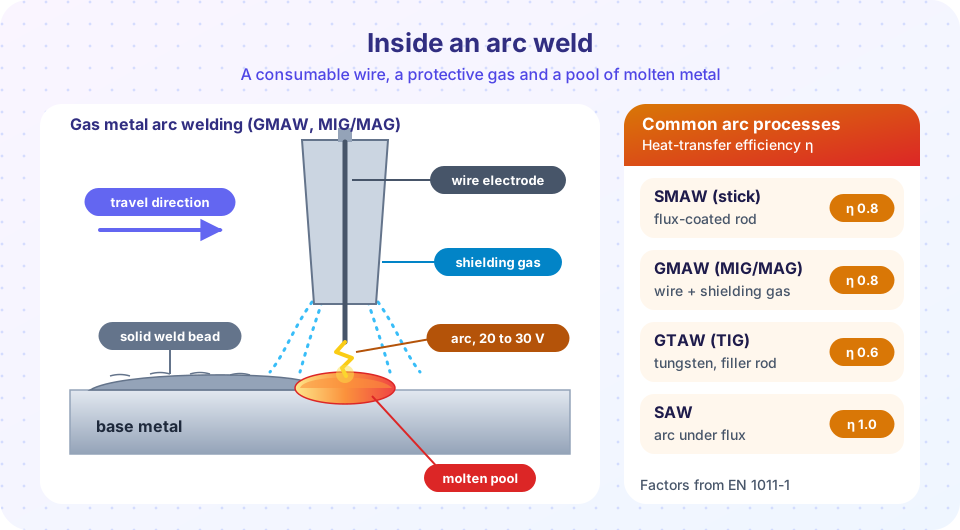
What you will learn
- How an arc weld forms and why shielding is needed.
- The differences between SMAW (stick), GMAW (MIG/MAG), GTAW (TIG) and SAW.
- How to compute heat input and why it matters.
- How to estimate the deposition rate of a wire welder.
- How to size a fillet weld for a given load.
Key terms
Shielding: a gas or flux that keeps oxygen and nitrogen from the air away from the hot metal.
Heat input (HI): energy delivered to the joint per millimeter of weld, in kJ/mm.
Penetration: how deep the weld melts into the base metal.
Fillet weld: a roughly triangular weld in the corner between two surfaces, such as a T-joint.
Throat (a): the shortest distance from the root of a fillet weld to its face; the section that carries the load.
Why a weld needs shielding
Molten steel reacts eagerly with oxygen and nitrogen. Without protection it forms oxides and absorbs gas that bubbles out as pores on freezing, and the joint turns weak and brittle. Every arc process therefore carries its own shield:
- Flux coating or flux blanket burns or melts to give a protective gas and a layer of slag that floats on the pool and also cleans it.
- Shielding gas pushed from a nozzle: argon, helium, carbon dioxide or mixtures. Argon is inert (it does not react with anything); carbon dioxide is slightly reactive but gives deep penetration and is cheap.
The four main processes
Shielded metal arc welding (SMAW, "stick"). A flux-coated rod is both electrode and filler. As it melts, the coating makes gas and slag. It needs no gas bottle, works outdoors in some wind and costs little in equipment, so it is popular for site work and repairs. It is slow because the welder must stop to change rods and chip off the slag.
Gas metal arc welding (GMAW, "MIG" or "MAG"). A wire fed from a spool through the torch is the electrode. Argon (MIG) is used for aluminum, and argon with 10 to 25 percent carbon dioxide (MAG) for steel. It is fast, easy to learn and easy to automate with robots. It is the workhorse of car bodies and fabrication shops. Depending on current and voltage, the metal moves from wire to pool in different transfer modes: short-circuit (low current, thin sheet), spray (high current, thicker sections) and pulsed (controlled drops, less spatter).
Gas tungsten arc welding (GTAW, "TIG"). The arc burns between a non-consumable tungsten electrode (melting point about 3,400 °C) and the work, shielded by argon. The welder adds a filler rod by hand if needed. It gives the cleanest, most precise welds, which makes it the choice for stainless steel, aluminum, titanium, and thin parts, but it is slow and takes skill. For aluminum, alternating current breaks up the stubborn oxide skin.
Submerged arc welding (SAW). A bare wire feeds into a deep layer of granular flux, so the arc is hidden. Currents of 500 to more than 1,000 A deposit metal at high rate with nearly no fumes or spatter. It is used for thick plates in pipes, pressure vessels and ship hulls, and it works in the flat position only.
Power sources and polarity
Stick and TIG use constant-current sources: the welder changes the arc length by hand, and the current stays near the set value. MIG/MAG uses constant-voltage sources: if the arc gets longer the current falls, and the wire speed brings it back, so the arc length is self-regulating.
Polarity matters because more heat appears at the electrode that receives the electrons. In DC electrode positive (DCEP) more heat goes into the wire, which suits MIG. In DC electrode negative (DCEN) more goes into the work piece, which gives deeper penetration with a TIG torch and protects the tungsten.
Heat input
The energy of a weld depends on the arc power and on how slowly the torch moves. The standard definition is:
HI = η × V × I × 60 / (1000 × S) (kJ/mm)
V is arc voltage (V), I is current (A), S is travel speed (mm/min), and η is the thermal efficiency, the fraction of arc energy that actually reaches the work. Common values (from standards such as EN 1011-1) are 1.0 for submerged arc, 0.8 for stick and MIG/MAG, and 0.6 for TIG.
Worked example 1: MAG weld on steel
V = 24 V, I = 200 A, S = 300 mm/min, η = 0.8:
HI = 0.8 × 24 × 200 × 60 / (1000 × 300) = 0.77 kJ/mm.
Why does it matter? High heat input means slow cooling: a wide heat-affected zone with coarse grains, softer and often less tough steel, and more distortion. Low heat input means fast cooling: harder, more brittle structure and a higher risk of cracking in hardenable steels. Procedures for carbon steels commonly live within about 0.5 to 2.5 kJ/mm, but codes set limits for each steel and thickness. You will see the metallurgy in the next lesson.
How fast does a wire welder deposit metal?
Wire feed speed (WFS) times the wire's cross-section gives the volume deposited per minute:
volume rate = (π/4) × d² × WFS
Worked example 2
A 1.2 mm steel wire at WFS = 8 m/min:
- Area
= π/4 × 1.2² = 1.131 mm². - Volume rate
= 1.131 × 8,000 = 9,048 mm³/min. - Mass rate
= 9,048 × 0.00785 g/mm³ ≈ 71 g/min ≈ 4.3 kg/h(assuming steel density 7.85 g/cm³ and nearly all the wire ending up in the weld).
That is a quick check for how long a weld will take: divide the weld metal needed (volume of the groove or fillet times density) by the deposition rate, and then add the time for setup, interpass cleaning and the arc-on factor, since welders rarely run the arc more than about 30 to 60 percent of the shift.
Weld types, joints and positions
Joint layouts include butt, lap, T, corner and edge joints. The two most important weld types are the groove weld (metal fills a prepared gap between the plates) and the fillet weld (metal fills the corner). Welding position is described as flat, horizontal, vertical or overhead (codes call these 1G to 4G for groove welds). Flat is the easiest and fastest, which is why fabricators often rotate or tilt the part to keep the welds flat.
Sizing a fillet weld
A fillet weld typically fails by shear along its throat. For a weld with equal legs w, the throat is a = 0.707 w. Many codes use an allowable shear stress based on the electrode's tensile strength (for example, about 0.3 times the nominal tensile strength of the weld metal; for a common E70 electrode with a strength of 483 MPa, that is roughly 145 MPa). Capacity per unit length is then:
F / L = a × τ_allow
Worked example 3
A 6 mm leg fillet: a = 0.707 × 6 = 4.24 mm. With τ_allow = 145 MPa, the capacity is 4.24 × 145 = 615 N/mm. A plate attached by two welds of 100 mm each (total length 200 mm) can carry about 200 × 615 = 123 kN. A bigger leg adds capacity linearly, but the weld metal volume grows with the square of the leg, so the cost grows faster than the strength. It is often better to weld a longer bead than a larger one. Real design uses the code of practice, load factors and checks of the parent metal, but this calculation shows how the throat carries the load.
Safety in one paragraph
Welding makes ultraviolet light (it burns eyes and skin within minutes unprotected), fume (needs extraction, particularly with stainless steel and coated steel), heat and electric current. Filter lenses, protective clothing, ventilation and dry conditions are not optional.
Common misconceptions
"A bigger weld is always a stronger joint." Strength grows with throat size, but large welds put in more heat, so more distortion and a wider weakened zone. Often a longer or better-placed weld is the better answer.
"Higher current always gives a better weld." Too much current at a given speed gives burn-through, undercut and a very wide, soft heat-affected zone. Current, voltage and speed must be balanced.
"The shielding gas cools the weld." Its job is chemical protection; its influence on heat is secondary but real (helium makes a hotter arc than argon).
Try it
Move the sliders to see how voltage, current and travel speed change the heat input, and what range it falls in. The ranges are broad guides for carbon steel, not a welding procedure.
Next, check the deposition rate and fillet weld calculations from the worked examples, and see how capacity and cost scale with leg size.
Press Run (or Ctrl + Enter) to see the result here.
Program input · what you'd type while the program runs
Type the answers before you press Run, one per line. Each time the program reads a line (with input()), it gets the next line from this box.
Check your understanding
Quick check · 5 questions
of 5 answered You scored / 5 · perfect!
-
1. Which arc process uses a non-consumable tungsten electrode and gives the cleanest, most precise welds?
In TIG welding the arc burns from a tungsten electrode that does not melt away; filler is added separately. It is slow but precise. -
2. A MAG weld uses 26 V and 220 A at 400 mm/min, η = 0.8. What is the heat input?
HI = 0.8 × 26 × 220 × 60 / (1000 × 400) = 274,560 / 400,000 = 0.686, so about 0.69 kJ/mm. -
3. What is the throat of a fillet weld with equal 8 mm legs?
The throat is 0.707 times the leg: 0.707 × 8 = 5.66 mm. -
4. Why does MIG/MAG use a constant-voltage power source?
With constant voltage, a longer arc means lower current, so the wire melts more slowly and the arc shortens again. The arc length regulates itself. -
5. What is the main risk of a very low heat input on a hardenable steel?
Low heat input gives rapid cooling, which can produce hard martensite in hardenable steels. High heat input is the cause of wide soft zones and distortion.
Summary
- Arc welding melts the joint with an electric arc, with flux or gas shielding the molten pool from air.
- Stick is simple and portable, MIG/MAG is fast, TIG is precise and slow, and submerged arc is deep and fast on thick plate.
- Heat input
HI = η V I 60 / (1000 S)kJ/mm controls cooling rate and zone width; both too high and too low cause problems. - Deposition rate follows from wire diameter and feed speed.
- A fillet weld carries load across its throat
a = 0.707 w; capacity is throat times allowable shear times length.
Track your progress
Create a free account to tick off lessons and pick up where you left off on any device.
of Manufacturing Processes lessons completed