


















Lesson 9 of 49 · Overview and Materials
Steel and Heat Treatment
Understand the iron-carbon system, pearlite and martensite, and the heat-treatment cycles of annealing, normalizing, quenching and tempering, with lever-rule and cooling calculations.
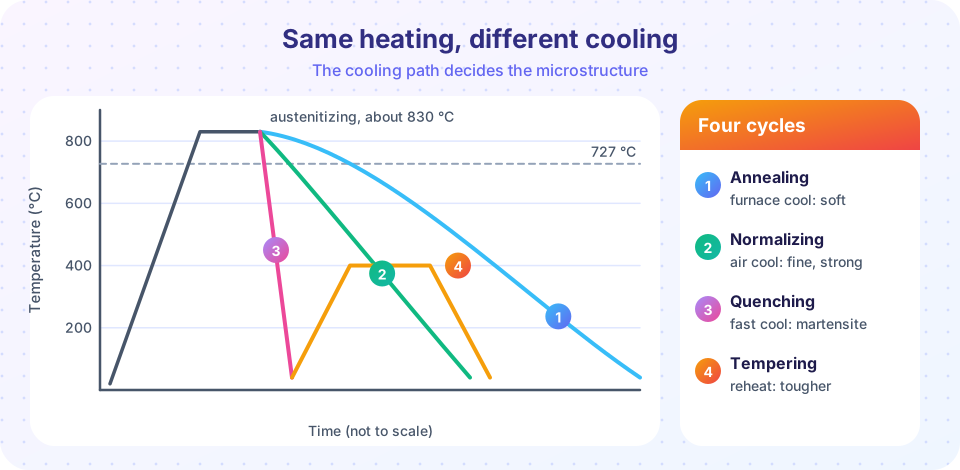
Take two steel bars with the same chemical composition. Heat one in a furnace and let it cool slowly with the furnace switched off. Heat the other to the same temperature and plunge it into water. The first will be soft enough to file and bend; the second will be glass-hard and might crack if dropped. Same atoms, wildly different behavior. The difference is microstructure, the arrangement of the crystals inside the metal, and heat treatment is the craft of controlling it. This lesson explains the iron-carbon system just enough for you to understand why the standard cycles work.
What you will learn
- Classify steels by carbon content and tell steel from cast iron.
- Name the phases ferrite, austenite, cementite, pearlite and martensite and what each is like.
- Describe annealing, normalizing, quench hardening, tempering and case hardening.
- Use the lever rule to find phase fractions and a lumped model to estimate quench cooling.
Key terms
Austenite: the face-centered cubic form of iron that holds up to about 2 percent carbon in solution; exists at high temperature.
Ferrite: the body-centered cubic form of iron, soft and ductile, with almost no dissolved carbon.
Cementite: the hard, brittle compound Fe₃C containing 6.67 percent carbon.
Pearlite: a fine layered mixture of ferrite and cementite.
Martensite: a very hard, brittle structure formed when austenite is cooled so fast that carbon is trapped.
Steel and cast iron
Pure iron is soft. Adding carbon makes it strong. By convention steel has up to about 2 percent carbon and cast iron has more, typically 2 to 4 percent. Steels are grouped as low-carbon (below about 0.3 percent), medium-carbon (0.3 to 0.6 percent) and high-carbon (above about 0.6 percent). Low-carbon steels are easy to form and weld; high-carbon steels harden strongly but are harder to work. Alloy steels add chromium, nickel, molybdenum and other elements to improve hardenability, toughness or corrosion resistance.
What the microstructure looks like
When steel is heated above a critical temperature (about 727 °C for the eutectoid composition and higher for lower-carbon steels), its structure turns into austenite, which dissolves carbon much more easily than ferrite does. What happens on cooling determines the final structure:
- Slow cooling lets carbon diffuse out of the austenite. A steel with 0.76 percent carbon (the eutectoid composition) turns completely into pearlite, alternating thin plates of soft ferrite and hard cementite. Lower-carbon steels first form soft ferrite grains and then pearlite in the leftover regions.
- Moderate cooling (such as in air) gives a finer pearlite, which is stronger.
- Rapid cooling (quenching) gives no time for carbon to move. The crystal snaps into a distorted body-centered tetragonal lattice called martensite, with carbon trapped inside. The distorted lattice resists slip, so martensite is extremely hard and also brittle. Its hardness rises with carbon content.
Lever rule example
How much ferrite and pearlite does a slowly cooled 0.45 percent carbon steel contain at room temperature? Use the eutectoid composition 0.76 percent and ferrite's carbon limit of about 0.022 percent:
- Fraction of proeutectoid ferrite =
(0.76 - 0.45) / (0.76 - 0.022) = 0.31 / 0.738 = 0.42. - Fraction of pearlite =
1 - 0.42 = 0.58.
So about 42 percent soft ferrite and 58 percent pearlite. As carbon rises toward 0.76 percent the pearlite fraction grows, and so does strength. Above 0.76 percent, hard cementite forms at the grain boundaries instead of ferrite.
The four basic heat treatments
- Full annealing. Heat to just above the critical temperature (
A₃for hypoeutectoid steel), hold until uniform, then cool very slowly (typically in the furnace). The result is soft, coarse pearlite and ferrite with low internal stress. Use it before heavy machining or cold forming. - Normalizing. Heat a little above the critical temperature, then cool in still air. The finer structure is stronger and more uniform than annealed steel. It refines grains after forging or casting.
- Quench hardening. Heat into the austenite range (roughly 30 to 50 °C above the critical temperature), hold, then cool rapidly in water, brine, oil or polymer solution. The structure becomes martensite. Severity of quench, from mildest to harshest, is roughly air, oil, water, brine; harsher quenches give higher hardness but more risk of distortion and cracking.
- Tempering. Reheat a quenched part to a moderate temperature, typically between 150 and 650 °C, and hold. Some carbon leaves the martensite and forms tiny carbides. The steel loses some hardness but gains a great deal of toughness. Higher tempering temperature means softer and tougher. Tool steels are tempered lightly; springs and structural parts are tempered more.
Quenching and tempering together are the standard way to get a high strength and acceptable toughness. A freshly quenched part is dangerously brittle and is normally tempered right away.
Surface treatments
Many parts need a hard surface and a tough core, for example gear teeth. Case hardening achieves this. In carburizing, a low-carbon steel is held at about 900 to 950 °C in a carbon-rich atmosphere so that carbon diffuses into the surface; quenching then hardens the carbon-rich case while the core stays tough. Nitriding diffuses nitrogen into the surface at a lower temperature of about 500 to 550 °C, producing a hard layer with very little distortion because no quench is needed. Induction hardening heats only the surface layer with a high-frequency coil before quenching.
Estimating the critical temperature and martensite start
For a hypoeutectoid steel, a rough straight-line estimate of A₃ runs from 912 °C at 0 percent carbon to 727 °C at 0.76 percent carbon. For 0.45 percent carbon: A₃ = 912 - 185 × (0.45 / 0.76) = 912 - 110 = 802 °C, so austenitize at about 830 °C. The temperature at which martensite begins to form on quenching is called Ms. A well-known empirical formula for plain-carbon steel gives Ms ≈ 539 - 423 × C in °C with C in weight percent: at 0.45 percent this is about 349 °C. Treat both as rough design numbers; real steels have alloying elements that shift them.
Quench cooling: a lumped model
A small part cooling in a quenchant follows Newton's law of cooling if its interior stays nearly uniform in temperature. The temperature after time t is:
T(t) = T_q + (T₀ - T_q) × exp(-t / τ), with τ = ρ c (V/A) / h
Here ρ is density (7,850 kg/m³), c is specific heat (about 490 J/kg·K), V/A is volume over surface area (d/6 for a sphere), and h is the heat-transfer coefficient (W/m²·K). The model is valid when the Biot number Bi = h (V/A) / k is below about 0.1, where k ≈ 45 W/m·K for steel. Because the real h of a quench varies enormously with the vapor blanket and agitation, the example below is a teaching model, not a way to predict real hardness.
Common misconceptions
"Quenching makes steel stronger in every way." Quenched steel is hard and brittle; it usually must be tempered, and even then toughness is traded for hardness.
"Heat treatment changes the shape." Heat treatment aims to change properties, but it also causes distortion; parts are often rough machined, heat treated, then finish ground.
"Steel is steel." Carbon content and alloying change hardness, hardenability, weldability and machinability dramatically.
Try it
Slide the carbon content and see the room-temperature structure from slow cooling, with phase fractions from the lever rule.
The second example models quench cooling of small steel spheres. The coefficient h is an assumed round number.
Press Run (or Ctrl + Enter) to see the result here.
Program input · what you'd type while the program runs
Type the answers before you press Run, one per line. Each time the program reads a line (with input()), it gets the next line from this box.
Check your understanding
Quick check · 5 questions
of 5 answered You scored / 5 · perfect!
-
1. Which structure forms when austenite is quenched very rapidly?
Rapid cooling traps carbon and forms hard, brittle martensite. -
2. What is the purpose of tempering?
Tempering trades some hardness for toughness by relieving the trapped carbon in martensite. -
3. A slowly cooled 0.40 percent carbon steel contains what fraction of proeutectoid ferrite? (use 0.76 and 0.022)
(0.76 - 0.40) / (0.76 - 0.022) = 0.36 / 0.738 = 0.49. -
4. Which treatment gives a hard surface and a tough core?
Case hardening adds carbon or nitrogen to the surface only, so the core stays tough. -
5. Which quenchant is generally the least severe?
Still air cools slowest; brine is harshest. Milder quenches reduce distortion and cracking.
Summary
- Steel has up to about 2 percent carbon; cast iron has more. Carbon drives strength and hardenability.
- Slow cooling gives ferrite and pearlite; fast cooling gives hard, brittle martensite.
- Annealing softens, normalizing refines, quenching hardens and tempering restores toughness.
- Case hardening gives a hard surface on a tough core.
- The lever rule gives phase fractions; a lumped cooling model gives rough quench times.
Track your progress
Create a free account to tick off lessons and pick up where you left off on any device.
of Manufacturing Processes lessons completed