


















Lesson 47 of 49 · Projects and Practice
Glossary of manufacturing terms
A searchable glossary of manufacturing terms: machining, welding and joining, additive manufacturing, forming and casting, quality, automation and lean, with short plain definitions.
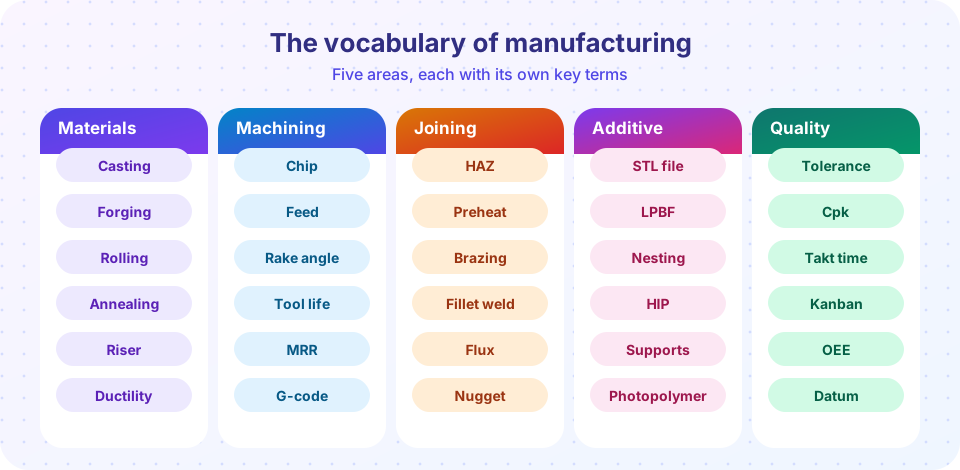
Every field has a vocabulary, and manufacturing has a large one: terms from metallurgy, mechanics, statistics, controls and management. This glossary collects the key terms used across the course, in plain language, grouped by topic. Use it when you meet a word you do not remember, or read it through before an exam as a quick revision. The search box below filters the list as you type, and a short quiz lets you test yourself.
What you will learn
- The meaning of the key terms of each chapter.
- How terms connect across areas (for example, residual stress appears in welding and in metal printing).
- How to use a glossary actively, not only as a reference.
Key terms
Glossary: an alphabetical or grouped list of terms with short definitions.
Jargon: specialist vocabulary; precise inside a field, confusing outside it.
Symbol: a short letter or abbreviation for a quantity, such as V for cutting speed or σ for standard deviation.
Terms by topic
Materials and forming
| Term | Meaning |
|---|---|
| Anisotropy | A property that depends on direction, such as the strength of a printed part along the layers versus across them. |
| Annealing | Heating a metal and cooling it slowly to soften it, relieve stress and improve ductility. |
| Casting | Shaping a part by pouring molten material into a mold cavity and letting it solidify. |
| Ductility | The ability of a material to deform plastically, for example to stretch, before it fractures. |
| Forging | Shaping metal by compressive force from hammers or presses, usually while the metal is hot. |
| Hardness | Resistance of a material to local plastic deformation such as indentation or scratching. |
| Quenching | Rapid cooling of hot steel, in water, oil or air, to form a hard structure such as martensite. |
| Riser | A reservoir of molten metal attached to a casting that feeds liquid to the part as it shrinks while solidifying. |
| Rolling | Reducing the thickness of metal by passing it between rotating rolls. |
| Sprue, runner and gate | The channels of a gating system that carry molten metal from the pouring cup into the mold cavity. |
| Tempering | Reheating hardened steel to a moderate temperature to reduce brittleness and increase toughness. |
| Work hardening | The increase in strength and hardness of a metal as it is plastically deformed at low temperature. |
Machining
| Term | Meaning |
|---|---|
| Ball screw | A precision screw with recirculating balls that converts rotary motion to linear motion with little friction and backlash. |
| Buy-to-fly ratio | The mass of raw stock purchased divided by the mass of the finished part. |
| Chip | The piece of material removed by a cutting tool. |
| Climb (down) milling | Milling in which the cutter rotates in the direction of the feed, so each tooth starts at maximum chip thickness. |
| CNC | Computer numerical control: a machine whose axes are driven by a stored program. |
| Crater wear | A hollow worn into the rake face of a tool by the sliding chip, driven by temperature. |
| Cutting speed | The speed of the cutting edge relative to the workpiece surface, in m/min. |
| Depth of cut | The thickness of the layer removed in one pass, in mm. |
| Feed | The distance the tool advances per revolution (or per tooth), in mm. |
| Flank wear | A worn land under the cutting edge on the flank face; the usual measure of tool wear (VB). |
| G-code | The standard language of CNC machines, made of blocks such as G01 X10 F200. |
| Material removal rate (MRR) | The volume of material removed per unit time, in mm³/min or cm³/min. |
| Orthogonal cutting | A simplified model of cutting in which the edge is perpendicular to the cutting velocity. |
| Rake angle | The angle of the tool face measured from the line perpendicular to the cut surface; positive rake eases cutting. |
| Shear angle | The angle between the shear plane and the cut surface in chip formation. |
| Specific cutting energy | The energy needed to remove a unit volume of material, in J/mm³. |
| Taylor tool life equation | V × Tⁿ = C: the relation between cutting speed V and tool life T. |
| Tool life | The cutting time until a wear criterion, such as VB = 0.3 mm, is reached. |
Joining and welding
| Term | Meaning |
|---|---|
| Brazing | Joining with a filler metal that melts above about 450 °C but below the melting point of the base metals. |
| Capillary action | The pull of a liquid into a narrow gap by surface tension; it draws molten filler into brazed and soldered joints. |
| Carbon equivalent (CE) | A formula combining carbon and alloy contents that predicts the hardenability and cracking risk of a steel. |
| Fillet weld | A roughly triangular weld in the corner between two surfaces; its throat carries the load. |
| Flux | A material that cleans the metal and shields the weld or brazed joint from air; in welding it also forms slag. |
| Fusion welding | Joining by melting the edges of the base metals so they flow together and solidify. |
| GMAW (MIG/MAG) | Gas metal arc welding: a continuously fed wire electrode with a shielding gas. |
| GTAW (TIG) | Gas tungsten arc welding: a non-consumable tungsten electrode, argon shielding and optional filler rod. |
| Heat input | Energy delivered to a weld per unit length, HI = η V I 60 / (1000 S) in kJ/mm. |
| Heat-affected zone (HAZ) | Base metal next to a weld that did not melt but whose microstructure was changed by the heat. |
| Hydrogen cracking | Delayed cracking caused by hydrogen, a hard microstructure and tensile stress together. |
| Nugget | The small region of melted and re-frozen metal at the interface of a resistance spot weld. |
| Preheat | Warming a joint before welding to slow its cooling rate. |
| Preload | The tension created in a bolt by tightening, which clamps the joint. |
| Residual stress | Stress that remains in a part with no external load, for example after welding or printing. |
| Resistance welding | Welding in which heat is produced by current passing through the joint, Q = I² R t. |
| SAW | Submerged arc welding: a wire arc buried under a blanket of granular flux. |
| SMAW (stick) | Shielded metal arc welding with a flux-coated consumable electrode. |
| Soldering | Joining with a filler that melts below about 450 °C, often for electrical connections. |
Additive manufacturing
| Term | Meaning |
|---|---|
| Additive manufacturing (AM) | Building parts by joining material layer by layer from 3D model data. |
| Binder jetting | An AM process in which a liquid binder glues powder layers together; metal parts are sintered afterward. |
| Design for AM (DfAM) | Designing parts to exploit additive manufacturing and respect its limits. |
| Directed energy deposition (DED) | An AM process in which a focused heat source melts material as it is fed onto the part. |
| Energy density (LPBF) | E = P / (v h t): laser energy delivered per unit volume, in J/mm³. |
| FDM / FFF | Fused deposition modeling or fused filament fabrication: material extrusion of thermoplastic filament. |
| HIP | Hot isostatic pressing: high temperature and gas pressure applied to close internal pores. |
| LPBF | Laser powder bed fusion: a laser selectively melts layers of metal powder. |
| Nesting | Packing many parts into one build to share the per-layer overhead and setup. |
| Photopolymer | A liquid resin that hardens when exposed to light of the right wavelength. |
| SLA / DLP | Vat photopolymerization with a laser (SLA) or a projected image (DLP). |
| SLS | Selective laser sintering: a laser fuses polymer powder in a heated bed. |
| Staircase effect | The stepped surface on sloped faces caused by building in discrete layers; cusp height ≈ t cos θ. |
| STL file | A file describing the surface of a solid as a mesh of triangles. |
| Support structure | Temporary material that holds overhangs in place during a build. |
Quality, automation and lean
| Term | Meaning |
|---|---|
| Bottleneck | The step that limits the output of a process or a line. |
| Clearance fit | A fit in which the shaft is always smaller than the hole, leaving a gap. |
| CMM | Coordinate measuring machine: a probe system that measures part geometry in three dimensions. |
| Common-cause variation | The natural variation of a stable process. |
| Cp and Cpk | Capability indices: Cp compares the tolerance width with 6σ; Cpk also accounts for how well the mean is centered. |
| Datum | A reference feature from which other features are located and measured. |
| GD&T | Geometric dimensioning and tolerancing: symbols that control form, orientation, location and runout. |
| Interference fit | A fit in which the shaft is always larger than the hole, so assembly needs force or heat. |
| IT grade | An international tolerance grade (IT6, IT7, ...) that sets the width of a tolerance zone for a given size. |
| Jidoka | Building in quality by letting machines stop themselves when something goes wrong. |
| Just-in-time | Making only what is needed, when it is needed, in the amount needed. |
| Kaizen | Continuous improvement by small steps involving everyone. |
| Kanban | A card or bin signal that triggers production or movement only when downstream demand appears. |
| Little's law | WIP = throughput × lead time. |
| MMC | Maximum material condition: the size at which a feature has the most material. |
| OEE | Overall equipment effectiveness: availability × performance × quality. |
| PLC | Programmable logic controller: an industrial computer that repeats a scan of read inputs, run program, write outputs. |
| Poka-yoke | Mistake-proofing that makes an error impossible or immediately obvious. |
| SMED | Single-minute exchange of die: methods for cutting changeover time. |
| SPC | Statistical process control: using control charts to monitor and improve a process. |
| Special-cause variation | Variation from a specific, identifiable event. |
| Takt time | Available production time divided by customer demand. |
| Tolerance | The total permitted variation of a dimension. |
| Transition fit | A fit that may leave a small gap or a small squeeze, depending on the actual sizes. |
Symbols used in the course
| Symbol | Quantity | Typical unit |
|---|---|---|
| V | Cutting speed | m/min |
| N | Spindle speed | rpm |
| f, fz | Feed per revolution, per tooth | mm |
| d, ap, ae | Depth or width of cut | mm |
| T | Tool life | min |
| n, C | Taylor exponent and constant | none, m/min |
| HI | Heat input | kJ/mm |
| η | Efficiency | none |
| E | Energy density (LPBF) | J/mm³ |
| t | Layer thickness | mm |
| Q* | Break-even quantity | parts |
| μ, σ | Mean and standard deviation | same as the measurement |
| Cp, Cpk | Capability indices | none |
| OEE | Overall equipment effectiveness | percent |
Reading tips
Many terms come in families that share a pattern. Wear terms (flank, crater) describe where on the tool the damage appears. Fit terms (clearance, transition, interference) describe the gap between a shaft and a hole. Zone terms (fusion zone, heat-affected zone) describe regions of a weld by what happened to them. Variation terms (common cause, special cause) describe whether a change is natural or needs action. When you meet a new term, try to place it in its family.
Abbreviations are often confusing because the same letters mean different things in different places: SAW is submerged arc welding, but CNC machines, PLCs and robots all have their own acronyms. Always check the context. When you write, spell out an abbreviation the first time.
Common misconceptions
"Accuracy and precision mean the same thing." Accuracy is closeness to the true value; precision is repeatability. A process can have either without the other.
"Brazing and welding are the same." Welding melts the base metals; brazing melts only a filler that flows into the joint.
"3D printing and additive manufacturing are different things." In everyday use 3D printing is the popular name for additive manufacturing; industry standards use the second term for all the processes.
Try it
Search the glossary. Type part of a term or of its meaning.
Now test yourself: the game shows a definition and four terms; pick the right one.
Check your understanding
Quick check · 5 questions
of 5 answered You scored / 5 · perfect!
-
1. Which term describes a fit in which the shaft is always larger than the hole?
In an interference fit even the smallest shaft is larger than the largest hole, so parts must be pressed or heated to assemble. -
2. What does HIP stand for in metal additive manufacturing?
Hot isostatic pressing applies heat and gas pressure to close internal pores. -
3. Which pair is correctly matched?
Takt time is available production time divided by customer demand. Crater wear is the hollow on the rake face, and kanban is a pull signal. -
4. Which term describes the stepped surface of a sloped printed face?
Layers of finite thickness produce steps on sloped surfaces, called the staircase effect. -
5. What does OEE multiply together?
Overall equipment effectiveness is availability × performance × quality.
Summary
- The glossary groups terms by materials and forming, machining, joining, additive manufacturing, and quality, automation and lean.
- Terms come in families (wear, fit, zone, variation); placing a new term in its family helps memory.
- Symbols and units are part of the vocabulary: always state units.
- Use the search and quiz to revise actively.
Track your progress
Create a free account to tick off lessons and pick up where you left off on any device.
of Manufacturing Processes lessons completed