


















Lesson 43 of 49 · Quality, Automation and Lean
Chapter review: quality, automation and lean
Review tolerances, fits, SPC, capability, automation and lean manufacturing with a one-picture summary, a formula table, a capability calculator and a ten-question quiz.
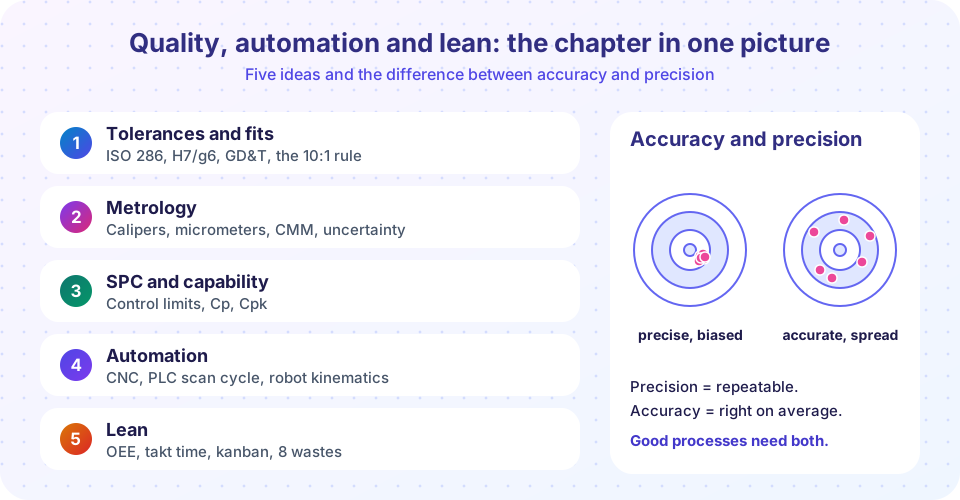
This chapter added three layers on top of the processes you already know. Quality tells you whether the parts are right and whether the process will keep making them right. Automation makes the work repeatable. Lean makes sure the work that is repeated is worth doing. Use this review to connect the three before you apply them in the final chapter.
What you will learn
- How the formulas and ideas of the chapter fit together.
- The difference between precision and accuracy in measurement and processes.
- How to compute capability from a sample of measurements.
Key terms
Precision: how closely repeated measurements or parts agree with each other.
Accuracy: how close the average is to the true or target value.
Bottleneck: the step that limits the output of the whole system.
Special cause: a specific, identifiable reason for a change in a process.
Recap table
| Topic | Key idea or formula | Remember |
|---|---|---|
| Tolerance | Upper limit − lower limit | Tight tolerance costs more |
| ISO fits | H7/g6 clearance, H7/k6 transition, H7/p6 interference | Hole basis; IT grade sets zone width |
| Stack-up | Worst case adds; RSS is the square root of the sum of squares | Statistical needs independence |
| GD&T | Form, orientation, location, runout, with datums; MMC bonus | Controls what size alone does not |
| Metrology | Reference 20 °C; ΔL = α L ΔT; ten-to-one rule |
Resolution is not accuracy |
| SPC | x̿ ± A2 R̄, D4 R̄; runs and trends |
Do not tamper |
| Capability | Cp = (USL−LSL)/6σ, Cpk = min(USL−μ, μ−LSL)/3σ |
Cpk 1.33 is about 63 ppm |
| PLC and CNC | Scan cycle; resolution = lead / counts | Safety needs certified hardware |
| Robots | Forward and inverse kinematics; repeatability versus accuracy | Two elbow solutions |
| Lean | Takt = time / demand; OEE = A × P × Q; WIP = TH × CT; kanban N | The bottleneck sets output |
How the three ideas fit together
A stable, capable process (quality) needs fewer inspections and fewer adjustments. An automated cell (automation) repeats the same motions without drift, which is exactly what a stable process requires. And a lean flow (lean) exposes problems early, because with little inventory a defect stops production immediately and cannot hide in a pile. Each idea supports the others: automating an unstable, wasteful process just makes defects faster.
A review checklist
When you meet a quality problem on the job, work through the chapter in order. Is the requirement clear: what is the tolerance, and which datum does it refer to? Can you measure it with an instrument ten times better than the tolerance, at a stated temperature? Is the process stable on a control chart, and is it capable (Cpk at or above the target)? If not, is the problem the spread or the centering? Finally, is the flow around the process creating problems, for example long queues that hide defects, or setups so slow that nobody changes over? Each question points to a tool from this chapter.
Common misconceptions
"If the process is accurate, it is precise." A process can be centered on target and still scatter widely, or scatter little and sit far from target. You need to look at both, which Cp and Cpk do.
"Automation removes the need for quality control." Automated processes can make perfect copies of a mistake. They need the same measurement and control.
Try it
Enter a list of measurements and the specification limits; the script reports the mean, standard deviation, Cp, Cpk, expected defect rate and the position of the points relative to the center line.
Press Run (or Ctrl + Enter) to see the result here.
Program input · what you'd type while the program runs
Type the answers before you press Run, one per line. Each time the program reads a line (with input()), it gets the next line from this box.
Then flip through some flashcards.
Check your understanding
Quick check · 10 questions
of 10 answered You scored / 10 · perfect!
-
1. A shaft is 30.00 ± 0.02 mm. Which measurement is in tolerance?
The limits are 29.98 and 30.02 mm. Only 30.018 mm lies inside. -
2. Which fit has a gap in every pair of parts?
In a clearance fit the smallest hole is larger than the largest shaft, so there is always a gap. -
3. Three parts in a stack have tolerances ±0.06, ±0.08 and ±0.24 mm. What is the RSS stack tolerance?
RSS = √(0.06² + 0.08² + 0.24²) = √(0.0036 + 0.0064 + 0.0576) = √0.0676 = 0.26 mm. The worst case would be 0.38 mm. -
4. A process has Cp = 1.50 but Cpk = 0.90. What is the most likely problem?
Cp shows the spread would fit if centered. A much lower Cpk means the mean sits close to one limit. -
5. Which signal on an X-bar chart suggests a special cause?
A long run on one side shows the mean has shifted, even if no point has crossed a limit. -
6. A PLC rung reads Motor = (Start OR Motor) AND NOT Stop. What happens when Start is pressed and released?
The motor's own contact keeps the rung true after Start is released (seal-in), until Stop breaks it. -
7. A two-link arm has L1 = 0.6 m and L2 = 0.3 m. Which target point is unreachable?
The reach is between |L1 − L2| = 0.3 m and L1 + L2 = 0.9 m from the base. The point (0.8, 0.5) is √(0.64 + 0.25) = 0.943 m away, beyond the maximum reach. -
8. A cell completes 90 units per hour and holds 180 units of WIP on average. What is the average lead time?
Lead time = WIP / throughput = 180 / 90 = 2 hours. -
9. Which is a typical benefit of SMED?
Shorter changeovers reduce setup cost, which lowers the economic batch size. -
10. Why is automating an unstable, wasteful process a poor idea?
Automation makes the existing process faster and more repeatable, including its problems. Stabilize and simplify first.
Summary
- Tolerances, fits and GD&T state what is acceptable; metrology checks it with known uncertainty at 20 °C.
- SPC detects special causes and capability (Cp, Cpk) says whether the process fits the specification.
- PLCs, CNC axes and robots automate repeatable work; safety uses dedicated hardware.
- Lean removes waste with takt time, OEE, Little's law, kanban and SMED; fix and simplify before you automate.
Track your progress
Create a free account to tick off lessons and pick up where you left off on any device.
of Manufacturing Processes lessons completed