


















Lesson 13 of 49 · Casting and Molding
Sand Casting, Gating and Chvorinov's Rule
Learn how sand molds are made, how patterns are allowed for shrinkage and draft, how to size a gating system with Bernoulli's equation, and how to predict solidification time.
Sand casting makes more metal parts by weight than any other casting process. Engine blocks, pump bodies, machine beds, manhole covers and enormous ship propellers are made this way. The reason is simple: sand is cheap, it survives molten steel, and it can be packed around almost any pattern. Two pieces of engineering knowledge decide whether a sand casting comes out sound. The first is the gating system, which controls how the metal enters the mold. The second is solidification time, which decides where the metal freezes last. Both can be estimated with short formulas.
What you will learn
- Describe how green-sand molds and cores are made and what a pattern must allow for.
- Apply Bernoulli's equation and continuity to size a sprue and gate and estimate fill time.
- Use Chvorinov's rule to compare solidification times of different shapes.
- Recognize why a tapered sprue and low pouring velocity matter.
Key terms
Green sand: a molding mix of silica sand, clay (bentonite) and water; "green" because it is not dried.
Parting line: the plane where the two mold halves meet.
Draft: a small taper on pattern walls so the pattern can be withdrawn without damaging the mold.
Gate: the opening through which metal enters the cavity.
Solidification time: the time from pouring until the casting is completely solid.
Making a sand mold
The usual recipe is green sand: about 85 to 90 percent silica sand, a few percent bentonite clay as the binder and a few percent water. The sand is packed (rammed) around a pattern held in a box called a flask. The pattern is in two halves: one half sits in the drag, the other in the cope. After ramming, the pattern is withdrawn, channels are cut for the gating system, and cores are placed to form any hollow areas. The cope is set on the drag, and the mold is ready to pour.
Production foundries use other binders as well. Resin-bonded (no-bake) sands harden by chemical reaction and give better accuracy and surface finish, at higher cost. Shell molding coats sand with thermosetting resin and bakes thin shells against a heated pattern. These are variations on the same expendable-mold idea.
What a pattern must allow for
A pattern is not an exact copy of the finished part. It includes several allowances:
- Shrinkage allowance. The casting contracts as it cools from solidification to room temperature, so the pattern is made larger. Typical linear contractions are roughly 1 percent for gray iron, about 1.3 percent for aluminum and about 2 percent for steel. Foundries use "shrink rules" with oversized scales.
- Machining allowance. Surfaces that will be machined are cast with extra material, commonly a few millimeters, to be cut away.
- Draft. One to three degrees of taper on vertical faces.
- Distortion allowance for shapes that will bend as they cool.
- Core prints: extensions that locate the cores in the mold.
The gating system
The metal path is a chain: pouring basin, sprue (vertical), runner (horizontal), gate (entry into the cavity). A good system fills the mold quickly enough that metal does not freeze before it arrives, but gently enough to avoid turbulence, splashing and mold erosion. Turbulence mixes air and oxide skin into the metal, which later appear as defects.
Bernoulli and continuity
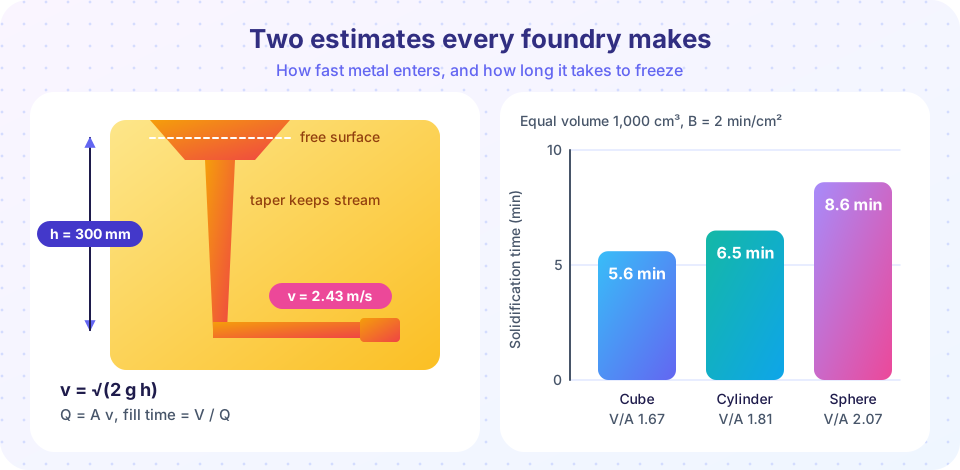
If we neglect friction, a liquid falling a height h reaches a speed given by Bernoulli's equation:
v = √(2 g h)
where g = 9.81 m/s². Continuity says the volume flow rate Q (m³/s) is the same everywhere in a channel: Q = A v. The metal speeds up as it falls, so the sprue must narrow or the stream will pull away from the walls and suck in air. A tapered sprue keeps the stream in contact with the wall. For a sprue with liquid at heights h₁ (top) and h₂ (bottom) measured down from the free surface:
A₂ / A₁ = √(h₁ / h₂)
Worked example
The liquid surface in the basin is 300 mm above the gate. The ideal gate speed is v = √(2 × 9.81 × 0.300) = 2.43 m/s. The casting cavity has volume 2,000 cm³ = 2.0 × 10⁻³ m³, and the gate area is 3 cm² = 3.0 × 10⁻⁴ m². Then:
Q = A v = 3.0 × 10⁻⁴ × 2.43 = 7.3 × 10⁻⁴ m³/s.- Fill time =
V / Q = 2.0 × 10⁻³ / 7.3 × 10⁻⁴ = 2.7 s.
Real fill takes longer because friction and bends reduce the speed; engineers apply a discharge coefficient well below 1. They also keep the velocity of aluminum in the mold below about half a meter per second so that the surface oxide skin does not fold into the stream, which usually means a larger gate area and a bottom-fill design rather than dropping metal straight into the cavity.
Chvorinov's rule
How long does a casting take to solidify? Heat leaves through the mold walls, so a casting with a large volume and a small surface area keeps its heat longest. Chvorinov's rule says:
t_s = B (V / A)^n
where V is the casting volume, A is the surface area in contact with the mold, n is about 2 and B is the mold constant (in s/cm² or min/cm²), which depends on the metal, the mold material, the pouring temperature and other conditions. The ratio V / A is a length called the modulus in some textbooks.
Which shape freezes first?
Compare three shapes with the same volume of 1,000 cm³:
| Shape | Dimensions | Surface area (cm²) | V/A (cm) | (V/A)² |
|---|---|---|---|---|
| Cube | 10 cm side | 600 | 1.67 | 2.78 |
| Cylinder (d = h) | d = 10.83 cm | 553 | 1.81 | 3.28 |
| Sphere | r = 6.20 cm | 484 | 2.07 | 4.28 |
With B = 2 min/cm², the cube freezes in about 5.6 minutes, the cylinder in 6.6 minutes and the sphere in 8.6 minutes. The sphere has the least surface per volume, so it loses heat slowest. This matters in two ways. A designer wants the riser to solidify last, so it must have a high V/A, and a spherical riser is the most efficient shape. And thick sections freeze much later than thin ones, which sets up the shrinkage problem of the next lesson.
Common misconceptions
"Fast pouring is always better." Pouring too fast causes turbulence and mold erosion; a good gating system is as gentle as it can be while still filling before freezing.
"A bigger riser is always safer." An oversized riser wastes metal and slows production; it only needs to freeze after the casting.
"Chvorinov's rule gives an exact time." It is a good estimate when B has been measured for your own process; between foundries B varies.
Try it
Change the head, gate area and cavity volume to see the ideal speed and fill time. The calculator ignores friction, so real fills take longer.
The second example evaluates Chvorinov's rule for the three shapes and plots the freezing times. Change B to see how a different mold material shifts them.
Press Run (or Ctrl + Enter) to see the result here.
Program input · what you'd type while the program runs
Type the answers before you press Run, one per line. Each time the program reads a line (with input()), it gets the next line from this box.
Check your understanding
Quick check · 5 questions
of 5 answered You scored / 5 · perfect!
-
1. Liquid metal falls 0.5 m. Ignoring friction, what is its speed?
v = √(2 × 9.81 × 0.5) = √9.81 = 3.13 m/s. -
2. Why is a sprue tapered (narrower at the bottom)?
The falling stream speeds up and narrows; a taper matches it so air is not drawn in. -
3. Which has the longest solidification time for the same volume?
The sphere has the smallest surface area per volume, so the largest V/A and the longest time. -
4. A casting has V/A = 2 cm and B = 3 min/cm². Using n = 2, the solidification time is:
t = 3 × 2² = 12 minutes. -
5. What is the purpose of draft on a pattern?
A small taper lets the pattern pull cleanly out of the packed sand.
Summary
- Sand molds are packed around a split pattern; patterns allow for shrinkage, machining stock and draft.
- Gate speed follows
v = √(2 g h); flow rate isQ = A vand fill time isV / Q. - A tapered sprue and gentle filling prevent turbulence and air entrainment.
- Chvorinov's rule
t = B (V/A)^2predicts solidification time; a high V/A freezes last.
Track your progress
Create a free account to tick off lessons and pick up where you left off on any device.
of Manufacturing Processes lessons completed