


















Lesson 48 of 49 · Projects and Practice
Cheat sheet: the formulas and rules on one page
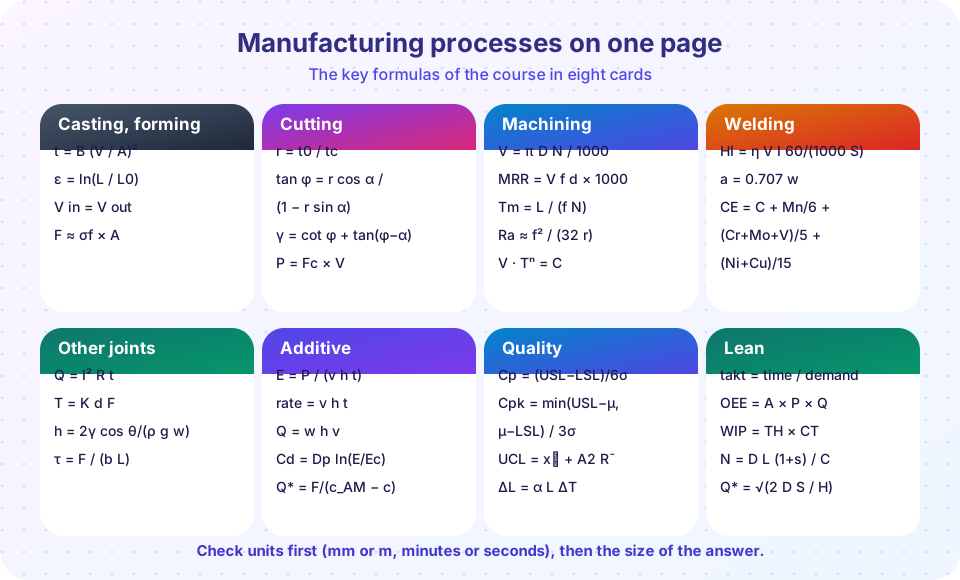
A one-page recap of manufacturing processes: casting and forming, cutting and machining, welding, joining, additive manufacturing, quality and lean formulas, with units and rules of thumb.
When you are in the middle of a calculation, you do not want to search through nine chapters. This page collects the key formulas of the course in one place, with units and the rules of thumb that help you decide whether an answer is reasonable. Print it, keep it next to your notes, and use the calculator below to check your arithmetic. Each formula has been explained, with a worked example, in its own lesson; the link at the end of each section takes you there.
What you will learn
- Where to find the key formula for each family of problems.
- The units each formula expects.
- Rules of thumb to check the size of an answer.
Key terms
Formula card: a short list of equations with their symbols and units.
Rule of thumb: an approximate guideline from experience, useful for checking but not a substitute for calculation.
Sanity check: a quick test that an answer has the right units and a plausible size.
Casting and forming
| Quantity | Formula | Units and notes |
|---|---|---|
| Solidification time (Chvorinov) | t = B (V / A)² |
V is the casting volume, A its cooling surface area; B depends on the mold material and metal |
| True strain | ε = ln(L / L₀) |
Additive for successive deformations |
| Volume constancy | V_in = V_out |
Plastic deformation does not change volume |
| Forging force (ideal) | F ≈ σ_f × A |
Flow stress times the projected area; friction raises it |
Thick, compact castings solidify more slowly than thin, spread-out ones, so risers must be thicker than the section they feed: the riser should freeze last.
Cutting and machining
| Quantity | Formula | Units and notes |
|---|---|---|
| Chip thickness ratio | r = t₀ / t_c = sin φ / cos(φ − α) |
r is below 1 |
| Shear strain | γ = cot φ + tan(φ − α) |
Typically 2 to 5 |
| Cutting power | P = F_c × V |
F in N, V in m/s gives W |
| Spindle speed | N = 1000 V / (π D) |
V in m/min, D in mm |
| Removal rate (turning) | MRR = V f d × 1000 |
mm³/min with V in m/min |
| Machining time | T_m = L / (f N) |
minutes |
| Milling feed rate | v_f = f_z z N |
mm/min |
| Ideal roughness | Ra ≈ f² / (32 r) |
f and r in the same unit |
| Taylor tool life | V Tⁿ = C |
n about 0.1 to 0.15 for HSS, 0.2 to 0.25 for carbide |
| Economic tool life | T_opt = (1/n − 1)(t_c + C_t/C_m) |
Cheapest speed |
Rule of thumb: a 20 percent increase in cutting speed roughly halves carbide tool life; depth of cut barely affects it. See the machining chapter review.
Welding and joining
| Quantity | Formula | Units and notes |
|---|---|---|
| Heat input | HI = η V I × 60 / (1000 S) |
kJ/mm with S in mm/min; η 0.8 for stick and MIG/MAG, 0.6 for TIG, 1.0 for SAW |
| Fillet throat | a = 0.707 w |
Equal legs; capacity per length a τ |
| Carbon equivalent | CE = C + Mn/6 + (Cr+Mo+V)/5 + (Ni+Cu)/15 |
Above about 0.4 to 0.5, think preheat |
| Cooling rate (thick plate) | R = 2π k (T_c − T₀)² / H |
k about 0.028 W/(mm·K), H in J/mm |
| Resistance welding heat | Q = I² R t |
J |
| Capillary rise | h = 2γ cos θ / (ρ g w) |
Narrower gap, higher rise |
| Bolt torque | T = K d F |
K about 0.2 (dry) |
Rule of thumb: hydrogen cracking needs hydrogen, a hard microstructure and tensile stress together. Break the chain with dry consumables, preheat and a sound joint design. See the joining chapter review.
Additive manufacturing
| Quantity | Formula | Units and notes |
|---|---|---|
| LPBF energy density | E = P / (v h t) |
J/mm³ |
| LPBF build rate | v h t |
mm³/s (multiply by 3.6 for cm³/h) |
| FDM flow rate | Q = w h v |
mm³/s |
| Resin cure depth | C_d = D_p ln(E / E_c) |
mm |
| Cusp height | t cos θ |
Staircase effect |
| Break-even quantity | Q* = F / (c_AM − c) |
parts |
Rule of thumb: surfaces steeper than about 45° from the horizontal print without supports. See the additive chapter review.
Quality and lean
| Quantity | Formula | Units and notes |
|---|---|---|
| Worst-case stack | Σ tolerances |
Certain, pessimistic |
| RSS stack | √(Σ tolerances²) |
Statistical, independent parts |
| Thermal expansion | ΔL = α L ΔT |
Reference temperature 20 °C |
| X-bar limits | x̿ ± A₂ R̄ |
A₂ = 0.577 for n = 5 |
| R chart upper limit | D₄ R̄ |
D₄ = 2.114 for n = 5 |
| Capability | Cp = (USL−LSL)/6σ, Cpk = min(USL−μ, μ−LSL)/3σ |
Cpk 1.33 is about 63 ppm |
| Takt time | available time / demand |
s per unit |
| OEE | A × P × Q |
85 percent is often quoted as world-class |
| Little's law | WIP = TH × CT |
units |
| Kanban cards | N = D L (1 + s) / C |
rounded up |
| Economic batch | Q* = √(2 D S / H) |
units |
Rule of thumb: never adjust a stable process because of one point; wait for a signal. See the quality chapter review.
Order-of-magnitude benchmarks
These typical values help you judge whether a result is plausible. They are broad guides drawn from the lessons, not specifications.
| Quantity | Typical value |
|---|---|
| Cutting speed, coated carbide on steel | 150 to 250 m/min (aluminum 250 to 600) |
| Specific cutting energy | about 0.4 to 1 J/mm³ for aluminum, 2 to 4 J/mm³ for steel |
| Arc welding heat input, carbon steel | about 0.5 to 2.5 kJ/mm |
| Spot weld on 1 mm steel | about 9 kA, nugget diameter about 5√t mm |
| LPBF layer thickness and build rate | 30 to 60 µm; roughly 10 cm³/h per laser |
| FDM melt flow limit of a standard hotend | about 10 to 15 mm³/s |
| Capability target for a stable process | Cpk of 1.33 or more |
| OEE benchmark often quoted as world-class | about 85 percent |
How to use the sheet
Start from the question, not the formula: how fast, how hot, how strong, how many, how good? Pick the card whose title fits the question, write the formula with its units, and fill in the numbers. If a number is missing, choose a typical value from the benchmark table and say that you assumed it. After the calculation, compare the answer with the benchmark: a cutting speed of 15 m/min on a carbide tool, a heat input of 20 kJ/mm or an OEE of 140 percent tells you that a unit or a decimal point went wrong. The sheet is a map, and the lessons are the territory: when a formula looks unfamiliar, follow the link to the lesson that derives it.
Unit conversion checklist
- Length: 1 mm = 1,000 µm; 1 in = 25.4 mm.
- Speed: 1 m/min = 1/60 m/s = 16.67 mm/s.
- Energy and power: 1 J = 1 W·s; 1 kW·h = 3.6 MJ; 1 kJ/mm = 1,000 J/mm.
- Pressure: 1 MPa = 1 N/mm²; 1 bar = 0.1 MPa.
- Volume: 1 cm³ = 1,000 mm³; 1 mm³/s = 3.6 cm³/h.
- Time: convert minutes to seconds before multiplying by watts.
Common misconceptions
"A formula sheet is a replacement for understanding." A formula without its assumptions is dangerous. Chvorinov's rule assumes a certain mold behavior, Merchant's rule is a model, Taylor's equation holds over a limited speed range.
"Rules of thumb are exact." They are guides for checking and early estimates. Final decisions need data, tests and standards.
Try it
Pick a formula, enter the inputs, and the calculator returns the result with its units.
For quick work in code, here is the same toolbox as a set of small Python functions.
Press Run (or Ctrl + Enter) to see the result here.
Program input · what you'd type while the program runs
Type the answers before you press Run, one per line. Each time the program reads a line (with input()), it gets the next line from this box.
Check your understanding
Quick check · 5 questions
of 5 answered You scored / 5 · perfect!
-
1. Which formula gives the spindle speed from cutting speed and diameter (V in m/min, D in mm)?
The 1000 converts millimeters to meters: N = 1000 V / (π D). -
2. A weld uses η = 0.6, 14 V, 150 A at 100 mm/min. What is the heat input?
HI = 0.6 × 14 × 150 × 60 / (1000 × 100) = 75,600 / 100,000 = 0.756 kJ/mm. -
3. A capability study gives Cp = 1.6 and Cpk = 1.1. What does this suggest?
Cpk lower than Cp indicates that the mean is closer to one limit than to the other. -
4. By Chvorinov's rule, which casting solidifies more slowly?
Solidification time is proportional to (V/A)²: a compact block has a larger V/A than a thin plate, so it freezes more slowly. -
5. What is 3 mm³/s in cm³/h?
3 mm³/s × 3,600 s/h = 10,800 mm³/h = 10.8 cm³/h.
Summary
- Eight families of formulas cover the course: casting and forming, cutting mechanics, machining, welding, other joints, additive manufacturing, quality and lean.
- Check units first (mm versus m, minutes versus seconds), then the size of the answer.
- Rules of thumb (45 degree overhangs, Cpk 1.33, 20 percent speed halves carbide life) guard against slips but never replace calculation.
Next: Where to go next
Track your progress
Create a free account to tick off lessons and pick up where you left off on any device.
of Manufacturing Processes lessons completed