


















Lesson 19 of 49 · Forming and Forging
Forging and Flow Stress: Estimating Press Force
Compare open-die and closed-die forging, estimate upsetting force and work from the flow curve with a friction factor, and see why forgings have better grain flow.
Forging is hitting or pressing hot (or sometimes cold) metal between dies until it takes the desired shape. It is humanity's oldest metalworking technique and still the way to make parts that must not fail: aircraft landing gear, crankshafts, connecting rods, turbine disks, hand tools and railway axles. In this lesson you will meet the main kinds of forging, then learn to answer the question every forging engineer asks first: how big must the press be? The answer comes from the flow curve of Chapter 2, a contact area and a friction factor.
What you will learn
- Distinguish open-die, closed-die and flashless forging and the machines that run them.
- Calculate the true strain, flow stress, force and work of an upsetting operation.
- Explain barreling and the effect of friction on force.
- Describe flash, draft and defects such as laps in closed-die forging.
Key terms
Upsetting: compressing a workpiece along its axis so that its height decreases and its cross-section grows.
Open-die forging: forging between flat or simple dies that do not enclose the workpiece.
Closed-die (impression-die) forging: forging in dies that contain a cavity in the shape of the part.
Flash: excess metal that escapes between the dies; it is trimmed off afterwards.
Friction coefficient (μ): the ratio of friction force to normal force at the die-workpiece interface.
Kinds of forging
Open-die forging uses flat or simply shaped dies, and the operator moves and rotates the workpiece between blows. It makes very large parts such as ship shafts and pressure-vessel rings, and also one-off or small-batch parts. The shape depends on operator skill and the tolerance is loose, but tooling cost is low. The simplest operation is upsetting: squashing a bar to shorter and fatter.
Closed-die forging squeezes a heated billet in a pair of dies that carry the shape of the part. The metal fills the cavity and any excess flows out into a narrow channel called flash, which also builds back pressure that helps fill the corners. The flash is trimmed away afterwards. Closed-die forging produces good accuracy and high output, so it suits crankshafts, connecting rods and gears in volumes from thousands to millions. Flashless or precision forging uses closely controlled billet volume to avoid flash and cuts waste.
Machines. A hammer delivers energy by impact: fast, versatile, but noisy and with heavy vibration. A mechanical press delivers a fixed stroke through a crank or eccentric at high speed. A hydraulic press delivers a controlled force through the whole stroke, with slower speeds, and is used for large or slow-forming alloys.
Temperature. Steels are commonly forged hot at about 1,100 to 1,250 °C, aluminum alloys at about 400 to 500 °C, titanium alloys somewhere near 900 to 1,000 °C. These are typical ranges only. Cold forging at room temperature gives excellent surface finish and strength but needs more force; bolts and many automotive parts are cold forged.
Force in upsetting
Take a cylinder of initial height h₀ and diameter d₀. When it is compressed to height h, the true strain is:
ε = ln(h₀ / h)
The flow stress at that strain, from the Hollomon equation, is σ_f = K ε^n. Without friction the force at that instant would be:
F = σ_f × A
where A is the current cross-sectional area. Friction between the dies and workpiece resists the sideways flow of the metal, so the real force is larger:
F = K_f × σ_f × A, with K_f ≈ 1 + 0.4 μ d / h
where d is the current diameter. This shape factor grows as the part flattens (d/h gets larger), which is why force rises steeply near the end of a squash.
Worked example
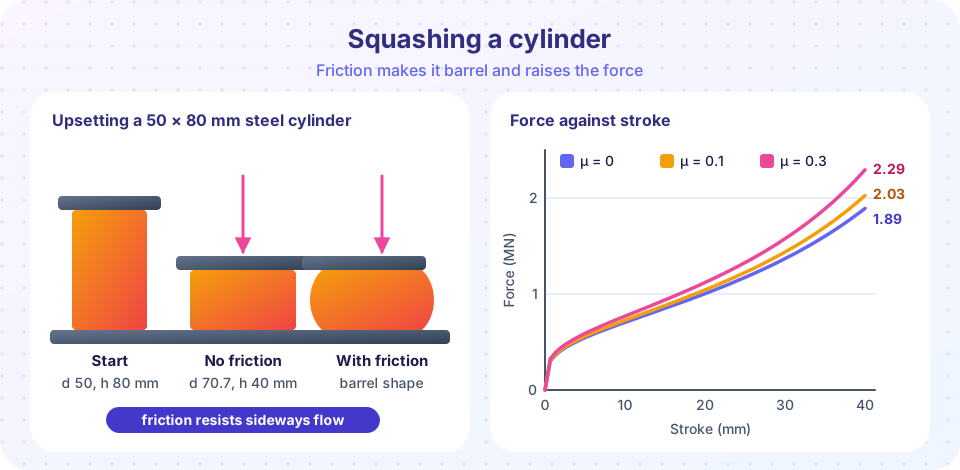
Upset a low-carbon steel cylinder (K = 530 MPa, n = 0.26) from d₀ = 50 mm, h₀ = 80 mm to h = 40 mm cold, with μ = 0.1.
- True strain:
ε = ln(80 / 40) = 0.693. - Final diameter from constant volume:
d = 50 √(80 / 40) = 70.7 mm; areaA = π × 70.7² / 4 = 3,927 mm². - Flow stress at the end:
σ_f = 530 × 0.693^0.26 = 530 × 0.909 = 482 MPa. - Ideal force:
482 × 3,927 = 1.89 MN. - Friction factor:
K_f = 1 + 0.4 × 0.1 × 70.7 / 40 = 1.071. - Real force:
1.071 × 1.89 = 2.03 MN, about 207 tonnes-force.
The work of deformation is the force integrated over the stroke. Using the average flow stress σ̄_f = K ε^n / (1 + n) = 482 / 1.26 = 382 MPa and the volume V = π × 50² × 80 / 4 = 157,080 mm³, the ideal work is W = σ̄_f × V × ε = 382 × 157,080 × 0.693 = 41.6 × 10⁶ N·mm = 41.6 kJ. A press must supply both the peak force and the energy, which is why the ratings of presses and hammers are different quantities.
Friction and barreling
In real upsetting, friction at the die faces stops the metal touching them from sliding outward, while the middle of the workpiece is free to bulge. The result is a barrel shape. A thick layer of lubricant reduces barreling and force: graphite or molybdenum disulfide for hot forging, phosphate coatings plus soap for cold forging, glass for very hot or exotic alloys. In the limit of very high friction the metal sticks to the die entirely, and the force rises very steeply, which is the situation in thin flat forgings and in the closed-die forging of flashed parts.
Closed-die forging force
For closed-die forging the same relation F = K_f σ_f A is used, but the shape factor K_f is larger because the metal must flow through the narrow flash gap and fill a complex cavity. Textbook values range from about 5 for simple shapes with flash up to about 12 for complex shapes, and the area A is the projected area including the flash. For a hot-forged steel connecting rod of projected area 10,000 mm² (including flash), a hot flow stress of about 100 MPa and K_f = 8, the force is 8 × 100 × 10,000 = 8.0 × 10⁶ N = 8 MN, about 815 tonnes-force; a 1,000-tonne press would do. At hot-forging temperatures flow stress depends strongly on strain rate: σ_f = C ε̇^m with m typically 0.1 to 0.3, so a faster press needs more force than a slow one.
Design rules and defects
- Draft angles of about 3 to 7 degrees on die walls let the part leave the die.
- Generous radii at corners and fillets help metal flow and prevent cracks.
- Parting line is placed on the largest cross-section so metal fills both halves.
- Underfill happens when the billet is too small or too cold.
- Laps are folds where the metal surface rolled over itself and was pressed shut without bonding; they look like cracks and are a serious defect.
- Grain flow should follow the geometry. Machined threads on a forging cut across grain if designed carelessly.
Common misconceptions
"Forging force equals flow stress times original area." The area to use is the current (final) area, and friction raises the force further.
"Hotter metal is easier at every speed." Hot flow stress depends on strain rate, so very fast forging can need more force than slow pressing.
"Forged means hammered by hand." Modern forging uses presses and hammers of thousands of tonnes in automated lines.
Try it
Choose the friction, material and reduction to see the force of an upsetting operation. The model uses the simple relations above, so it is an estimate.
The second example plots the force-stroke curve of the worked example and shows how friction steepens the end of the stroke.
Press Run (or Ctrl + Enter) to see the result here.
Program input · what you'd type while the program runs
Type the answers before you press Run, one per line. Each time the program reads a line (with input()), it gets the next line from this box.
Check your understanding
Quick check · 5 questions
of 5 answered You scored / 5 · perfect!
-
1. A bar is upset from 100 mm to 50 mm high. The true strain is:
ε = ln(100/50) = ln 2 = 0.693. -
2. Why is the flash in closed-die forging useful?
The narrow flash gap raises the pressure in the cavity, forcing metal into corners. -
3. What does friction do to the upsetting force?
Friction resists lateral flow, so a friction factor greater than 1 multiplies the force. -
4. Which defect is a fold of metal pressed shut during forging?
A lap is a surface fold that does not bond and looks like a crack. -
5. A press must deliver 6 MN at the end of the stroke. Which statement is correct?
Both peak force and the work over the stroke must be supplied.
Summary
- Open-die forging suits large or few parts; closed-die forging suits volume production with flash controlling fill.
- Upsetting force is
K_f σ_f AwithK_f ≈ 1 + 0.4 μ d / h, using the current area and flow stress. - Work is about
σ̄_f V ε; presses need both peak force and energy. - Friction causes barreling and raises force; lubrication helps.
- Laps and underfill are the characteristic defects; grain flow makes forgings strong.
Track your progress
Create a free account to tick off lessons and pick up where you left off on any device.
of Manufacturing Processes lessons completed