


















Lesson 22 of 49 · Forming and Forging
Chapter 4 Review: Forming and Forging
Review Chapter 4: constant volume, flow stress, forging force, rolling, extrusion, wire drawing, blanking, bending, springback and deep drawing, with a ten-question quiz.
Chapter 4 showed you how solid metal can be squeezed, stretched, pulled and bent into shape. The thread that ties every lesson together is simple: the metal flows plastically at a stress given by the flow curve, the volume stays constant, and every force estimate multiplies a stress by an area, adjusted for friction. With a handful of formulas you can size a forging press, a rolling mill, an extrusion press, a drawing die or a blanking tool, and flatten a sheet-metal part. This review collects them in one place.
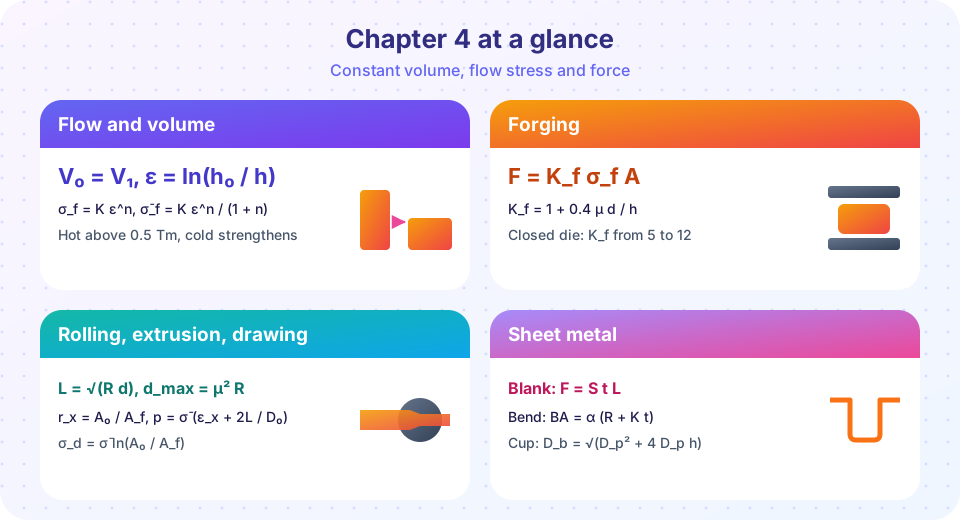
The chapter in one table
| Process | What happens | Key formulas |
|---|---|---|
| All forming | Volume stays constant | V₀ = V₁; ε = ln(h₀/h); σ_f = K ε^n; σ̄_f = K ε^n / (1+n) |
| Forging (upsetting) | Squeeze between dies | F = K_f σ_f A, K_f ≈ 1 + 0.4 μ d / h; W ≈ σ̄_f V ε |
| Rolling | Squeeze between rolls | L = √(R d), d_max = μ² R, F = σ̄_f w L, P = 2π N F L |
| Extrusion | Push through a die | r_x = A₀/A_f, p = σ̄_f (ε_x + 2L/D₀), ε_x = a + b ln r_x |
| Drawing | Pull through a die | σ_d = σ̄_f ln(A₀/A_f), limit near 50 percent per pass |
| Blanking | Shear a sheet | F = S t L, S ≈ 0.7 UTS, clearance about 6 to 9 percent of t |
| Bending | Fold a sheet | BA = α(R + K_ba t), F = 1.33 TS w t²/D, springback relation |
| Deep drawing | Pull into a cup | D_b = √(D_p² + 4 D_p h), F = π D_p t TS (DR - 0.7), DR limit about 2 |
Questions to ask about any forming job
- How much strain? True strain ε tells how hard the metal is working and whether it needs an anneal.
- Hot or cold? Use
T / T_mto decide; hot is soft but loose, cold is strong but needs more force. - What area is loaded? Use the current area, projected area or cut length, as the formula requires.
- What does friction do? It raises forces and causes barreling; lubrication is a design variable.
- Will it spring back or tear? Check bend radius, springback, draw ratio and clearances.
Common mistakes to avoid
- Using the original area in a force formula. Forging force uses the current (final) area, rolling force uses the contact area, and blanking force uses the cut length times thickness.
- Ignoring friction. The ideal formulas for extrusion and drawing are lower bounds; real pressures can be several times higher.
- Forgetting the hot-working strain-rate effect. A very fast forging blow can need more force than a slow press stroke on the same hot metal.
- Flattening a bent part by adding the outside dimensions. The flat length is the sum of the straight sections plus the bend allowances.
- Trying to draw a deep cup in one step. A single draw is limited to a draw ratio of about 2; taller shapes need redraws and often an anneal.
Look for these traps in the questions below.
Try it
This checker evaluates one formula from each process so you can verify your hand calculations.
Press Run (or Ctrl + Enter) to see the console output here.
No output.
Check your understanding
Quick check · 10 questions
of 10 answered You scored / 10 · perfect!
-
1. A cylinder 30 mm in diameter and 90 mm tall is upset to 45 mm tall. The new diameter is about:
d₁ = 30 × √(90/45) = 30 × 1.414 = 42.4 mm. -
2. What is the true strain of that upsetting operation?
ε = ln(90/45) = ln 2 = 0.693. -
3. The friction factor in upsetting, K_f = 1 + 0.4 μ d / h, is larger when:
A large d/h and high μ increase the term, so force rises. -
4. Strip is rolled with roll radius 400 mm and draft 4 mm. The contact length is:
L = √(400 × 4) = √1,600 = 40 mm. -
5. Which reduces rolling force?
Smaller rolls shorten the contact length; tension also lowers the force. -
6. Extruding a 80 mm billet to a 20 mm rod. The extrusion ratio is:
(80/20)² = 16. -
7. Why does a perfectly plastic wire have a single-pass reduction limit near 63 percent?
When σ_d equals the yield of the exit wire it necks; for an ideal material that happens at ln ratio = 1, or 1 - 1/e. -
8. Blanking force depends on:
F = S t L: shear strength times thickness times perimeter. -
9. A sheet is bent 90° with R = 5 mm and t = 2 mm (K_ba = 0.5). The bend allowance is:
BA = 1.571 × (5 + 1) = 9.42 mm, which is about 9.4 mm. -
10. A cylindrical cup of 40 mm diameter and 25 mm height requires a blank of diameter:
D_b = √(1,600 + 4 × 40 × 25) = √5,600 = 74.8 mm.
Summary
- Forming keeps volume constant and uses the flow curve to find the stress; force is stress times area, corrected for friction.
- Bulk forming (forging, rolling, extrusion, drawing) and sheet forming (blanking, bending, deep drawing) have their own limits: draft, extrusion ratio, reduction per pass, bend radius, springback and draw ratio.
- Hot working lowers force, cold working strengthens; lubrication matters in both.
- Next, Chapter 5 turns to machining, where material is removed in chips instead of moved.
Next: continue with the next chapter from the course page.
Track your progress
Create a free account to tick off lessons and pick up where you left off on any device.
of Manufacturing Processes lessons completed