


















Lesson 11 of 49 · Overview and Materials
Chapter 2 Review: Overview and Materials
Review Chapter 2: material families, stress-strain and flow stress, process fit, hot versus cold working, steel heat treatment, fits and roughness, with a quiz of ten questions.
This chapter equipped you with the material knowledge behind every manufacturing decision. You learned how metals, polymers, ceramics and composites differ, how a tensile test turns into forming forces through the flow curve, how a process must match its material, how heat treatment rewrites a steel's microstructure, and how tolerances and roughness turn a drawing into a measurable requirement. Use this page to check that the pieces fit together before moving on to casting and molding.
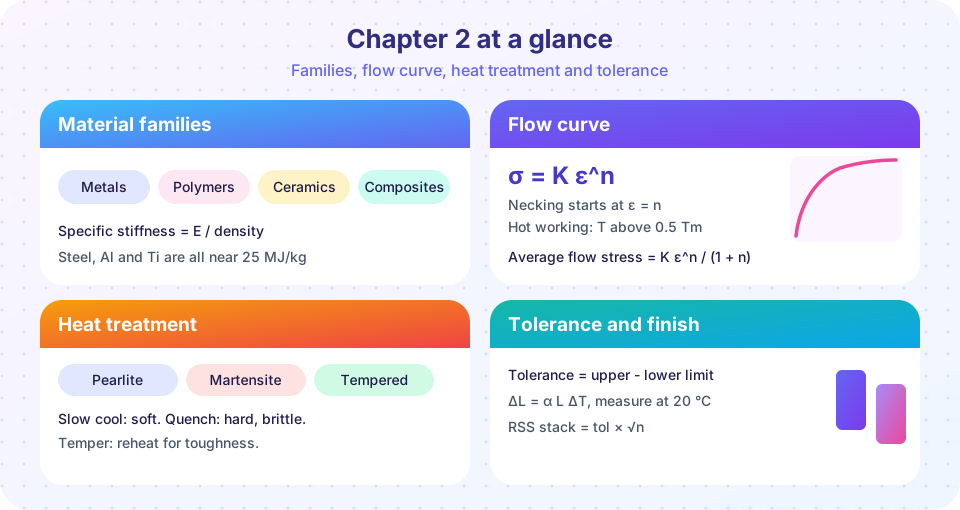
The chapter in one table
| Lesson | Key idea | Key formula or rule |
|---|---|---|
| Overview | Four families; stiffness per weight | E / ρ (specific stiffness) |
| Mechanical properties | Strength, ductility, hardness | σ = F / A₀, ε = ln(1 + e), σ_f = K ε^n, necking at ε = n |
| Process fit | Each process wants a certain material behavior | Hot working above about 0.5 T_m (kelvin) |
| Steel and heat treatment | Cooling rate sets microstructure | Lever rule; quench gives martensite; temper to regain toughness |
| Tolerances and finish | Accuracy costs money | Tolerance = upper limit - lower limit; ΔL = α L ΔT; RSS = tol × √n |
Connections to remember
- Flow stress feeds forming force. In Chapter 4 the average flow stress
K ε^n / (1 + n)multiplies a contact area to give a press force. - Melting point shapes casting. Aluminum's low melting point is why it dominates die casting; steel casting needs hotter, more robust molds.
- Hardness shapes machining. Chapter 5 uses hardness and thermal conductivity to judge how a material will cut.
- Heat treatment changes the plan. A hardened part is distorted, so finish grinding comes after the furnace.
- Tolerance chooses the process. Chapter 3's sand castings hold about a millimeter; if a feature must be held to 20 µm, it will be machined after casting.
Common mistakes to avoid
- Using engineering strain for large deformations. Engineering strain is fine for small elastic strains, but forming involves strains of 0.3 or more, where true strain
ln(1 + e)is the honest measure and strains add up properly. - Treating the engineering curve's drop as weakening. The metal keeps hardening after the peak; the curve falls only because the area used in the division is out of date.
- Applying the 0.5 T_m rule in Celsius. Homologous temperature must be computed in kelvin. For aluminum, half of 933 K is 466 K, which is 193 °C, not 330 °C.
- Skipping tempering. A freshly quenched steel part is martensite at its most brittle; it can crack on the bench before it ever reaches service.
- Specifying the tightest tolerance everywhere. Only mating and functional features deserve tight tolerances; every other dimension should be as loose as the function allows.
Several quiz questions below are built around these traps, so read each one slowly and check the units.
Try it
This calculator reviews the chapter's three most important formulas at once: true strain, flow stress and homologous temperature.
Press Run (or Ctrl + Enter) to see the console output here.
No output.
Check your understanding
Quick check · 10 questions
of 10 answered You scored / 10 · perfect!
-
1. Which two material properties give specific stiffness?
Specific stiffness is E divided by density, the stiffness for a given weight. -
2. A bar is stretched from 50 mm to 65 mm. The engineering strain is:
(65 - 50) / 50 = 0.30. -
3. A material has K = 600 MPa and n = 0.2. At true strain 0.1 its flow stress is about:
600 × 0.1^0.2 = 600 × 0.631 = 379 MPa. -
4. For σ = K ε^n, at what true strain does necking start when n = 0.3?
Necking starts when ε equals n, so at 0.3. -
5. Which pair of metals matches 'hot working starts near room temperature' and 'needs heating to hot-work'?
Lead's low melting point makes room temperature hot working; steel needs much higher temperatures. -
6. Which structure forms from a very fast quench of austenite?
A fast quench traps carbon and gives hard martensite. -
7. Why is a quenched part tempered?
Tempering relieves stress in martensite and increases toughness. -
8. Hole 25.000 to 25.021 mm and shaft 24.980 to 24.993 mm. The minimum clearance is:
Smallest hole minus largest shaft: 25.000 - 24.993 = 0.007 mm = 7 µm. -
9. Four parts each ±0.1 mm. What is the RSS stack-up?
0.1 × √4 = 0.2 mm; the worst case would be 0.4 mm. -
10. Which Ra is typical of a ground surface?
Grinding typically gives about 0.1 to 1.6 µm.
Summary
- Choose the material and process together; each process demands certain behavior.
- The flow curve and homologous temperature connect material data to forming decisions.
- Heat treatment sets microstructure through cooling rate, then temper to restore toughness.
- Tolerances and roughness decide whether a process is accurate enough and what it will cost.
- Chapter 3 now applies these ideas to processes that begin with liquid material.
Track your progress
Create a free account to tick off lessons and pick up where you left off on any device.
of Manufacturing Processes lessons completed