


















Lesson 28 of 49 · Joining and Welding
Joining and welding at a glance
A map of joining processes: fusion and solid-state welding, brazing and soldering, adhesives and mechanical fasteners, and how to choose between them.
Hardly any product is a single piece. A bicycle has hundreds of parts, a car body has several thousand spot welds, and a single circuit board holds thousands of soldered joints. Joining is everything we do to hold parts together, and the choice of method often matters more for cost and reliability than the shaping of the parts themselves.
This chapter covers the joining processes engineers use most: arc welding, the metallurgy that decides whether a weld is any good, welding defects, resistance welding, brazing, soldering, adhesives and fasteners. You do not need to have held a welding torch. You do need the ideas from the materials chapter: what melting and cooling do to a metal's structure.
What you will learn
- The five families of joining and the physical idea behind each.
- Why welds and fasteners are chosen for different jobs.
- The questions that guide the choice of a joining process.
- A first look at how loads are shared in lap joints.
Key terms
Fusion welding: joining by melting the edges of the base metals (usually with a filler) so they flow together and freeze as one piece.
Solid-state welding: joining by pressure, heat below melting, or friction, with no bulk melting.
Brazing and soldering: joining with a filler metal that melts at a lower temperature than the base metals. By convention, brazing fillers melt above 450 °C and solders below.
Adhesive bonding: joining with a polymer that sticks to both surfaces and then cures.
Mechanical fastening: joining with bolts, screws, rivets or interlocking shapes.
The five families
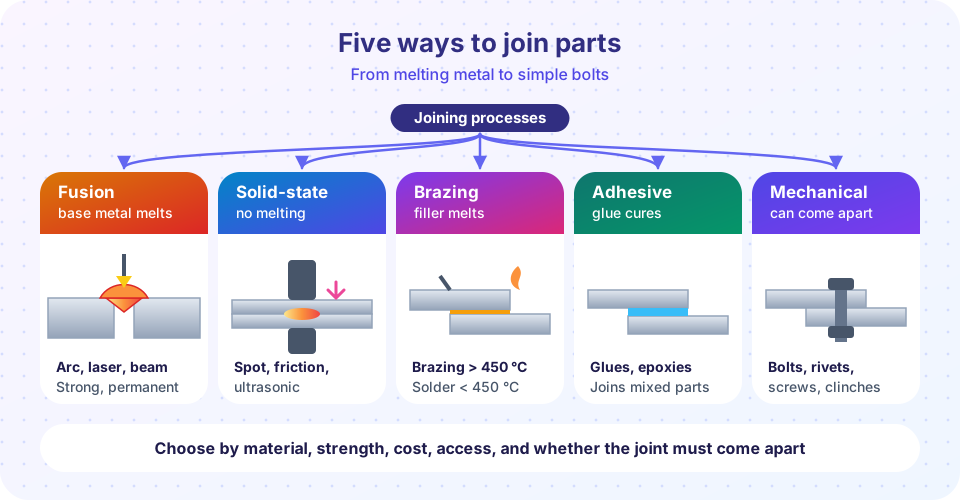
Fusion welding melts the base metal. A heat source (an electric arc, a laser, a flame) creates a small pool of liquid metal that freezes into a continuous solid. The joint can be as strong as the parent metal, but the heat also changes the metal near the joint, which is why metallurgy matters (see weld metallurgy and defects).
Solid-state welding never melts the bulk. In resistance spot welding a pulse of current heats the interface until a small nugget forms. In friction stir welding a rotating tool stirs two aluminum plates together in a plastic state. These methods avoid many melting-related defects, such as porosity from dissolved gas.
Brazing and soldering use a filler that melts while the parts stay solid. The molten filler is drawn into narrow gaps by capillary action, in the same way a paper towel draws up water. The base metal does not get hot enough to change its structure much, so these processes suit thin, delicate or dissimilar parts. Details are in spot welding, brazing, adhesives and fasteners.
Adhesive bonding spreads a load over a whole area, so there are no stress spikes at holes. It joins unlike materials, such as aluminum to carbon fiber, and seals at the same time. Its weaknesses are limited temperature range, sensitivity to surface preparation, and low strength in peeling.
Mechanical fastening uses bolts, screws, rivets, clips or clinching. These joints can be disassembled for repair, and they do not depend on heat. They need holes, which concentrate stress, and the fasteners add weight and cost.
How a joint holds
Questions to ask
Quality starts early
Comparing the families
| Family | Typical strength | Heat on parts | Dissimilar materials | Can be disassembled |
|---|---|---|---|---|
| Fusion welding | Up to parent metal | High, local | Difficult | No |
| Solid-state welding | High | Medium | Limited | No |
| Brazing, soldering | Good (solder is lower) | Medium to low | Good | No (re-heat) |
| Adhesive | Good in shear | None | Excellent | Hardly |
| Mechanical | Depends on fastener | None | Excellent | Yes |
Common misconceptions
"A weld is always stronger than the metal around it." A good weld can match the base metal, but the heat-affected zone beside it may be weaker or more brittle. Designers use a joint efficiency below 100 percent unless the weld is proven.
"Soldering and brazing are the same." They use the same principle but differ in temperature (about 450 °C is the usual dividing line) and in strength. Solder joints are weak compared with brazed ones.
"Adhesives are only for light jobs." Structural adhesives carry aircraft and car body loads. They need the right joint design: loads in shear, not peel.
Try it
First, a small helper that suggests a joining family from a few answers. It is a demonstration of the reasoning, not a design tool.
Second, a quick estimate of how long a glued overlap must be. It assumes the shear stress is spread evenly, which real joints do not do perfectly (stress is higher at the ends), so treat the answer as a first estimate.
Press Run (or Ctrl + Enter) to see the result here.
Program input · what you'd type while the program runs
Type the answers before you press Run, one per line. Each time the program reads a line (with input()), it gets the next line from this box.
What each lesson covers
- Joining and welding at a glance (this lesson).
- Arc welding: the arc, the processes (stick, MIG, TIG, submerged arc), heat input and fillet weld strength.
- Weld metallurgy and defects: the heat-affected zone, cooling rate, carbon equivalent, preheat, residual stress and defects.
- Spot welding, brazing, adhesives and fasteners: the other ways to hold parts together.
- Chapter review.
Check your understanding
Quick check · 4 questions
of 4 answered You scored / 4 · perfect!
-
1. Which family melts only a filler and not the base metals?
In brazing and soldering the filler melts and flows into the gap by capillary action while the base metals stay solid. -
2. What is the usual temperature dividing line between brazing and soldering?
By convention, filler metals that melt above about 450 °C are brazing alloys, and those that melt below are solders. -
3. Which joint would you choose for a panel that must be removed for servicing?
Bolts and screws can be undone without damaging the parts. Welded and brazed joints are permanent. -
4. Why are adhesives well suited to joining aluminum to carbon fiber composite?
Adhesives spread the load over an area, avoid heat damage and holes, and can join materials that cannot be welded to each other. Surface preparation is still essential.
Summary
- Joining falls into five families: fusion welding, solid-state welding, brazing and soldering, adhesives, and mechanical fasteners.
- Fusion welds can match the parent metal but change the metal near them; brazing and adhesives spare the base metal; fasteners allow disassembly.
- Ask first: must it come apart, which materials, how much heat can the parts take, and how many will you make?
Next: Arc welding
Track your progress
Create a free account to tick off lessons and pick up where you left off on any device.
of Manufacturing Processes lessons completed