


















Lesson 26 of 49 · Machining
Tool materials, tool life and CNC
Cutting tool materials and coatings, how tools wear, Taylor's tool life equation, the speed that minimizes cost, and the basics of CNC programming with G-code.
A cutting edge works under harsh conditions: contact pressure of more than a gigapascal, chips sliding over it at tens of meters per minute, and temperatures that can pass 800 °C at the contact. No tool survives forever. Every tool wears, and the engineer's job is to pick a speed where it wears at a rate that makes economic sense. This lesson covers what tools are made of, how they wear, the classic equation that predicts their life, and how a CNC machine turns your decisions into motion.
What you will learn
- The main tool materials (HSS, carbide, ceramic, CBN, diamond) and what each is good for.
- How coatings and cutting fluids extend tool life.
- The wear types and the flank wear criterion.
- How to fit and use Taylor's equation
V × Tⁿ = C. - How to find the cutting speed that minimizes cost per part.
- How a G-code program describes tool motion.
Key terms
Hot hardness: the ability of a tool material to stay hard at cutting temperatures.
Flank wear (VB): the width of the worn land under the cutting edge on the flank face.
Tool life (T): cutting time until a wear limit (for example VB = 0.3 mm) is reached.
Taylor exponent (n): how steeply life falls as speed rises; larger n means a more forgiving tool.
G-code: the standard programming language of CNC machines; each line commands a move or a machine function.
Tool materials
The right tool material balances hardness (resists wear) against toughness (resists chipping). Hard materials tend to be brittle.
- High-speed steel (HSS) has a hardness of roughly 62 to 67 HRC, is tough, and can be ground to sharp, complex shapes. It is used for drills, taps and cutters, and for jobs with interruptions or low-rigidity machines. It softens at about 600 °C, so it runs at low speeds.
- Cemented carbide (tungsten carbide grains in a cobalt binder) keeps its hardness much hotter and runs at several times the speed of HSS. It is by far the most common material for inserts. More cobalt means tougher but softer.
- Coatings (a few micrometers thick) are applied by PVD or CVD on carbide. Titanium nitride (TiN, gold colored) cuts friction; titanium aluminum nitride (TiAlN) forms a protective aluminum oxide skin at high temperature; aluminum oxide (Al₂O₃) is a thermal barrier for fast cutting of steel.
- Ceramics (alumina or silicon nitride) have excellent hot hardness for cast iron and superalloys, but are brittle.
- Cubic boron nitride (CBN) is nearly as hard as diamond and is stable in contact with iron, so it machines hardened steels (above about 50 HRC) and cast irons.
- Polycrystalline diamond (PCD) is the best tool for aluminum, copper and composites, but it reacts with iron at high temperature, so it is not used on steel.
Cutting fluids do three jobs: they cool (water-based fluids), lubricate (oil-based), and flush chips away. Minimum quantity lubrication (MQL) uses a mist of a few milliliters per hour and is popular where cleanliness and cost matter.
How tools wear
The common wear patterns:
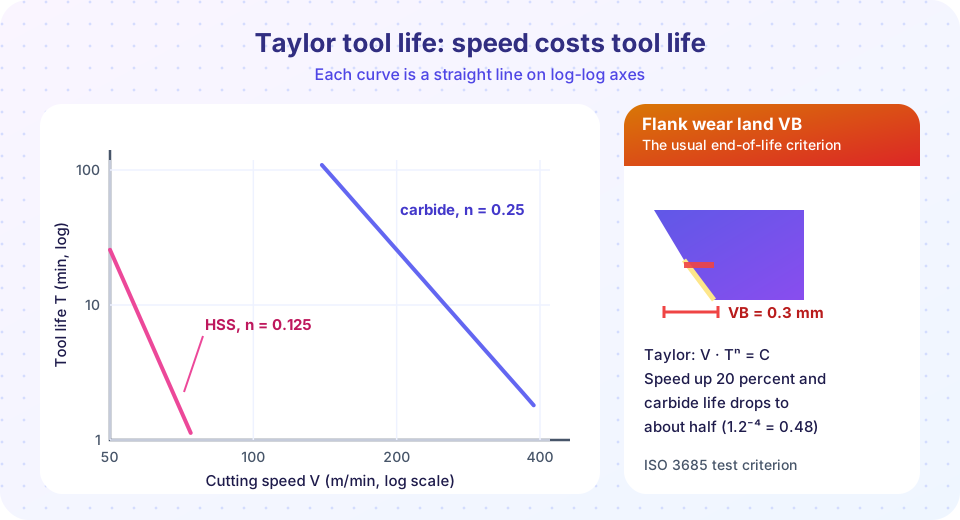
- Flank wear is a flat band on the flank face caused by abrasion against the new surface. It is regular and predictable, so it is the standard measure. Under ISO 3685, a typical end-of-life criterion for carbide is an average flank wear
VB = 0.3 mm. - Crater wear is a hollow on the rake face where the chip slides. It is driven by temperature (diffusion between chip and tool) and shows up in steel cutting at high speed.
- Built-up edge and chipping appear at low speed or in interrupted cuts.
- Thermal cracking appears in milling, where the edge heats and cools in every revolution.
The worn tool shows itself in the part: dimensions drift (the tool is physically shorter), the surface gets rougher, forces and power rise, and chips turn blue from heat.
Taylor's tool life equation
In 1907 Frederick W. Taylor published tool-life tests that gave one of the most used equations in manufacturing:
V × Tⁿ = C
V is cutting speed (m/min), T is tool life (min), and n and C are constants for a given tool, workpiece and condition. Typical n values: roughly 0.1 to 0.15 for HSS, 0.2 to 0.25 for carbide, 0.4 to 0.6 for ceramics. Plotted on log-log axes, the equation is a straight line, as in the chart above.
Worked example: find n and C from two tests
Two tests with a carbide insert: at V₁ = 150 m/min the tool lasted T₁ = 45 min, and at V₂ = 200 m/min it lasted T₂ = 15 min.
n = ln(V₂/V₁) / ln(T₁/T₂) = ln(1.333) / ln(3) = 0.288 / 1.099 = 0.262
C = V₁ × T₁ⁿ = 150 × 45^0.262 ≈ 406
Predict the life at V = 170 m/min: T = (C / V)^(1/n) = (406 / 170)^(3.82), about 28 minutes (the code below computes it exactly).
What the exponent says. With n = 0.25, raising the speed by 20 percent multiplies the life by 1.2^(−4) = 0.48, i.e. life is halved. A 20 percent gain in speed saves about 17 percent of the machining time but doubles the number of tool changes. Whether that pays depends on the cost of changing a tool, which is the next topic.
The simple equation ignores feed and depth. Extended forms add them: V Tⁿ fᵃ dᵇ = C, with a and b smaller than n, which shows that speed hurts life most, then feed, then depth.
The economic cutting speed
Cost per part has three pieces: machining cost (the time the machine is cutting), tool-change cost, and tool cost. Let Cm be the machine plus operator cost rate ($/min), tc the time to change a tool (min) and Ct the cost of one cutting edge ($):
Minimum cost tool life:      T_opt = (1/n − 1) × (tc + Ct / Cm)
Maximum production rate:     T_max = (1/n − 1) × tc
Worked example
With n = 0.25, tc = 2 min, Ct = $4 and Cm = $1.20/min:
T_opt = 3 × (2 + 4 / 1.2) = 3 × 5.33 = 16 min.T_max = 3 × 2 = 6 min.
So the cheapest speed gives a tool life of 16 minutes, not "as long as possible" and not "as short as possible". Running at the faster T_max speed gives a few more parts per hour but at a higher cost per part. The cost curve is also fairly flat around the minimum, which is good news: a speed 10 percent away from the optimum costs only a little.
CNC programming in brief
A CNC (computer numerical control) machine moves its axes by commands. Each axis has a servo motor and a position sensor, and a controller compares them hundreds of times per second. A program is a list of lines called blocks. Here is a short program that traces a rectangle, then drills a hole:
G21 G90 G54            ; metric, absolute coordinates, work offset 1
T01 M06                ; load tool 1
S3000 M03              ; spindle on clockwise at 3000 rpm
G00 X0 Y0 Z5           ; rapid to start, 5 mm above the work
G01 Z-2 F150           ; feed down 2 mm
G01 X60 F300           ; cut along X
G01 Y40
G01 X0
G01 Y0
G00 Z5                 ; rapid up
M05                    ; spindle stop
M30                    ; end of program
The main words:
| Code | Meaning |
|---|---|
| G00 | Rapid move (as fast as possible, not for cutting) |
| G01 | Linear move at the feed rate F |
| G02 / G03 | Clockwise / counterclockwise arc (center given by I, J) |
| G90 / G91 | Absolute / incremental coordinates |
| G54 | Work coordinate system (zero at the part, not the machine) |
| G43 H | Apply tool length offset |
| G41 / G42 | Cutter radius compensation left / right |
| M03 / M05 | Spindle on / off |
| M06 | Tool change |
| S, F, T | Spindle speed, feed, tool number |
Offsets are how CNC fixes real-world differences. The work offset tells the machine where the part is, the tool length offset compensates for the tool's length, and wear offsets let the operator nudge a dimension by a few hundredths of a millimeter as the tool wears.
Common misconceptions
"Harder tool material is always better." Hard materials are brittle. In an interrupted cut (milling a block with holes) a tougher tool can outlast a harder one.
"Longer tool life is always cheaper." A very long life means a slow speed, which costs machine time. The economic life is a compromise, typically tens of minutes for carbide.
"Taylor's equation is exact." It is an empirical fit that works over a limited speed range. Outside that range, or with a new tool grade, you must test again.
Try it
Fit Taylor's equation to the two tests, then compute the cost per part against speed to see the minimum.
Press Run (or Ctrl + Enter) to see the result here.
Program input · what you'd type while the program runs
Type the answers before you press Run, one per line. Each time the program reads a line (with input()), it gets the next line from this box.
Now read some G-code. This demonstration parses a few commands (G00, G01, G02, G03, G90, G91, F), draws the tool path and estimates the cutting time. It is a teaching sketch, not a real controller.
Check your understanding
Quick check · 5 questions
of 5 answered You scored / 5 · perfect!
-
1. Which tool material is normally chosen for machining hardened steel (above about 50 HRC)?
CBN is extremely hard and stable in contact with iron. Diamond reacts with iron at high temperature and HSS is far too soft. -
2. For n = 0.25, cutting speed is raised by 20 percent. What happens to tool life?
T scales as V^(-1/n). With n = 0.25 the factor is 1.2^(-4) = 0.48, so life is about halved. -
3. A tool lasts 60 min at 100 m/min and 20 min at 140 m/min. What is the exponent n?
n = ln(140/100) / ln(60/20) = 0.336 / 1.099 = 0.306, about 0.31. -
4. What does G01 do?
G00 is a rapid move, G01 is a linear interpolation at feed rate F, and G02 is a clockwise arc. -
5. Why is the economically best tool life not the longest possible?
Long tool life requires slow cutting, and machine time costs money. Total cost per part is lowest at an intermediate speed where tool and time costs balance.
Summary
- HSS is tough and cheap, carbide is the production workhorse, ceramics and CBN cut hard materials and PCD cuts non-ferrous materials; coatings and fluids extend life.
- Flank wear VB = 0.3 mm is the usual end-of-life measure.
- Taylor's equation
V Tⁿ = Clinks speed and tool life; a 20 percent speed increase can halve life when n is 0.25. - The cheapest speed corresponds to a tool life of
(1/n − 1)(tc + Ct/Cm). - G-code blocks (G00, G01, G02/G03, M03, M06, F, S, T) plus work and tool offsets drive CNC machines.
Track your progress
Create a free account to tick off lessons and pick up where you left off on any device.
of Manufacturing Processes lessons completed