


















Lesson 3 of 49 · Getting Started
Production Volume and Process Choice
See how quantity, shape, material and tolerance drive process choice, and use a break-even calculation to find where one process overtakes another.
Suppose you must make a small aluminum bracket. You could machine it from a block, cast it in sand, or cast it in a steel die. All three can produce a good part. So which one do you choose? The honest answer starts with a question: how many do you need? Quantity is the single most powerful input to process choice, because it decides how much expensive tooling you can afford to buy. In this lesson you will learn to describe production volume, list the other factors that matter, and find the exact quantity at which one process becomes cheaper than another.
What you will learn
- Classify production as one-off, batch, mass or continuous, and relate each to a factory layout.
- List the main factors in process selection besides quantity.
- Write the cost-per-part equation and compute break-even quantities.
- Read a crossover chart to pick the cheapest process for a given volume.
Key terms
Fixed cost: a cost paid once no matter how many parts are made, such as tooling, programming and fixtures.
Variable cost: the cost that grows with each part, such as material, labor, energy and machine time.
Break-even quantity: the number of parts at which two processes cost the same.
Batch: a group of identical parts made in one production run.
Cycle time: the time to complete one part at a station.
Volume classes and layouts
Production volume is conventionally grouped into broad classes. The boundaries vary by industry and country, so treat the numbers below as orders of magnitude, not rules.
| Class | Typical annual quantity | Typical factory layout | Example |
|---|---|---|---|
| One-off or prototype | 1 to 10 | Fixed position or general workshop | A custom machine, a ship |
| Low volume (job shop) | 10 to 1,000 | Process layout (machines grouped by type) | Aerospace brackets |
| Batch or medium volume | 1,000 to 100,000 | Cells or batch lines | Industrial valves |
| Mass production | 100,000 and more | Dedicated flow lines | Car body panels, bottle caps |
| Continuous | Flows without stopping | Process plant | Steel sheet, paper, fuel |
There is a trade-off hiding in that table. General machines, such as a milling machine, are flexible: change the program and the fixture and you can make something else. Dedicated machines, such as a die-casting cell producing one housing, are fast but make only that part. Flexibility costs rate, and rate costs flexibility. Modern factories try to narrow the gap with CNC machines, quick-change tooling and robot cells.
The cost-per-part equation
The core of process economics is a short equation. If a process has a fixed cost F and a variable cost per part v, then the cost per part when you make N parts is:
C(N) = F / N + v
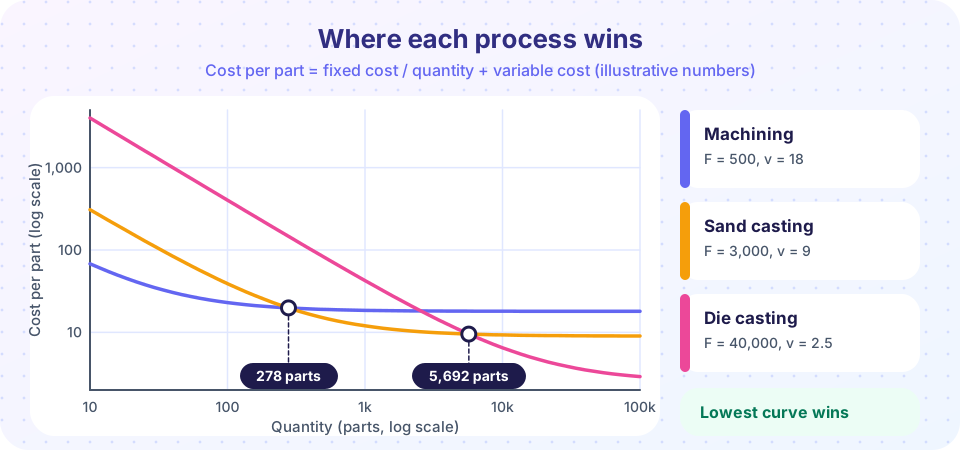
Plot it and you get a curve that falls steeply at first, because the fixed cost is spread over few parts, and then flattens toward v. A process with high F and low v starts out expensive but ends up cheapest. A process with low F and high v does the reverse.
Worked example
Three processes can make the same bracket. The costs below are illustrative classroom numbers.
| Process | Fixed cost F | Variable cost v |
|---|---|---|
| Machining from stock | 500 | 18.00 |
| Sand casting and light machining | 3,000 | 9.00 |
| Die casting | 40,000 | 2.50 |
At what quantity does sand casting beat machining? Set the two costs equal:
500 + 18 N = 3000 + 9 N, so 9 N = 2500 and N = 277.8.
Sand casting wins from about 278 parts upward. Now compare die casting with sand casting:
3000 + 9 N = 40000 + 2.5 N, so 6.5 N = 37000 and N = 5692.
Die casting wins above about 5,700 parts. Notice that comparing machining and die casting directly gives N = 39500 / 15.5 = 2548, but sand casting is cheaper than both in that range, so that crossover never matters. The rule is simple: the best choice at each quantity is the lowest curve, which engineers call the lower envelope.
More than quantity
Quantity is first, but it is not alone. A process selection checklist also asks:
- Shape complexity. Internal cavities and thin curved walls favor casting or molding. Flat parts with holes favor stamping. Prismatic parts with crisp faces favor machining.
- Size. A ship propeller is cast; a watch gear is stamped or machined. Machine size sets an upper limit on part size.
- Material. Not every process works with every material. Titanium is awkward to cast and hard to machine; thermoplastics are ideal for injection molding but cannot be forged.
- Tolerance and surface finish. Sand casting typically holds only a millimeter or so, while grinding can hold micrometers. If the tolerance is tight, add a finishing operation or choose a precise process.
- Properties. Forged parts have a grain structure that follows the shape and resists fatigue. Cast parts can contain tiny pores. Additively built parts may have directional strength.
- Lead time. Making a die can take weeks or months. If the customer needs the part next week, tooling-free processes win.
- Sustainability and waste. Machining from billet can turn most of the material into chips. Forming and casting waste far less.
Experienced engineers treat this list as a funnel. First they discard processes that cannot make the part at all. Then they discard those with the wrong volume economics. Then they compare the remaining candidates on cost, quality and risk.
Where the curves bend: product life and risk
Break-even calculations assume you will actually sell the volume you planned. Tooling is a bet. If a product sells 3,000 units instead of 30,000, a die-cast housing may have been the wrong choice. Companies often start with low-tooling processes for the first few hundred units, learn from customers, then invest in hard tooling once volume is proven. This is called bridge tooling or a staged ramp-up. It costs more per part early and saves money when forecasts miss.
A decision story
Imagine a start-up that designs a handheld sensor housing. In the first month it needs twenty units for testers, so it prints them in plastic: no tooling, a week to deliver. For the first customer order of three hundred units it switches to machined aluminum, because the program and fixtures cost little and the parts look professional. When orders reach five thousand a year, the quoted price of a machined part is painful, and a sand or investment casting with machined faces saves money. At fifty thousand a year, the company commissions a die-cast housing and a plastic injection-molded lid, accepting a large one-time tooling bill because the cost per part drops by an order of magnitude.
At every step the product barely changed, yet the process changed completely. That is the lesson of the cost equation: process choice is a property of the quantity, not only of the part. Engineers who understand this plan tooling in stages and ask for quotes at several quantities instead of one.
Common misconceptions
"Automation is always cheaper." Automation adds fixed cost. At low volume, a skilled operator and a general machine usually beat a custom robot cell.
"Casting is cheaper than machining." Only above a certain quantity. For a handful of parts, the pattern or die costs more than machining the parts directly.
"Break-even is a fixed property of a part." It also depends on labor rates, material price and machine availability, so it shifts over time and between countries.
Try it
This widget finds the cheapest of the three processes for a quantity you choose with the slider. The cost numbers are the illustrative ones from the worked example.
The second example plots the three cost curves on a log axis and finds the break-even points numerically, so you can change the costs and see the envelope move.
Press Run (or Ctrl + Enter) to see the result here.
Program input · what you'd type while the program runs
Type the answers before you press Run, one per line. Each time the program reads a line (with input()), it gets the next line from this box.
Check your understanding
Quick check · 5 questions
of 5 answered You scored / 5 · perfect!
-
1. A process has fixed cost 2,000 and variable cost 5 per part. What is the cost per part at 400 parts?
2000 / 400 = 5, plus 5 variable gives 10 per part. -
2. Process A: F = 1,000, v = 10. Process B: F = 5,000, v = 6. At what quantity do they cost the same?
1000 + 10N = 5000 + 6N gives 4N = 4000, so N = 1000. -
3. Which situation most favors a flexible general-purpose machine?
Low volume with variety needs flexibility, because dedicated tooling would never pay back. -
4. Why might a company use bridge tooling?
Bridge tooling reduces upfront risk: cheap tooling first, expensive hard tooling once volume is proven. -
5. On a cost-versus-quantity chart, which curve defines the best choice at each quantity?
At each quantity you pick the cheapest option, so the lowest curve is the envelope that matters.
Summary
- Production volume ranges from one-off through batch and mass to continuous, with layouts that match.
- Cost per part is
F / N + v; high-tooling processes win at high volume. - Break-even between two processes is
N = (F2 - F1) / (v1 - v2), and the lower envelope picks the winner. - Shape, size, material, tolerance, properties, lead time and waste also decide the choice.
- Tooling is a bet on future volume, so many firms stage their investment.
Track your progress
Create a free account to tick off lessons and pick up where you left off on any device.
of Manufacturing Processes lessons completed