


















Lesson 37 of 49 · Additive Manufacturing
Chapter review: additive manufacturing
Review additive manufacturing with a one-picture summary, a formula table, a staircase-effect explorer, a process-selection script and a ten-question mixed quiz.
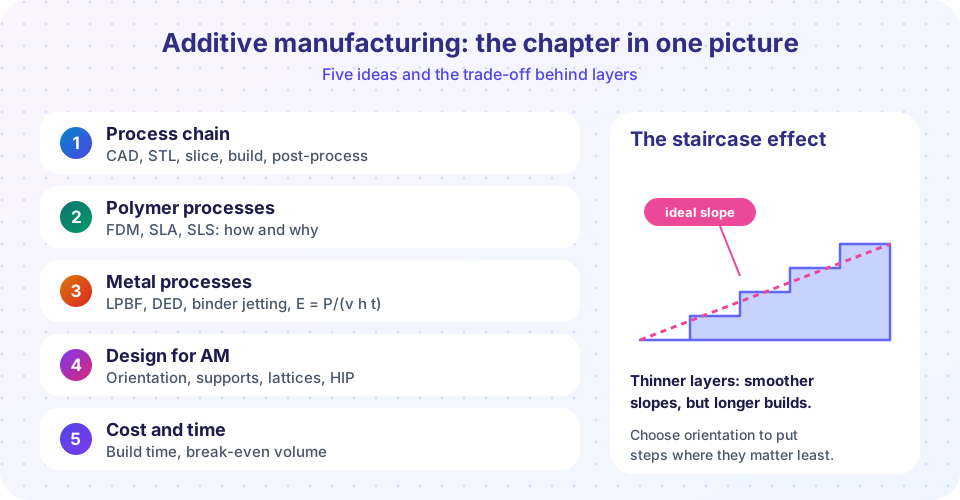
This chapter showed that additive manufacturing is not one technology but a family, linked by a single idea: build a part by adding thin layers. Every strength (no tooling, free geometry) and every weakness (slow builds, stair-stepped surfaces, anisotropy, post-processing) follows from that idea. Use this review to put the pieces together before the final chapters on quality and automation.
What you will learn
- How the chapter's formulas and rules of thumb connect.
- How the staircase effect links layer height to surface quality.
- How to match a part's needs to a process.
Key terms
Staircase effect: the stepped surface left on sloped faces because the part is built in discrete layers.
Cusp height: the greatest deviation between a stepped surface and the ideal sloped surface.
Near-net shape: a part that is close to final size and needs only finishing.
Recap table
| Topic | Key idea or formula | Remember |
|---|---|---|
| Process chain | CAD, STL, orient, slice, build, post-process | STL holds only the surface |
| Seven categories | Extrusion, vat photopolymerization, powder bed fusion, jetting, binder jetting, DED, sheet lamination | ISO/ASTM 52900 |
| FDM | Q = w h v; weak between layers |
Walls matter more than infill |
| SLA, DLP | Cd = Dp ln(E/Ec) |
Smooth, fine detail; needs washing and post-curing |
| SLS | Powder supports the part; nesting | Cost falls as the chamber fills |
| LPBF | E = P/(v h t); build rate v h t |
Window between lack of fusion and keyholes |
| Post-processing | Stress relief, supports, HIP, machining | Often costs as much as the build |
| DfAM | 45 degree rule, orientation, powder removal | Design for the process |
| Cost | Overhead shared by nesting; Q* = F / (c_AM − c) |
Low volume, custom and complex parts |
The staircase effect
A sloped surface printed in layers of thickness t looks like a staircase. The largest deviation from the ideal slope, measured perpendicular to the surface, is about:
cusp height ≈ t × cos θ
where θ is the angle of the surface from the horizontal. Nearly flat surfaces (θ close to 0) have the biggest deviation relative to the layer height, while vertical walls (θ = 90°) have none. Thinner layers reduce the cusp, but the build time grows in proportion to the number of layers, so layer height is a deliberate compromise. Designers often orient the part so that critical sloped faces are close to vertical, or plan to machine them.
Common misconceptions
"The finest layer height is always the best choice." Halving the layer height halves the cusp but doubles the build time, and the process may have a practical lower limit.
"If it can be drawn, it can be printed." Supports, minimum features, powder removal, residual stress and tolerances all limit what prints successfully.
Try it
Explore the staircase effect: change the surface angle and layer height and watch the steps and the cusp height.
Now a rough process selector. Score the processes against what your part needs. The weights and scores are teaching values, not a design tool.
Press Run (or Ctrl + Enter) to see the result here.
Program input · what you'd type while the program runs
Type the answers before you press Run, one per line. Each time the program reads a line (with input()), it gets the next line from this box.
Check your understanding
Quick check · 10 questions
of 10 answered You scored / 10 · perfect!
-
1. A surface at 30 degrees from the horizontal is printed with 0.2 mm layers. What is the approximate cusp height?
Cusp height ≈ t cos θ = 0.2 × cos 30° = 0.2 × 0.866 = 0.17 mm. -
2. Which process needs no support structures because the surrounding material holds the part?
In SLS the loose powder supports each layer, so overhangs need no printed supports. -
3. What is the build rate of an LPBF machine with v = 800 mm/s, h = 0.1 mm and t = 0.04 mm?
Build rate = v × h × t = 800 × 0.1 × 0.04 = 3.2 mm³/s. -
4. Why should critical overhangs generally be at least about 45 degrees from the horizontal?
At about 45 degrees or steeper each layer is adequately supported by the layer below, so no support is needed. -
5. What is the effect of halving the layer height on build time, other things equal?
Half the layer height needs twice as many layers, each with its overhead, so the build takes much longer. -
6. A mold costs $24,000 and parts cost $3. A printed part costs $51. What is the break-even quantity?
Q* = 24,000 / (51 − 3) = 500 parts. -
7. What is the purpose of HIP for a printed titanium part?
Hot isostatic pressing collapses internal pores, which improves fatigue performance. -
8. Which is NOT stored in an STL file?
An STL has only the surface mesh. The slicer adds layer height and tool path. -
9. Why does an FDM part break more easily across layers than along them?
Interlayer bonds form against partly cooled plastic and are weaker than the lines themselves. -
10. A designer needs 40 identical stainless parts on a plate with strict powder-bed economics. What is the best way to cut cost per part?
Nesting shares the per-layer overhead and setup across parts, which cuts cost per part. Thinner layers add more layers and more overhead.
Summary
- AM builds from layers; its strengths and weaknesses all follow from that fact.
- Pick FDM, SLA or SLS for polymers by surface, strength and supports; LPBF, DED, EBM or binder jetting for metals.
- Layer height trades surface quality against build time; the cusp height is about
t cos θ. - Metal AM needs stress relief, often HIP and machining; design to the 45 degree rule and for powder removal.
- Break-even against tooled processes is
Q* = F / (c_AM − c); nesting and customization shift the balance toward AM.
Track your progress
Create a free account to tick off lessons and pick up where you left off on any device.
of Manufacturing Processes lessons completed