


















Lesson 46 of 49 · Projects and Practice
Practice problems with worked answers
Fifteen practice problems on machining, welding, additive manufacturing, quality and lean, with hints, a runnable solution checker and a drill generator for speeds, heat input and takt time.
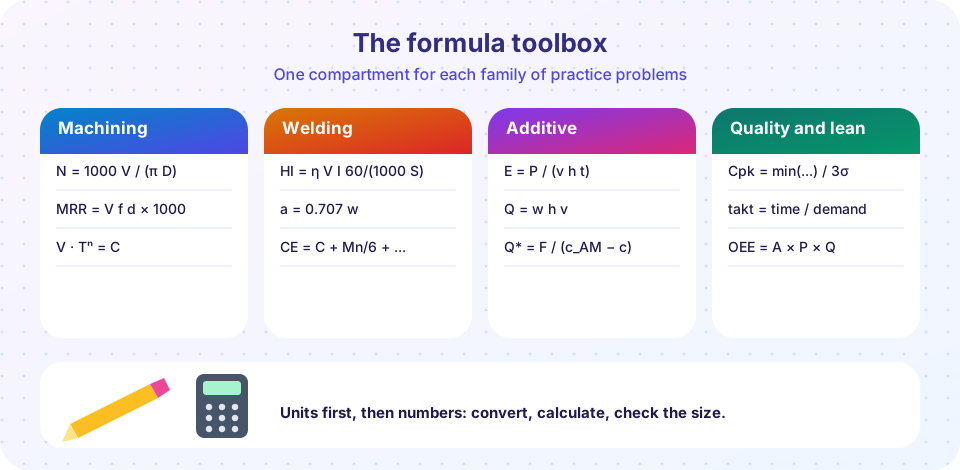
You learn manufacturing calculations by doing them. This lesson gives you fifteen problems that mirror the way engineers use the formulas in the second half of the course. Try each one on paper first. The hint tells you which formula to reach for, and the solution script in the "Try it" section computes every answer with the working shown, so you can check your result and your method.
What you will learn
- How to recognize which formula a problem needs.
- How to carry units through a calculation.
- How to check your answers for sense and with code.
Key terms
Unit check: confirming that the units on both sides of an equation agree; the quickest way to catch a mistake.
Order of magnitude: a rough size of the answer (is it tens or thousands?), used to detect gross errors.
Assumption: a number you choose when the problem does not give one; state it clearly.
How to work a problem
- Write the givens with units, and what is asked.
- Choose the formula and write it before substituting numbers.
- Convert units first (mm to m, minutes to seconds, kJ to J).
- Calculate, keeping one extra digit until the end.
- Check: units, size, and whether a limiting case makes sense (if the feed doubles, does the time halve?).
Machining (chapter 5)
Problem 1. A 60 mm diameter bar is turned at a cutting speed of 140 m/min. What spindle speed is needed?
Hint: N = 1000 V / (π D).
Problem 2. The cut then uses f = 0.30 mm/rev and d = 2.5 mm at the same V. Find the material removal rate in cm³/min, and the motor power if the specific cutting energy is 2.2 J/mm³ and the drive efficiency is 85 percent.
Hint: MRR = V f d × 1000 in mm³/min; convert to mm³/s; P = MRR × u; divide by efficiency.
Problem 3. Two tool-life tests: 50 min at 120 m/min and 10 min at 180 m/min. Find the Taylor exponent n and the constant C, and predict the life at 150 m/min.
Hint: n = ln(V₂/V₁) / ln(T₁/T₂), C = V₁ T₁ⁿ, T = (C/V)^(1/n).
Problem 4. A finishing pass uses f = 0.15 mm/rev with a nose radius of 0.4 mm. What is the ideal roughness Ra?
Hint: Ra ≈ f² / (32 r).
Joining and welding (chapter 6)
Problem 5. A TIG weld is made at 14 V and 150 A, travelling at 100 mm/min. With η = 0.6, find the heat input in kJ/mm.
Hint: HI = η V I 60 / (1000 S).
Problem 6. A fillet weld with 8 mm legs is 150 mm long. Using an allowable shear stress of 145 MPa on the throat, what load can it carry?
Hint: throat a = 0.707 w, capacity = a × τ × L.
Problem 7. A steel has C 0.25, Mn 1.20, Cr 0.20, Mo 0.10, Ni 0.30, Cu 0.10 (weight percent), V negligible. Compute the carbon equivalent and say whether preheat should be considered.
Hint: CE = C + Mn/6 + (Cr+Mo+V)/5 + (Ni+Cu)/15.
Problem 8. A spot weld passes 10 kA for 0.25 s through an effective resistance of 80 µΩ. How much heat is generated?
Hint: Q = I² R t; convert µΩ to Ω.
Additive manufacturing (chapter 7)
Problem 9. An LPBF machine runs with P = 250 W, v = 900 mm/s, h = 0.11 mm and t = 0.04 mm. Find the volumetric energy density and the build rate in cm³/h.
Hint: E = P / (v h t); build rate = v h t.
Problem 10. An injection mold costs $35,000 and makes parts for $3.20 each. A printed part costs $58. What is the break-even quantity?
Hint: Q* = F / (c_AM − c).
Problem 11. An FDM printer lays lines 0.5 mm wide and 0.25 mm high at 70 mm/s. How long does a part that needs 35 cm³ of plastic take, ignoring overhead?
Hint: Q = w h v; time = volume / Q.
Quality and lean (chapter 8)
Problem 12. A process has USL = 50.10 mm, LSL = 49.90 mm, mean 50.03 mm and σ = 0.025 mm. Find Cp and Cpk and explain the difference.
Hint: Cp = (USL−LSL)/6σ, Cpk = min(USL−μ, μ−LSL)/3σ.
Problem 13. Subgroups of n = 4 give x̿ = 12.000 mm and R̄ = 0.040 mm. Find the X-bar chart limits and the upper limit of the R chart (A2 = 0.729, D4 = 2.282).
Problem 14. A line has 7.5 hours of available time and customer demand of 600 units. What is the takt time, and how many units per shift can a 50 s bottleneck deliver?
Problem 15. A machine has availability 0.92, performance 0.88 and quality 0.99. What is the OEE?
Two problems worked in full
Problem 2, step by step. The givens are V = 140 m/min, f = 0.30 mm/rev, d = 2.5 mm, u = 2.2 J/mm³ and η = 0.85. The formula MRR = V f d × 1000 has V in m/min and f, d in mm, and the factor 1000 converts the meters to millimeters: 140 × 0.30 × 2.5 × 1000 = 105,000 mm³/min, which is 105 cm³/min. Power needs a per-second rate: 105,000 / 60 = 1,750 mm³/s. Energy per volume times volume per second is power: 1,750 × 2.2 = 3,850 W = 3.85 kW at the cutting edge. The motor must supply more because of losses: 3.85 / 0.85 = 4.53 kW. Check the units: J/mm³ × mm³/s = J/s = W. Check the size: a 4.5 kW motor is a typical rating for a medium lathe, so the answer is plausible. If your answer had been 4.5 W or 4.5 MW, the check would have caught an error in unit conversion.
Problem 12, step by step. The tolerance band is USL − LSL = 0.20 mm. The process spread is 6σ = 0.15 mm, so Cp = 0.20 / 0.15 = 1.33: if the process were centered, it would fit comfortably. But the mean is 50.03, not 50.00, so the distance from the mean to the nearer limit is USL − μ = 0.07 mm, while the distance to the other is μ − LSL = 0.13 mm. Cpk = 0.07 / (3 × 0.025) = 0.93, below 1. The difference between Cp and Cpk is a diagnosis: the spread is fine but the setting is off by 0.03 mm toward the upper limit. Re-centering (adjusting a tool offset by about 0.03 mm) would raise Cpk to 1.33 without any change to the process spread. Compare this with the "do not tamper" rule: a consistent offset found over many parts justifies an adjustment, but a single high part does not.
Strategies for exam-style questions
- Look for the hidden unit conversion. Hours to seconds, kilowatts to watts, micrometers to millimeters, and per-minute to per-second are where most marks are lost.
- Use ratios when you can. If a question changes one variable, you often do not need the whole formula: heat input scales as 1/S, Taylor tool life as V^(−1/n), ideal roughness as f², and Cpk as 1/σ.
- Say which assumption you made. If the problem leaves out the efficiency, the specific cutting energy or the machine rate, write the value you chose and why.
- Estimate first. A quick mental estimate of the answer's size, such as "around a thousand rpm" or "under a kilojoule per millimeter", protects you against slips.
Common misconceptions
"If the numbers fit the formula, the answer is right." Mixing units (mm with m, minutes with seconds) is the most common error. Always check units.
"A more precise answer is a better answer." Inputs are usually known to two or three significant figures; reporting six digits only suggests accuracy you do not have.
"One method always works." Real problems have missing data. State your assumptions, and test how sensitive the answer is to them.
Try it
Run the solution checker. It prints a line for each problem so you can compare with your work.
Press Run (or Ctrl + Enter) to see the result here.
Program input · what you'd type while the program runs
Type the answers before you press Run, one per line. Each time the program reads a line (with input()), it gets the next line from this box.
For endless practice, use the drill generator. It makes up random numbers for three types of problems.
Check your understanding
Quick check · 5 questions
of 5 answered You scored / 5 · perfect!
-
1. A turning operation uses V = 200 m/min on a 50 mm bar. What spindle speed is closest?
N = 1000 × 200 / (π × 50) = 1,273 rpm. -
2. A weld has HI = 0.8 kJ/mm and the travel speed is doubled with voltage and current unchanged. What is the new heat input?
Heat input is inversely proportional to travel speed, so doubling the speed halves it. -
3. The takt time is 40 s. The line has stations of 35 s, 42 s and 38 s. How many units per 8-hour shift (28,800 s) can the line make?
The bottleneck (42 s) limits output: 28,800 / 42 = 685.7, so 685 complete units. -
4. A process with Cp = 1.8 and Cpk = 0.6 should be improved first by:
The large gap between Cp and Cpk shows the mean is off-center; re-centering costs little and raises Cpk toward Cp. -
5. A mold costs $18,000 and saves $6 per part against the alternative. What is the break-even quantity?
Q* = 18,000 / 6 = 3,000 parts.
Summary
- Choose the formula first, convert units, calculate, then check the answer for sense.
- The same few formulas (speed, removal rate, Taylor, heat input, energy density, break-even, Cp/Cpk, takt, OEE) cover most routine questions.
- State your assumptions, and test how sensitive your answer is to them.
Track your progress
Create a free account to tick off lessons and pick up where you left off on any device.
of Manufacturing Processes lessons completed