


















Lesson 32 of 49 · Joining and Welding
Chapter review: joining and welding
Review the joining chapter with a one-picture summary, a formula recap, a runnable weld-procedure screening script, flashcards and a ten-question mixed quiz.
This chapter followed the heat of a joint from the arc to the microstructure, then moved to joints that avoid melting the base metal altogether. Use this review to check that the main ideas fit together: where the heat goes, what it does to the metal, and when you should not use heat at all.
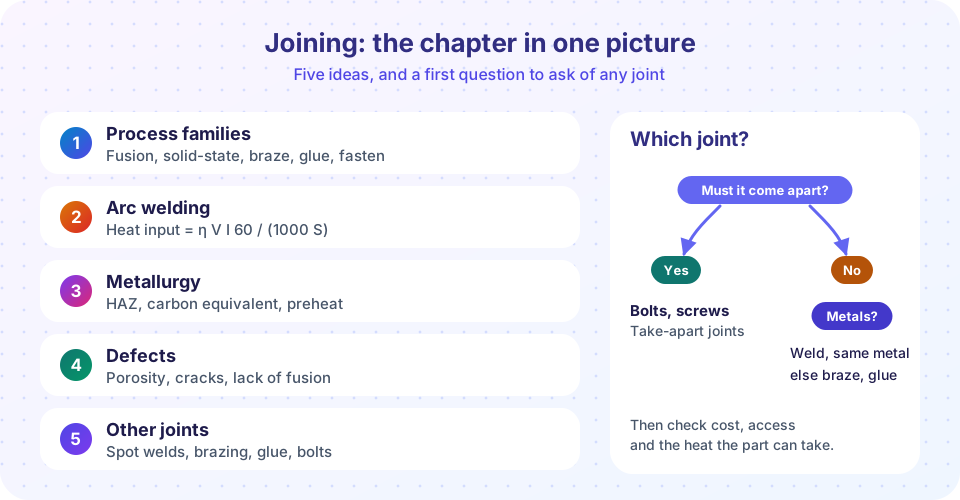
What you will learn
- How the heat input, cooling rate and carbon equivalent work together to decide whether a weld needs special care.
- Which formulas to use for each joint type.
- How to screen a weld procedure quickly.
Key terms
Weld procedure: a written recipe (process, filler, current, voltage, speed, preheat) that has been qualified by test.
Interpass temperature: the temperature of the weld area when the next pass is started.
Joint efficiency: the strength of a joint as a fraction of the strength of the plain parent metal.
Recap table
| Topic | Key idea or formula | Why it matters |
|---|---|---|
| Families | Fusion, solid-state, braze/solder, adhesive, mechanical | The choice starts with materials, heat limits and whether the joint must come apart |
| Heat input | HI = η V I 60 / (1000 S) kJ/mm |
Sets cooling rate and HAZ width |
| Deposition | (π/4) d² × WFS |
Estimates weld time |
| Fillet weld | Throat a = 0.707 w, capacity a τ L |
Sizing welds |
| Cooling rate | R = 2π k (Tc − T0)² / H |
Preheat slows cooling |
| Carbon equivalent | C + Mn/6 + (Cr+Mo+V)/5 + (Ni+Cu)/15 |
Predicts hardenability and cracking risk |
| Hydrogen cracking | Hydrogen + hard structure + stress | Remove any one |
| Spot welding | Q = I² R t |
Current, time and force |
| Brazing | h = 2γ cos θ / (ρ g w) |
Narrow gaps pull filler in |
| Bolts | T = K d F |
Torque gives only approximate preload |
Screening a weld procedure
A quick screen asks three questions: how hardenable is the steel (CE), how fast will it cool (heat input and thickness), and is there a source of hydrogen? If the carbon equivalent is high and heat input is low, preheat and low-hydrogen consumables are necessary. If the material is thick, the cooling rate is even faster. This sort of screen does not replace a code, but it tells you early which welds will need extra care.
Three questions before any weld
Before you strike an arc, ask three questions, in this order. First: what is the steel? Look up the composition and compute the carbon equivalent, because it tells you whether the heat-affected zone can harden. Second: how fast will it cool? The heat input, the plate thickness and the preheat temperature decide that, and you can estimate the effect with the cooling-rate model. Third: where could hydrogen come from? Check that electrodes are dry, the joint is clean and the shielding gas is correct. If any answer is uncomfortable, change the procedure before you weld, not after you find the crack. Experienced welding engineers often say that most weld failures were decided long before the welder started.
Common misconceptions
"A qualified welder produces any weld to code." A weld needs a qualified procedure and a qualified welder. Neither alone is enough.
"More heat is always safer." Excess heat softens and distorts. The target is a controlled cooling rate between the two extremes.
Try it
The script below screens three example welds for cracking risk with a rough rule: carbon equivalent, cooling rate and hydrogen level. The thresholds are teaching values, not code limits.
Press Run (or Ctrl + Enter) to see the result here.
Program input · what you'd type while the program runs
Type the answers before you press Run, one per line. Each time the program reads a line (with input()), it gets the next line from this box.
Last, flip some flashcards. Click a card to see the answer.
Check your understanding
Quick check · 10 questions
of 10 answered You scored / 10 · perfect!
-
1. Which pair of joining methods does NOT melt the base metals?
Brazing melts only the filler and adhesives use a polymer, so the base metals stay solid. The other pairs are all arc welding processes that melt the base metal. -
2. A TIG weld has V = 12 V, I = 120 A, S = 120 mm/min, η = 0.6. What is the heat input?
HI = 0.6 × 12 × 120 × 60 / (1000 × 120) = 51,840 / 120,000 = 0.432 kJ/mm. -
3. What is the main effect of preheating a thick steel plate?
A warm plate cools more slowly, which gives softer microstructures and lets hydrogen diffuse away. -
4. A fillet weld has legs of 10 mm. What is its throat?
Throat = 0.707 × leg = 7.07 mm. -
5. Which defect is most likely when moisture is present on the joint surface in MAG welding?
Moisture supplies hydrogen and oxygen that form gas pores in the freezing weld metal. -
6. Which inspection method is best for internal flat defects such as lack of fusion?
Ultrasound reflects from internal flat defects. Dye penetrant and visual testing show surface-breaking defects only. -
7. What does the carbon equivalent predict?
CE combines the effect of alloying elements on hardenability, to estimate the risk of hard, brittle zones and cold cracking. -
8. Why does a narrow gap suit brazing?
Capillary rise varies as 1/gap. Narrow gaps pull the filler in strongly and fill the joint. -
9. A bolt with a 30 kN preload, d = 10 mm and K = 0.2 needs what torque?
T = 0.2 × 0.010 × 30,000 = 60 N·m. -
10. Which first question best narrows the choice of a joining method?
Whether the joint must be disassembled and the materials (and their heat sensitivity) rule out most options immediately.
Summary
- Choose a joining family from materials, heat limits and whether the joint must come apart.
- Arc welding heat input, preheat and carbon equivalent together decide the HAZ structure and the cracking risk.
- Spot welds, brazes, adhesives and bolts each carry load differently and have their own rules (current and time, narrow gaps, shear loading, preload).
Track your progress
Create a free account to tick off lessons and pick up where you left off on any device.
of Manufacturing Processes lessons completed