


















Lesson 30 of 49 · Joining and Welding
Weld metallurgy, residual stress and defects
What the heat of welding does to steel: weld zones, cooling rate, carbon equivalent and preheat, hydrogen cracking, distortion, common weld defects and how they are inspected.
A weld is not just metal that has been glued together by melting. During a weld, a small volume goes from room temperature to above 1,500 °C and back to room temperature within seconds, and the metal around it is heated and cooled almost as fast. That heat treatment, done accidentally and without a furnace, can leave the weld region hard and brittle, soft and weak, or full of residual stress. This lesson explains what happens, how engineers predict it, and how the common defects arise and are found.
What you will learn
- The zones of a weld and why the heat-affected zone (HAZ) is often the weak link.
- How cooling rate controls the microstructure of steel.
- How to calculate carbon equivalent and decide whether preheat is needed.
- How hydrogen cracking happens and how to prevent it.
- The common weld defects, their causes and the tests that find them.
Key terms
Heat-affected zone (HAZ): base metal that did not melt but was heated enough to change its microstructure and properties.
Martensite: a very hard, brittle steel microstructure formed when austenite cools quickly.
Carbon equivalent (CE): a formula that combines the alloy content of a steel into one number that predicts how hardenable it is.
Preheat: warming the joint before welding to slow the cooling rate.
Residual stress: stress that remains in a part after welding even with no load, because the weld shrank as it cooled.
The zones of a weld
Looking across a weld of steel, from the center outward:
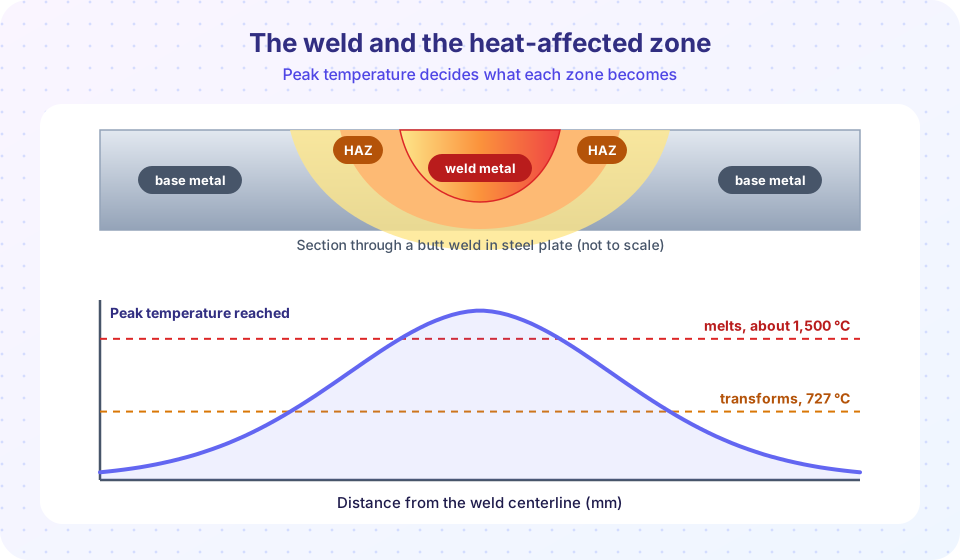
- Weld metal (fusion zone). It melted and froze. Its composition is a blend of filler and parent metal, and its grain structure is columnar (long grains growing inward from the edges, perpendicular to the cooling surface).
- The fusion boundary. The thin line where the base metal just melted.
- Coarse-grained HAZ. Heated to about 1,100 °C or more, close to the weld. The grains grow large, which can reduce toughness. This is often the most brittle region.
- Fine-grained HAZ. Heated to just above the transformation temperature, so it recrystallizes into small grains, which is a good thing.
- Intercritical and subcritical HAZ. Heated only partly through the transformation range (a mixture of old and new structure), or tempered. Cold-worked or heat-treated steels may be softened here.
- Base metal, not affected.
The chart in the figure above is the reason the zones occur: the peak temperature falls with distance from the heat source in a smooth curve. Where it crosses about 1,500 °C the steel melts; where it falls below about 727 °C (the lower critical temperature, where steel begins to change its structure) the HAZ ends.
Cooling rate decides the microstructure
Heated above the critical temperature, a carbon steel becomes austenite. How it changes on cooling depends on how fast:
- Slowly: soft ferrite and pearlite.
- Medium: bainite, tougher than martensite.
- Quickly: martensite, very hard and brittle, with hardness above 400 HV in steels with enough carbon.
Cooling rate depends on the heat input, the plate thickness and the starting temperature. For a thick plate, the cooling rate at about 550 °C can be estimated with a simplified model of a moving point heat source:
R = 2π k (Tc − T0)² / H (kelvin per second)
where k is the thermal conductivity (taken here as 0.028 W/(mm·K)), Tc is the temperature at which cooling rate is evaluated, T0 the start (preheat) temperature, and H the net heat input in J/mm.
Worked example 1: effect of preheat
With a net heat input of H = 770 J/mm (the MAG weld of the previous lesson) and Tc = 550 °C:
- No preheat (
T0 = 20 °C):R = 2π × 0.028 × 530² / 770 ≈ 64 K/s. - Preheat to 150 °C:
R = 2π × 0.028 × 400² / 770 ≈ 37 K/s.
A preheat of 150 °C has cut the cooling rate by about 40 percent. The model is a thick-plate approximation and gives only a first estimate; thin plates cool more slowly and welding codes use their own charts. But the lesson is general: preheat and higher heat input both slow cooling.
Carbon equivalent
How hard can a steel become? It depends mainly on carbon, then on the alloying elements, each of which makes martensite form more easily. The International Institute of Welding (IIW) formula weights them:
CE = C + Mn/6 + (Cr + Mo + V)/5 + (Ni + Cu)/15 (weight percent)
Worked example 2
A steel with C 0.20, Mn 1.0, Cr 0.10, Mo 0.05, V 0.02, Ni 0.10, Cu 0.20 percent:
CE = 0.20 + 0.167 + (0.17)/5 + (0.30)/15 = 0.20 + 0.167 + 0.034 + 0.020 = 0.42.
Rough guidance used in practice: below about 0.35 the steel welds easily; between about 0.35 and 0.5 it needs care and often preheat depending on thickness; above about 0.5 it needs preheat, low-hydrogen consumables and controlled cooling. The code or the steel supplier's data sheet is the authority; this is a screening number.
Hydrogen cracking
Cold cracking (hydrogen-induced cracking) appears hours or days after welding, so it is dangerous. It needs three things at once:
- Hydrogen in the weld, from moisture in electrodes, flux, shielding gas, rust or oil.
- A hard microstructure (martensite) in the HAZ or weld.
- Tensile stress from shrinkage or restraint.
Remove one, and it does not happen. The practical measures are low-hydrogen electrodes stored dry, clean joints, preheat (it slows cooling and lets hydrogen diffuse out), maintaining a minimum interpass temperature, and sometimes a post-weld hold at 200 to 300 °C for several hours.
Residual stress and distortion
The weld metal wants to shrink as it cools, but the cold plate around it resists. The weld region ends up in tension at about the yield strength, with compression further out. Consequences:
- Distortion: angular bending, bowing, shrinkage across and along the seam. Plate that is thin, or welded on one side, distorts the most.
- Premature failure: tensile residual stress adds to service loads and promotes fatigue and brittle fracture.
Controls include fewer and smaller welds, balanced welding on both sides, back-step sequences, clamps and fixtures, presetting the joint to spring back, and post-weld heat treatment (stress relief at roughly 600 °C for carbon steels), which reduces residual stress substantially.
Common defects
| Defect | What it is | Typical causes | Remedies |
|---|---|---|---|
| Porosity | Gas pores in the weld | Moisture, rust, oil, drafts, no shielding | Clean the joint, dry consumables, shield properly |
| Slag inclusion | Trapped slag | Poor cleaning between passes | Chip and brush each pass |
| Lack of fusion | Weld metal does not bond to parent metal | Low heat input, poor technique | Raise current, correct the angle |
| Incomplete penetration | Root not melted | Gap too small, current too low | Wider gap, higher current |
| Undercut | Groove melted in the parent metal beside the weld | Current or speed too high, wrong angle | Reduce current, adjust technique |
| Hot cracking | Crack during solidification | Impurities (sulfur), poor bead shape | Better filler and joint design |
| Cold (hydrogen) cracking | Delayed crack in the HAZ | Hydrogen, hard structure, stress | Low hydrogen, preheat, dry electrodes |
| Burn-through, spatter, distortion | Melted holes, droplets, warped parts | Excess heat, wrong settings | Reduce heat, adjust settings |
Finding defects
- Visual testing (VT) costs the least and catches surface defects: undercut, cracks, poor profile, spatter. Every weld gets it.
- Dye penetrant (PT) shows surface-breaking cracks on any material.
- Magnetic particle (MT) shows surface and near-surface cracks in magnetic steels.
- Radiography (RT): X-rays or gamma rays through the weld show internal pores, slag and incomplete fusion on film.
- Ultrasonic testing (UT): sound waves reflect from internal flat defects such as cracks and lack of fusion.
- Destructive tests on sample welds: tensile, bend, hardness traverse, macro etch to show the penetration and HAZ.
Which method to use depends on the code and the risk: a pressure vessel or a bridge needs volumetric inspection, whereas a garden gate does not.
Other metals in one paragraph
Stainless steel held between roughly 450 and 850 °C can lose corrosion resistance by forming chromium carbides at the grain boundaries (sensitization), which is why low-carbon "L" grades or stabilized grades are used for welded parts. Aluminum alloys pick up hydrogen easily (porosity), crack when solidifying in some alloys, and heat-treatable grades such as 6061-T6 lose a large part of their strength in the HAZ.
Common misconceptions
"If the weld looks good, it is good." Porosity, lack of fusion and cracks can sit beneath a smooth surface. Appearance is only the first inspection.
"Preheat is only needed in cold weather." Preheat is about cooling rate and thickness. A thick plate of a hardenable steel needs it even in a warm shop.
"Stress relief removes all residual stress." It reduces it a lot but not entirely, and it adds cost and risks of its own.
Try it
Calculate the carbon equivalent of several steels, then see how preheat changes the cooling rate for different heat inputs.
Press Run (or Ctrl + Enter) to see the result here.
Program input · what you'd type while the program runs
Type the answers before you press Run, one per line. Each time the program reads a line (with input()), it gets the next line from this box.
Then test your eye for defects. The demonstration shows a defect name and asks you to match its most likely cause.
Check your understanding
Quick check · 5 questions
of 5 answered You scored / 5 · perfect!
-
1. Which region of a steel weld is often the most brittle?
Close to the weld the steel is heated above about 1,100 °C, so grains grow large and toughness can fall. Fine-grained HAZ is usually good. -
2. Which three conditions must occur together for hydrogen cracking?
Removing any one of hydrogen, hard microstructure or tensile stress prevents the crack. Preheat and dry low-hydrogen consumables attack the first two. -
3. A steel has C 0.30 and Mn 1.2 and negligible others. What is its carbon equivalent?
CE = 0.30 + 1.2/6 = 0.30 + 0.20 = 0.50. Steels around 0.5 need preheat and low-hydrogen practice. -
4. How does preheating affect the cooling rate of a weld?
A warmer starting plate has a smaller temperature difference to lose, so the weld cools more slowly, giving softer structures and time for hydrogen to escape. -
5. Which inspection method finds internal pores and slag using penetrating radiation?
Radiographic testing images the inside of the weld on film or a detector; dye penetrant and visual testing find only surface defects.
Summary
- A weld has weld metal, a fusion boundary, a HAZ with coarse-grained, fine-grained and partly transformed regions, and unaffected base metal.
- Fast cooling makes hard, brittle martensite in hardenable steels; preheat and higher heat input slow cooling.
- Carbon equivalent
CE = C + Mn/6 + (Cr+Mo+V)/5 + (Ni+Cu)/15screens how hardenable a steel is. - Hydrogen cracking needs hydrogen, hard structure and stress together; remove one.
- Welds shrink and leave residual stress; controls include sequence, fixtures and stress relief.
- Common defects (porosity, lack of fusion, undercut, cracks) have specific causes and are found by VT, PT, MT, RT and UT.
Track your progress
Create a free account to tick off lessons and pick up where you left off on any device.
of Manufacturing Processes lessons completed