


















Lesson 38 of 49 · Quality, Automation and Lean
Quality, automation and lean at a glance
How manufacturers keep parts within tolerance, automate repetitive work and remove waste: the big picture of quality control, automation and lean production.
You can have the best machine and the best process plan in the world and still ship bad parts. Two bolts that both look right can differ by a few hundredths of a millimeter, and that difference can decide whether an engine runs or seizes. At the other end of the factory, a perfectly good process can still be slow and expensive if parts wait in piles, workers walk long distances, or machines stop for hours.
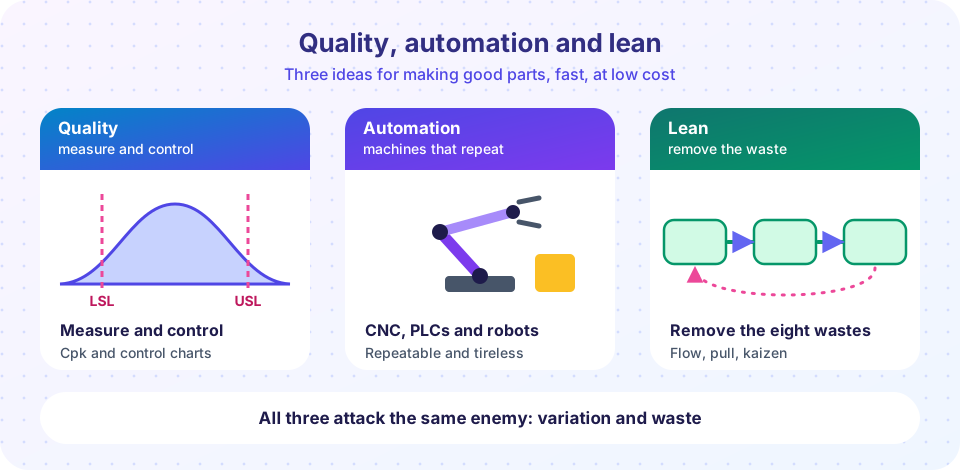
This chapter covers the three ideas that turn a process into a reliable, competitive production system: quality (making every part conform to the requirements), automation (letting machines do repetitive work consistently) and lean (removing everything that does not add value). They share a root: variation and waste are the enemies.
What you will learn
- What quality means in manufacturing and how it is specified and measured.
- The role of statistics in keeping a process under control.
- What automation does well and where humans remain essential.
- The core ideas of lean production.
Key terms
Quality: the degree to which a product meets its requirements, consistently.
Tolerance: the permitted variation of a dimension, written as limits such as 25.00 ± 0.05 mm.
Variation: the natural differences between parts made by the same process.
Automation: using machines and control systems to perform tasks with little human intervention.
Lean production: a management approach that maximizes value by eliminating waste and improving flow.
Quality: more than inspection
Early factories relied on inspection: make the part, measure it, throw away the bad ones. That finds problems but does not prevent them, and every scrapped part has already consumed material, machine time and energy. The modern view moves effort upstream:
- Prevention (training, good design, capable machines, clear procedures) is the cheapest.
- Appraisal (measurement and testing) finds what prevention missed.
- Failure costs (scrap and rework inside the plant, returns, repairs and lost customers outside it) are the most expensive, especially when the failure reaches the customer.
Quality thinking was shaped by a few people. Walter Shewhart, at Bell Laboratories in the 1920s, invented the control chart and showed that variation has two kinds of causes: the natural "common" variation of a stable process and "special" causes that signal that something changed. W. Edwards Deming and Joseph Juran brought these ideas to Japanese industry after the Second World War, and they became central to the Toyota Production System developed by Taiichi Ohno and others. Motorola's Six Sigma program in the 1980s added a data-driven problem-solving method and a very ambitious target for defect rates.
Three quality questions
- What is required? Drawings state dimensions with tolerances, fits, surface finish and geometric controls (GD&T). Specifications also cover materials, hardness, cleanliness and appearance. The lesson on tolerances and metrology explains these.
- How do we know a part meets it? Measurement uses calipers, micrometers, gauges, coordinate measuring machines (CMMs) and optical systems. Every measurement has uncertainty, which has to be small compared with the tolerance.
- Is the process stable and capable? Statistical process control (SPC) uses control charts and capability indices (Cp, Cpk) to decide whether the process will keep producing good parts. See SPC and process capability.
Automation
Automation ranges from a simple timer to a lights-out factory. It excels at tasks that are repetitive, dangerous, heavy or demanding in accuracy. Typical building blocks:
- CNC machines that follow a program, as seen in the machining chapter.
- Programmable logic controllers (PLCs) that run conveyors, presses and packaging lines by reading sensors and switching outputs in a fixed scan cycle.
- Industrial robots that weld, paint, load machines and assemble parts.
- Sensors and vision systems that measure and sort parts in real time.
Automation brings consistency, speed and safety, but it needs capital, programming skill, maintenance, and parts that arrive in a predictable condition. The lesson on automation, PLCs and robots shows how they work.
Lean
Lean manufacturing grew out of the Toyota Production System. Its starting point is to define value as what the customer is willing to pay for and to treat everything else as waste (in Japanese, muda). It identifies eight typical wastes (transport, inventory, motion, waiting, overproduction, over-processing, defects, and unused talent) and uses tools such as 5S (a way to organize the workplace), kanban (a card-based signal that triggers production only when downstream demand appears), takt time (the pace of customer demand), and kaizen (continuous small improvements by everyone). The lesson on lean manufacturing and OEE develops them.
Variation is the enemy
What machines add
What lean adds
Common misconceptions
"Quality means the tightest possible tolerance." Tighter tolerance costs more (slower processes, better machines, more inspection). Quality means meeting the requirement at a reasonable cost.
"Inspect 100 percent and you have quality." Inspection finds defects after the cost is spent, and people miss defects when inspecting repetitive items. Prevention and process control do better.
"Lean means cutting jobs." Lean targets waste, not workers. Companies that use it to cut staff lose the cooperation that continuous improvement depends on.
Try it
First, check a measured part against its tolerance.
Then see how the fraction of out-of-tolerance parts depends on process spread and centering. This uses the normal distribution, the standard model for measurement scatter.
Press Run (or Ctrl + Enter) to see the result here.
Program input · what you'd type while the program runs
Type the answers before you press Run, one per line. Each time the program reads a line (with input()), it gets the next line from this box.
What each lesson covers
- Quality, automation and lean at a glance (this lesson).
- Tolerances, fits and metrology: how limits are written and how parts are measured.
- SPC and process capability: control charts, Cp and Cpk.
- Automation, PLCs and robots.
- Lean manufacturing and OEE.
- Chapter review.
Check your understanding
Quick check · 4 questions
of 4 answered You scored / 4 · perfect!
-
1. Who is credited with inventing the control chart at Bell Laboratories?
Shewhart developed the control chart in the 1920s. Ohno developed the Toyota Production System and Taylor studied tool life and work methods. -
2. A dimension is 40.00 ± 0.10 mm. Which measured value is out of tolerance?
The limits are 39.90 and 40.10 mm. 40.12 mm is above the upper limit. -
3. Why is prevention usually cheaper than inspection?
Inspection finds defects after their cost has been incurred. Prevention reduces the chance that defects occur in the first place. -
4. In lean terms, what is 'waste'?
Lean defines value from the customer's point of view; everything that does not add value, such as waiting, transport or rework, is waste.
Summary
- Quality means meeting requirements consistently; it is built by prevention, supported by measurement and kept by statistical control.
- Automation brings consistency and speed through CNC machines, PLCs, robots and sensors.
- Lean removes waste and improves flow with tools such as 5S, kanban, takt time and kaizen.
- All three fight variation and waste.
Track your progress
Create a free account to tick off lessons and pick up where you left off on any device.
of Manufacturing Processes lessons completed