


















Lesson 31 of 49 · Joining and Welding
Spot welding, brazing, adhesives and fasteners
Resistance spot welding, friction stir welding, brazing and capillary action, soldering, structural adhesives and bolt preload, with worked calculations for each joint type.
Arc welding is not the answer to every joining problem. A car body has thousands of sheet-metal joints made in seconds each, where an arc would burn through. A radiator has hundreds of tiny joints between copper tubes and fins that must not melt. An aircraft skin may be bonded to its frame with a glue layer a fraction of a millimeter thick. Your laptop is held together by screws. This lesson covers the joining methods that fill the gaps arc welding leaves, with one numerical idea for each.
What you will learn
- How resistance spot welding makes a nugget and how to estimate its heat.
- Why brazing filler is drawn into joints, and how gap size controls it.
- The main types of solder and adhesive and the design rules for glued joints.
- How a bolt carries load through preload, and how to estimate tightening torque.
Key terms
Resistance welding: heating the joint by passing a large current through it; the heat is Q = I² R t.
Nugget: the small zone of melted and re-frozen metal at the interface of a spot weld.
Capillary action: the pull of a liquid into a narrow gap by surface tension, strong enough to defeat gravity.
Preload: the tension created in a bolt by tightening, which clamps the parts together.
Peel: loading that pulls a joint apart from one edge, concentrating stress on a line; very hard on adhesives.
Resistance spot welding
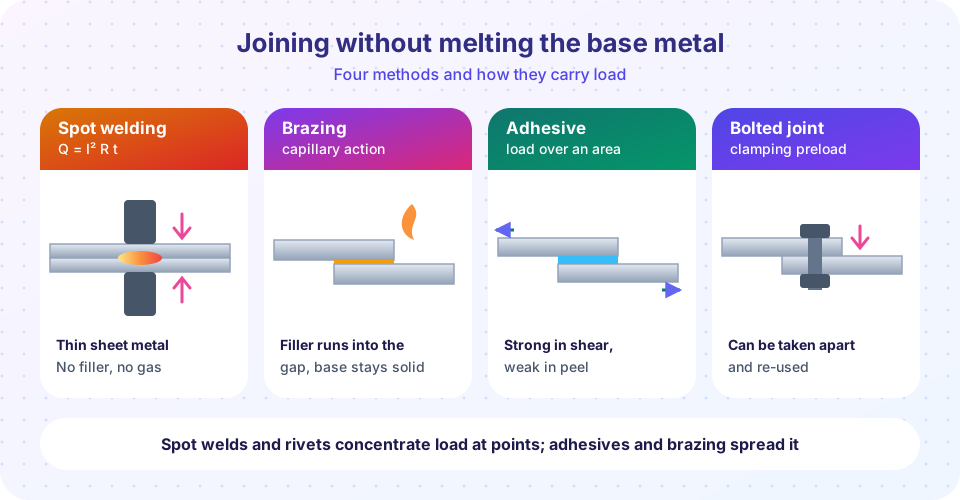
Two copper electrodes squeeze overlapping sheets, and a large current flows for a fraction of a second. The electrical resistance is highest at the interface between the sheets (the faying surface), so the heat appears there. The relationship is Joule heating:
Q = I² × R × t
Worked example 1
I = 9,000 A, effective resistance R = 100 µΩ (that is 0.0001 Ω) and t = 0.2 s:
Q = 9000² × 0.0001 × 0.2 = 1,620 J.
How much of that does the weld use? A common guide is a nugget diameter of about 5 √t millimeters for sheet thickness t in mm; for 1 mm steel that gives 5 mm. If the nugget is about 1.5 mm thick, its volume is roughly 29 mm³, or 0.23 g of steel. Heating that mass to the melting point and melting it takes approximately 300 J, only about a fifth of the energy supplied. The rest is conducted away into the sheets and the water-cooled electrodes. That is why spot welding needs high current but takes a fraction of a second, and why the copper electrodes must be cooled.
The three variables are current, time and electrode force. Too little current gives a small weak nugget or a "stuck" weld; too much melts through the sheet or ejects molten metal (expulsion). The strength of a good spot weld in 1 mm mild steel in shear is typically around 4 to 5 kN per spot, which you can estimate from the nugget area times a shear strength of about 60 percent of the tensile strength.
Spot welding is fast, needs no filler or gas, and robots do it all day. It suits steel sheet in car bodies and appliances. Aluminum is harder because its conductivity is high and its oxide layer changes contact resistance, so it needs more current and careful electrode care.
Friction stir welding
In friction stir welding (FSW) a rotating tool with a pin plunges into the seam between two plates, heats the metal by friction and stirs it into one piece while it stays solid, below its melting point. It makes strong, defect-free welds in aluminum alloys that are difficult to fusion weld, with low distortion and no filler. It is used for aircraft and rocket tanks, rail vehicles and ship panels. The cost is a heavy machine and a large clamping force.
Brazing and capillary action
Brazing uses a filler alloy that melts above about 450 °C but below the melting point of the parts. Common fillers are silver-copper-zinc alloys, copper and copper-phosphorus, aluminum-silicon, and nickel alloys for high temperature. A flux (or a vacuum or inert-gas furnace) removes oxide so the molten filler can wet the surface: it spreads rather than beading up.
Once the filler is liquid, the joint fills by capillary action. For two parallel plates separated by a gap w, the height a liquid is pulled up against gravity is:
h = 2 γ cos θ / (ρ g w)
where γ is the surface tension of the liquid, θ its contact angle with the metal (near zero when wetting is good), ρ its density and g = 9.81 m/s².
Worked example 2
A silver-based filler with γ ≈ 0.9 N/m, ρ ≈ 9,000 kg/m³ and θ ≈ 0 in a gap of 0.1 mm = 1×10⁻⁴ m:
h = 2 × 0.9 × 1 / (9000 × 9.81 × 1×10⁻⁴) ≈ 0.20 m.
The filler could climb about 200 mm in that gap, so capillary forces are much larger than gravity. In a 0.5 mm gap the rise falls to about 40 mm. That is why joint design matters: the best gap for a brazed joint is small, typically in the range of a few hundredths to about 0.15 mm. A gap that is too wide leaves voids and a weak joint; one too tight can keep the filler out.
Brazed joints are strong (often stronger than the filler alone, because the thin layer is constrained by the stiffer parent metal), leak tight, and good for dissimilar metals such as copper to steel or carbide tips to steel tool bodies. Distortion is small because the parts are heated only to the filler's flow temperature, but whole assemblies are often heated in a furnace.
Soldering
Soldering follows the same wetting-and-capillary principle at lower temperature. Electronics assemblies use tin-silver-copper alloys (for example, SAC305 with about 3 percent silver and 0.5 percent copper, melting around 217 to 220 °C). The old tin-lead eutectic (63 percent tin, 183 °C) is restricted in many products by regulations such as the EU's RoHS directive. In reflow soldering, solder paste is printed onto a circuit board, the components are placed, and the board passes through an oven; in wave soldering the board crosses a standing wave of molten solder. A thin intermetallic layer forms at the interface; too much of it makes the joint brittle.
Solder joints are weak compared with welds or brazes, so they often carry little mechanical load. The mechanical strength comes from the lead's shape, the component body or an adhesive underfill.
Adhesive bonding
Structural adhesives (epoxies, acrylics, polyurethanes) cure into a tough polymer that bonds to both surfaces. Typical lap-shear strengths of structural adhesives are in the region of 10 to 30 MPa on well-prepared metal. The design rules matter more than the adhesive:
- Load in shear or compression, avoid peel and cleavage. An adhesive that carries 20 MPa in shear might carry only a few N/mm of width in peel.
- Use a large bond area. Overlap length is helpful but only up to a point, because the stress concentrates at the ends of the overlap rather than being spread evenly (a result worked out by Volkersen in 1938).
- Prepare the surfaces. Degrease, abrade or etch, sometimes prime. Most adhesive failures are preparation failures, and a clean break at the interface (adhesive failure) shows it.
- Control the bond line thickness, typically 0.1 to 0.5 mm.
- Mind temperature and moisture. Most structural adhesives lose strength above their glass transition temperature.
Adhesives join dissimilar materials without galvanic corrosion, seal the joint, damp vibration and spread loads, but they can't be inspected easily and are hard to repair.
Mechanical fasteners
A bolt works because tightening stretches it. The tension it carries after tightening is the preload, and it clamps the parts together so they carry loads by friction and the bolt sees only a small part of the external load, which matters a lot for fatigue. Preload is usually 60 to 90 percent of the bolt's proof load. The torque needed is estimated by:
T = K × d × F (T in N·m with d in m and F in N)
where d is the nominal diameter, F the desired preload and K the "nut factor", about 0.2 for dry steel threads (lubrication lowers it).
Worked example 3
An M10 bolt of property class 8.8 has a stress area of about 58 mm² and a proof strength of about 580 MPa. Its proof load is 580 × 58 ≈ 33.6 kN. Tightening to 75 percent gives F ≈ 25.2 kN. The torque is T = 0.2 × 0.010 × 25,200 ≈ 50 N·m.
Torque is a poor way to set preload because friction varies, so the real preload can scatter by ±25 percent; critical joints use torque-plus-angle or direct tension measurement. Other methods: rivets (permanent, quick, common in aircraft), clinching (cold forming sheets into an interlock, no extra part), snap-fits in molded plastics and press fits, which use interference between a shaft and a hole.
Choosing among them
| If you need... | Think of... |
|---|---|
| Fast joints in steel sheet, thousands per hour | Resistance spot welding |
| Leak-tight joints between copper tubes or dissimilar metals | Brazing |
| Electrical connection and light mechanical hold | Soldering |
| Joining unlike materials with a large bond area | Structural adhesive |
| Disassembly and service | Bolts and screws |
Common misconceptions
"A tighter bolt is always better." Over-tightening yields the bolt or strips the thread. Preload is chosen as a fraction of proof load.
"A wider brazing gap lets more filler in, so it is stronger." The opposite: capillary force falls as the gap grows, and wide gaps leave voids.
"Solder is just a low-temperature weld." The base metals are not melted, and the joint is mainly metallurgical wetting with a thin intermetallic layer; it is much weaker than a weld.
Try it
Run the numbers from the worked examples and plot capillary rise against gap width.
Press Run (or Ctrl + Enter) to see the result here.
Program input · what you'd type while the program runs
Type the answers before you press Run, one per line. Each time the program reads a line (with input()), it gets the next line from this box.
And a quick bolt preload calculator, where you can choose the size, grade and friction condition.
Check your understanding
Quick check · 5 questions
of 5 answered You scored / 5 · perfect!
-
1. In resistance spot welding, where is the heat generated most strongly?
The contact resistance is highest where the two sheets meet, and the cooled copper electrodes have low resistance, so the heat appears at the faying surface. -
2. A spot weld passes 8,000 A for 0.25 s through an effective resistance of 120 µΩ. How much heat is generated?
Q = I² R t = 8000² × 0.00012 × 0.25 = 64,000,000 × 0.00012 × 0.25 = 1,920 J. -
3. Why is a narrow gap important in brazing?
Capillary rise is inversely proportional to gap width, so narrow gaps draw the molten filler in strongly and fully. -
4. Which loading is most damaging to an adhesive joint?
Peel concentrates the load on a thin line at the edge of the bond, so even strong adhesives fail at low loads. -
5. A bolt has a proof load of 40 kN and is tightened to 70 percent with K = 0.2 and d = 12 mm. What torque is needed?
F = 0.7 × 40,000 = 28,000 N. T = K d F = 0.2 × 0.012 × 28,000 = 67 N·m.
Summary
- Spot welding uses
Q = I² R tat the interface between sheets; most heat is lost to the surroundings, so high current and cooled electrodes are needed. - Friction stir welding joins aluminum in the solid state with a rotating pin tool.
- Brazing and soldering rely on wetting and capillary pull, strongest in narrow gaps; brazing is strong, soldering is for electrical contacts and light loads.
- Structural adhesives need shear loading, a large clean bond area and surface preparation.
- A bolt works through preload; torque
T = K d Fsets it only roughly.
Track your progress
Create a free account to tick off lessons and pick up where you left off on any device.
of Manufacturing Processes lessons completed