


















Lesson 23 of 49 · Machining
Machining at a glance
A map of machining: how cutting removes material, the four workhorse processes, and what every lesson in this chapter will teach you about chips, speeds and tools.
Most metal parts you can hold started life as a bar, a plate or a rough casting, and ended up with their final shape because a hard tool cut the extra material away. That is machining. It is the most flexible shaping family in manufacturing: the same lathe or machining center can make one prototype today and a thousand production parts next week, and it can hold sizes within a few thousandths of a millimeter.
This chapter explains how machining works, why it works, and how engineers choose the numbers (speed, feed, depth) that decide cost and quality. You do not need to have touched a lathe. You do need the ideas from the earlier chapters: what materials are, and why a shape can be cast, formed or cut.
What you will learn
- What "subtractive" means and when it beats casting, forming or printing.
- How turning, milling, drilling and grinding differ in motion and in the shapes they make.
- The three settings that control every cutting operation: cutting speed, feed and depth of cut.
- Why tools wear out and why the economic decision is always a trade between speed and tool life.
- How a CNC machine turns a drawing into motion.
Key terms
Machining: shaping a part by removing material with a cutting tool.
Chip: the piece of material the tool peels away; chips carry most of the heat out of the cut.
Cutting speed (V): how fast the tool edge moves relative to the work surface, in meters per minute.
Feed (f): how far the tool advances per revolution (or per tooth), in millimeters.
Depth of cut (d): how thick a layer is removed in one pass, in millimeters.
CNC: computer numerical control, where a program drives the machine axes.
Two big ideas
The first idea is that cutting is controlled fracture. A sharp wedge is pushed into metal that is moving relative to it. The metal ahead of the edge cannot flow around the wedge fast enough, so a thin layer shears off along a plane and slides up the tool face as a chip. Lesson 2 of this chapter, the mechanics of cutting, puts numbers on that picture.
The second idea is that every machining process is a trade among time, cost and quality. Faster cutting makes parts sooner but wears the tool sooner and may leave a rougher surface. Deep cuts remove a lot of metal per minute but need a stiff machine and more power. A good process planner is mostly someone who knows where those trade-offs bend. You will meet formulas for each trade-off in turning, milling and drilling and in tool life and CNC.
The four workhorses
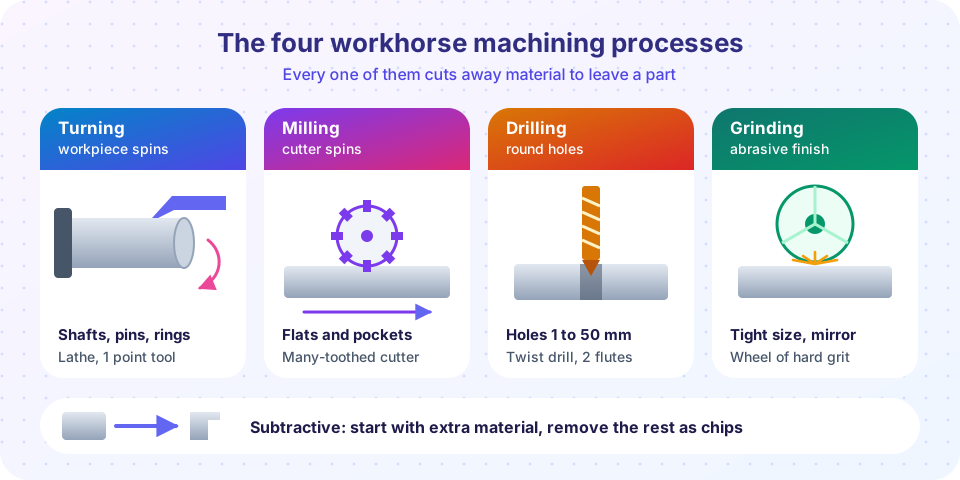
Turning spins the workpiece while a single-point tool moves along it. It makes anything round: shafts, pins, bushings, threaded rods. The tool is fixed in a holder, so the machine only needs to move it in two directions.
Milling does the opposite. The tool spins and has several cutting edges (teeth), while the workpiece is fed past it. Milling makes flat faces, slots, pockets and complex 3D surfaces. A modern five-axis machining center can reach almost any face of a block in one clamping.
Drilling makes round holes with a twist drill. The tip cuts at the bottom and the spiral flutes carry chips up and out. Holes are so common that drilling is probably the most frequent machining operation of all.
Grinding uses a wheel of hard abrasive grit as thousands of tiny cutting edges. It removes very little material per pass, so it is used for hard materials and for finishing to tight tolerances and smooth surfaces.
There are also non-traditional processes that remove material without a conventional tool: electrical discharge machining (EDM) erodes metal with sparks, laser and waterjet cutting slice sheets, and electrochemical machining dissolves metal. They are useful when the material is too hard to cut or the shape too delicate, but they are usually slower per cubic millimeter than a good cutting tool.
Machining in two moves
Three settings
The trade-off
Then measure
Why choose machining?
| Strength | Limit |
|---|---|
| Very good accuracy and surface finish | Wastes material as chips |
| No tooling cost, so ideal for low volumes | Slower than casting or forming at high volumes |
| Works on nearly every metal and many plastics | Complex internal cavities are hard to reach |
| Easy to change the design (change the program) | Hard materials wear tools quickly |
The waste point matters. If you cut a small bracket from a solid block, most of the block ends up as chips. Engineers describe this with the buy-to-fly ratio: mass of stock bought divided by mass of finished part. A ratio of 4 means three quarters of what you paid for goes in the recycling bin (chips are recycled, but at scrap value).
Common misconceptions
"Cutting is like slicing with a knife." A knife works by pressure at a very sharp edge. A metal-cutting tool works by shear: it shears a layer along a plane at roughly 20 to 40 degrees to the cutting direction, and the chip curls because of friction on the tool face.
"Faster is always cheaper." Higher speed cuts the machining time but shortens tool life much more steeply, so the cheapest speed is usually well below the fastest possible one.
"CNC machines are always accurate." The program is exact, but the machine, the tool wear and the heat are not. Accuracy comes from measuring and correcting.
Try it
First, choose a feature and see which process usually makes it. This demonstration is a simple lookup, not a process planner.
Next, work out how much of a block becomes chips when you machine a small aluminum bracket.
Press Run (or Ctrl + Enter) to see the result here.
Program input · what you'd type while the program runs
Type the answers before you press Run, one per line. Each time the program reads a line (with input()), it gets the next line from this box.
What each lesson covers
- Machining at a glance (this lesson): the map.
- The mechanics of cutting: shear plane, rake angle, chip ratio, forces and power.
- Turning, milling and drilling: speed and feed formulas, removal rate, roughness, machining time.
- Tool materials, tool life and CNC: tool wear, Taylor's equation, coatings and G-code.
- Chapter review: one picture and a mixed quiz.
Check your understanding
Quick check · 4 questions
of 4 answered You scored / 4 · perfect!
-
1. In turning, which part moves in rotation?
In turning the workpiece is held in a chuck and spins while a fixed single-point tool moves along it. In milling it is the tool that spins. -
2. A 100 g finished part is machined from a 400 g block. What is the buy-to-fly ratio?
Buy-to-fly is mass of stock divided by mass of finished part: 400 / 100 = 4. Three quarters of the block became chips. -
3. Why is machining a good choice for low-volume parts?
Casting and forging need molds or dies that cost money to make. Machining only needs a program and standard tools, so the setup cost is small. It does waste material, and it is slower at high volume. -
4. Which process is normally chosen to finish a hardened shaft to a very tight tolerance?
Grinding uses hard abrasive grit that can cut hardened steel and removes very little material per pass, so it is used for final size and finish.
Summary
- Machining shapes parts by removing material as chips; it is flexible, accurate and needs no part-specific tooling.
- Turning spins the workpiece, milling and drilling spin the tool, and grinding uses an abrasive wheel.
- Speed, feed and depth of cut are the three settings that decide removal rate, tool life and surface quality.
- Machining wastes material, which is measured by the buy-to-fly ratio.
Next: The mechanics of cutting
Track your progress
Create a free account to tick off lessons and pick up where you left off on any device.
of Manufacturing Processes lessons completed