


















Lesson 35 of 49 · Additive Manufacturing
Metal additive manufacturing and design for AM
How laser powder bed fusion, DED and binder jetting make metal parts, the energy density equation, residual stress, HIP, overhang rules and design for additive manufacturing.
Metal additive manufacturing changed what aircraft, rocket engines and medical implants can look like. A turbine part can carry its own cooling channels, a bracket can look like bone, and an assembly of a dozen welded pieces can become one. But metal printing is demanding: it melts metal in a tiny pool hundreds of thousands of times, so process control and post-processing are central, and designers who ignore the process rules get warped, cracked or unaffordable parts.
What you will learn
- How laser powder bed fusion (LPBF) works and what the energy density equation tells you.
- How DED, EBM and binder jetting differ from LPBF.
- Why metal parts warp, and what post-processing is needed (stress relief, HIP, machining).
- The rules of design for additive manufacturing (DfAM): overhangs, orientation, wall thickness, lattices and consolidation.
Key terms
LPBF: laser powder bed fusion; also called selective laser melting (SLM) or DMLS (a trademark).
Volumetric energy density (E): laser energy delivered per unit volume of material, in J/mm³.
Melt pool: the tiny pool of liquid metal formed by the beam, typically on the order of 100 µm wide.
HIP: hot isostatic pressing, applying high temperature and gas pressure to close internal pores.
DfAM: design for additive manufacturing: designing parts to exploit AM and respect its limits.
Laser powder bed fusion
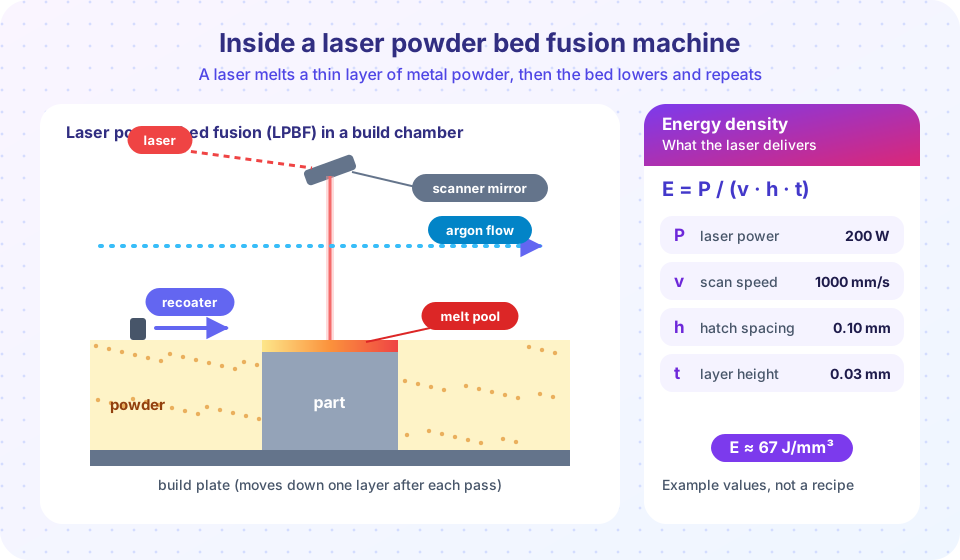
In LPBF, a recoater spreads a thin layer of fine metal powder (particles typically 15 to 45 µm, about as thin as a human hair) across a build plate, and a laser scans the part's cross-section. Wherever the laser passes, the powder melts and freezes within a fraction of a millisecond into solid metal, fused to the layer below. The plate lowers by one layer (typically 30 to 60 µm), a new layer of powder is spread, and the cycle repeats thousands of times. The chamber is filled with argon or nitrogen so the metal does not oxidize.
Materials: stainless steels (316L, 17-4 PH), aluminum alloys (AlSi10Mg), titanium (Ti-6Al-4V), nickel superalloys (Inconel 718 and 625), cobalt-chrome and tool steels.
Energy density
The key control parameters are the laser power P, the scan speed v, the hatch spacing h (distance between adjacent scan lines) and the layer thickness t. They combine into the volumetric energy density:
E = P / (v × h × t) (J/mm³)
Worked example 1. P = 200 W, v = 1,000 mm/s, h = 0.10 mm, t = 0.03 mm:
E = 200 / (1000 × 0.10 × 0.03) = 200 / 3 = 66.7 J/mm³.
The same product v × h × t is the volume built per second: 1000 × 0.10 × 0.03 = 3 mm³/s = 10.8 cm³/hour. That is slow; a fist-sized steel part can take a day. Multi-laser machines with 4 or more lasers and thicker layers raise it, but the contrast with machining (hundreds of cm³/min) is stark.
Energy density gives a first view of the process window:
- Too low: powder is not fully melted, leaving lack-of-fusion voids with irregular shapes.
- Too high: the metal overheats and vaporizes, digging a deep "keyhole" that collapses and traps round pores, and the surface turns rough from spatter.
Each alloy has a window found by testing; E is only a rough guide, since the individual variables also matter (for example, speed and power at the same ratio do not behave identically). Parameter sets are developed by the machine maker and refined by the user, and a part that must be certified needs consistent powder, parameters and monitoring.
Other metal processes
Electron beam melting (EBM) uses an electron beam in vacuum with a heated bed (above 600 °C for titanium). The hot bed reduces residual stress, and the process suits titanium implants and brittle alloys, but the surface is rougher.
Directed energy deposition (DED) feeds powder or wire into a laser, electron or arc beam on a movable head. It builds large parts, adds features to existing parts and repairs damaged components such as turbine blades. Wire-arc additive manufacturing (WAAM) uses a welding arc and wire, with deposition rates of kilograms per hour but a rough "near-net" shape that must be machined.
Binder jetting prints a binder into a powder bed to glue the shape (a "green" part), which is then debound and sintered in a furnace to densify. It prints fast with no supports and no laser, but the part shrinks by perhaps 15 to 20 percent in each direction during sintering, and the shrinkage must be calculated in advance.
Residual stress and post-processing
The steep temperature gradients of LPBF freeze in residual stress, which can bend the part off its plate, crack it, or pull it away from supports. The rules in practice:
- Anchor the part to the plate with supports that also conduct heat away.
- Stress relieve the part (a furnace cycle) while it is still on the plate, before cutting it off, usually with wire EDM or a band saw.
- Remove supports and the powder trapped inside.
- Heat treat to the final condition (aging, annealing, solution treatment).
- HIP when fatigue life matters. Typical conditions for titanium Ti-6Al-4V are about 900 to 950 °C at 100 MPa or more for a few hours. This closes internal pores but does not heal pores open to the surface.
- Machine critical features: as-built surfaces are rough (commonly Ra of roughly 5 to 15 µm), and tolerances are generally a few tenths of a millimeter, so bearing seats, threads and sealing faces are machined.
Design for additive manufacturing
Overhangs and orientation. Metal and polymer parts can generally be built without support if every surface leans at least about 45 degrees from the horizontal (a "45-degree rule"). Flatter overhangs sag or curl and need supports, which cost material, take time to remove, and leave rough surfaces. The best orientation balances support volume, surface quality on critical faces, build height (time) and the direction of the stresses.
Wall thickness and features. Walls thinner than roughly 0.4 to 1 mm may not build reliably; holes under a few millimeters may close; horizontal holes can be teardrop or diamond shaped to be self-supporting. Sharp corners and abrupt section changes concentrate heat and stress; use fillets and chamfers.
Powder removal. Closed internal cavities trap powder. Add drain holes and avoid enclosed voids that cannot be emptied.
Lattices and topology optimization. Software can place material only where loads need it, producing organic shapes and internal lattices that save mass: a bracket can be 30 to 60 percent lighter than the machined original. The shapes only make sense because AM does not care about complexity. But they still have to survive fatigue, inspection and cost.
Part consolidation. If an assembly of 10 parts can be printed as one, you remove joints, fasteners, assembly labor and failure points. A widely cited example is a jet engine fuel nozzle tip that replaced an assembly of about twenty parts with one printed part.
Conformal cooling channels in injection mold inserts follow the contour of the cavity, which is impossible to drill, and can shorten cycle time substantially.
Common misconceptions
"A printed metal part comes off the machine finished." It needs stress relief, support removal, heat treatment, often HIP and machining of critical surfaces, which can cost as much as the printing.
"Complex shapes are free, so make everything complex." Complexity is free at the printing step only. Supports, powder removal, inspection and post-processing do add cost.
"Higher laser power always speeds up the build." Faster scanning at higher power can push the process out of its window and cause porosity.
Try it
First, see how the overhang angle decides whether a feature needs support. Drag the slider to change the angle of an overhanging arm.
Second, compare two orientations of a 20 mm diameter, 100 mm long cylinder in LPBF. This script uses a simple build-time model (a fixed recoating time per layer plus scan time) to show why height matters so much, and estimates the support under the lying cylinder. The model and its constants are illustrative.
Press Run (or Ctrl + Enter) to see the result here.
Program input · what you'd type while the program runs
Type the answers before you press Run, one per line. Each time the program reads a line (with input()), it gets the next line from this box.
Check your understanding
Quick check · 5 questions
of 5 answered You scored / 5 · perfect!
-
1. LPBF with P = 300 W, v = 1,200 mm/s, h = 0.12 mm, t = 0.04 mm. What is the energy density?
E = P / (v h t) = 300 / (1200 × 0.12 × 0.04) = 300 / 5.76 = 52.1 J/mm³. -
2. What is the main reason to stress relieve an LPBF part before cutting it from the build plate?
The plate and supports restrain the residual stress. If the part is cut off first, the stress is released and the part distorts. -
3. Which condition produces lack-of-fusion voids?
With too little energy the powder is not fully melted, leaving irregular voids between tracks and layers. Too much energy causes keyhole pores. -
4. What does HIP do to a printed metal part?
Hot isostatic pressing applies high temperature and gas pressure to collapse internal pores, improving fatigue life. It cannot close pores that are open to the surface. -
5. A designer wants a horizontal 30 mm hole inside an LPBF part with no supports. Which change helps most?
A pointed top makes every surface at least about 45 degrees from the horizontal, so it is self-supporting.
Summary
- LPBF melts thin powder layers with a laser;
E = P / (v h t)guides the process window, andv h tis the build rate (often about 10 cm³/h per laser). - EBM, DED/WAAM and binder jetting trade resolution, speed, size and cost differently.
- Residual stress demands supports, stress relief on the plate, and often HIP and machining.
- DfAM means designing for the 45-degree rule, orientation, minimum features, powder removal, lattices and consolidation, with post-processing costs in mind.
Track your progress
Create a free account to tick off lessons and pick up where you left off on any device.
of Manufacturing Processes lessons completed