


















Lesson 14 of 49 · Casting and Molding
Shrinkage, Risers and Casting Defects
Why castings shrink in three stages, how to size a riser with Chvorinov's rule and a volume check, and how to diagnose misruns, porosity, hot tears and inclusions.
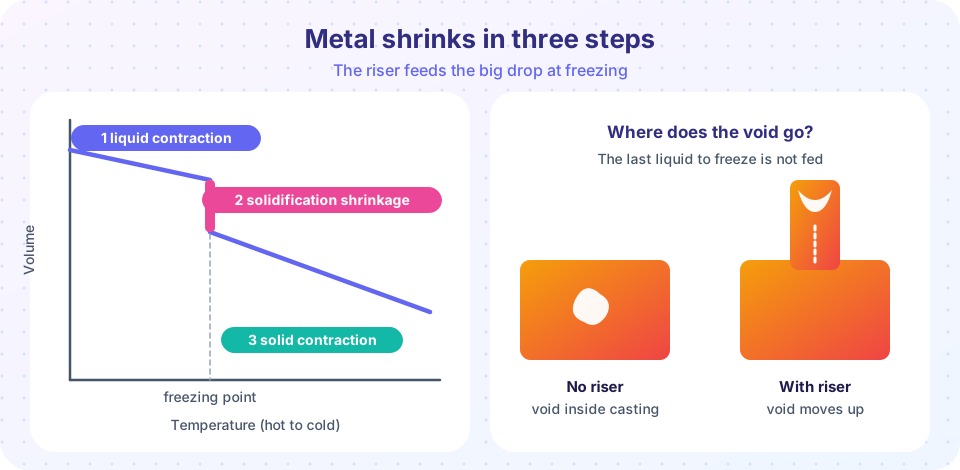
Pour a glass of water into an ice-cube tray and it expands as it freezes. Most metals do the opposite: they contract. Aluminum loses roughly 6 to 7 percent of its volume when it turns from liquid to solid. If the mold cannot supply extra liquid to fill the gap, the casting ends up with a hole inside, usually in the thickest section where it freezes last. Much of casting engineering is about steering that hole into a place where it does no harm, a sacrificial reservoir called a riser. This lesson explains the three stages of shrinkage, shows how to size a riser, and tours the defects every foundry fights.
What you will learn
- Name the three stages of shrinkage and say which one a riser must feed.
- Size a riser using Chvorinov's rule and a feeding-volume check.
- Explain directional solidification and the role of chills.
- Match common casting defects to their causes and remedies.
Key terms
Solidification shrinkage: the volume reduction as liquid metal turns to solid at its freezing point.
Directional solidification: freezing that progresses from the thinnest sections toward the riser, so liquid is always available to feed.
Chill: a piece of metal placed in the mold to speed local freezing.
Hot tear: a crack that forms in a casting still weak from partial solidification when shrinkage is restrained.
Porosity: small voids caused by trapped gas or shrinkage.
Three stages of shrinkage
- Liquid contraction. The metal cools from the pouring temperature to its freezing temperature and contracts a little. The gating system and riser simply stay full of liquid, so this stage needs no special action.
- Solidification shrinkage. At the freezing point the liquid changes to a denser solid. This is the large step. Typical volume losses are about 6 to 7 percent for aluminum and about 3 to 4 percent for many carbon steels. Gray cast iron is the odd one: the graphite that forms as it freezes expands and almost cancels the shrinkage. This is the stage that the riser must supply.
- Solid contraction. Between freezing and room temperature the solid casting shrinks again. This is the contraction that the pattern's shrinkage allowance takes care of, as you saw in the last lesson.
If the volume deficit in stage 2 is not fed, a shrinkage cavity or a diffuse network of microporosity appears.
Directional solidification and risers
To avoid cavities, the casting should freeze starting from the points far from the riser and end at the riser. Then the riser's liquid can flow into every freezing region. That is directional solidification. Two rules follow from Chvorinov's rule:
- The riser must freeze after the casting. Since
t = B (V/A)², the riser needs a larger V/A than the casting section it feeds. A common rule of thumb is that the riser's solidification time is about 25 percent longer than the casting's. - The riser must hold enough liquid. It has to supply the volume lost in stage 2 and also still have liquid left when the casting finishes. In practice only a modest fraction of the riser's volume is actually available to feed, often 10 to 15 percent.
Risers are placed on top of or beside the heaviest sections. Chills (blocks of steel, iron or copper) are set in the mold next to thick sections far from risers to speed up freezing there and push the "last to freeze" point toward the riser. Padding adds a tapered thickness to a thin wall so that heat flows toward the riser, and insulating or exothermic sleeves around the riser keep it liquid longer.
Worked example: a plate with a cylindrical riser
An aluminum plate casting measures 200 × 100 × 20 mm.
- Volume
V = 200 × 100 × 20 = 400,000 mm³ = 400 cm³. - Surface area
A = 2 (200×100 + 200×20 + 100×20) = 52,000 mm² = 520 cm². - Modulus
V/A = 400 / 520 = 0.77 cm.
Time criterion. We want t_riser ≥ 1.25 × t_casting. With n = 2 this means (V/A)_riser ≥ √1.25 × 0.77 = 1.118 × 0.77 = 0.86 cm. For a cylindrical riser with height equal to diameter, V = π D³ / 4 and (counting all surface) A = 1.5 π D², so V/A = D/6. Setting D / 6 ≥ 0.86 gives D ≥ 5.2 cm.
Volume criterion. With 6 percent solidification shrinkage the casting needs 0.06 × 400 = 24 cm³ of feed metal. If 15 percent of the riser can be used, the riser must satisfy 0.15 × π D³ / 4 ≥ 24, so D³ ≥ 24 × 4 / (0.15 π) = 204, and D ≥ 5.9 cm.
The larger result governs. So choose D = H = 5.9 cm, and the volume criterion, not the time criterion, decides. (If the riser's contact face with the casting is excluded from its cooling surface, as in practice it is, the time requirement becomes less demanding. The example is a first estimate, and foundries refine it with simulation.)
Common defects
| Defect | What you see | Typical cause | Typical remedy |
|---|---|---|---|
| Misrun | Casting incomplete; edges rounded | Metal froze before filling; low pouring temperature; thin section | Higher pouring temperature, better gating, thicker section |
| Cold shut | Seam where two streams met but did not fuse | Low temperature, slow pouring | Raise temperature, change gate positions |
| Shrinkage cavity | Void in thick section, rough walls | Insufficient feeding | Larger or better-placed risers, chills |
| Gas porosity | Smooth round bubbles | Dissolved gas (hydrogen in aluminum), damp sand, poor venting | Degas the melt, dry the mold, add vents |
| Hot tear | Jagged crack near a corner | Restrained shrinkage while weak | Generous fillets, collapsible cores |
| Sand inclusion or scab | Rough patch, embedded sand | Mold erosion, weak sand | Slower pour, stronger mold |
| Oxide or slag inclusion | Dark particles, dull spots | Turbulence, dirty melt | Skim, use filters, quiet fill |
| Mold shift | Parts of casting misaligned | Cope and drag not aligned | Better flask pins and clamping |
Inspection methods include visual and dimensional checks, dye penetrant testing for surface cracks, radiography (X-ray) and ultrasonic testing for internal voids, and pressure testing for parts such as pump housings that must not leak.
Design for castability
Designers help the foundry with simple rules: keep wall thickness as uniform as practical, make transitions gradual, use generous fillet radii at corners (sharp corners cool differently and tear), avoid isolated heavy sections, and add draft. These rules are driven directly by the physics above.
Common misconceptions
"Shrinkage is just the pattern allowance." The pattern allowance covers solid contraction; solidification shrinkage is a different volume loss that must be fed with liquid metal.
"Porosity always comes from gas." Shrinkage causes porosity as well; the rough, irregular voids are usually shrinkage and the smooth round ones gas.
"A casting that looks perfect is sound." Internal voids may only appear on an X-ray, so critical parts are inspected.
Try it
Pick a symptom to see likely causes and remedies. It is a study aid built from the defect table, not a diagnostic system.
The second example sizes a riser with both criteria. Edit the dimensions and shrinkage to see which criterion wins.
Press Run (or Ctrl + Enter) to see the result here.
Program input · what you'd type while the program runs
Type the answers before you press Run, one per line. Each time the program reads a line (with input()), it gets the next line from this box.
Check your understanding
Quick check · 5 questions
of 5 answered You scored / 5 · perfect!
-
1. Which stage of shrinkage must a riser feed?
At freezing the metal loses volume suddenly; the riser supplies liquid to fill that deficit. -
2. Why must the riser solidify after the casting?
If the riser froze first it could not feed the casting. -
3. Smooth round bubbles inside a casting most likely indicate:
Gas porosity produces smooth, rounded cavities, unlike the jagged voids of shrinkage. -
4. A casting needs 30 cm³ of feed metal and 15 percent of a riser's volume is usable. What minimum riser volume is needed?
30 / 0.15 = 200 cm³. -
5. What does a chill do?
A metal chill removes heat quickly, pushing the last-to-freeze location toward the riser.
Summary
- Castings shrink in three stages; the riser feeds the large step at solidification.
- Directional solidification needs the riser to freeze last, using Chvorinov's rule and enough feed volume.
- Chills, padding and insulating sleeves steer freezing.
- Misruns, cold shuts, porosity, hot tears and inclusions each have characteristic causes and cures.
- Uniform walls, fillets and draft make parts easier to cast.
Track your progress
Create a free account to tick off lessons and pick up where you left off on any device.
of Manufacturing Processes lessons completed