


















Lesson 21 of 50 · Present Tense and Word Order
Word order and the verb-second rule
Learn German word order: the verb-second rule, inversion after time words, yes/no and question-word questions, time-manner-place and conjunctions.
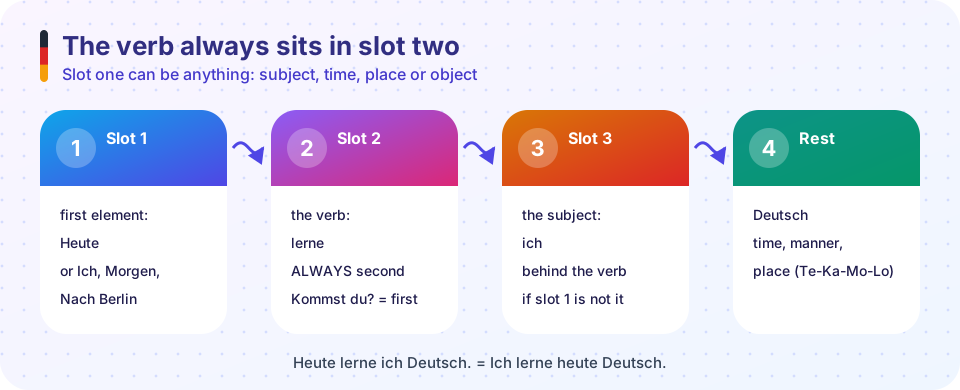
If German has one golden rule, this is it: in a statement, the conjugated verb is always in the second position. It does not matter what stands first, and the first element can be nearly anything: the subject, a time, a place, an object. The verb stays second. Master this one idea and your sentences will sound German instead of translated English. In this lesson you will also learn how questions work, in what order to put time, manner and place, and which little words (und, aber, denn) do not change the order.
What you will learn
- the verb-second (V2) rule and inversion
- yes/no questions and question-word questions
- the order time, manner, place
- coordinating conjunctions (und, oder, aber, denn, sondern) that do not change the order
- where pronouns and objects go
Key terms
V2 (Verb-Zweit-Stellung): the finite verb occupies position 2 in a main clause. Inversion: the subject follows the verb because another element is in first position. Satzglied: a sentence element (a "slot filler"), which can be a single word or a phrase. Konjunktion: a connecting word such as und, aber, denn.
The rule: the verb is the second element
Count elements, not words. A sentence element can be one word (ich) or several (mit dem Zug, am Wochenende). The finite verb is the second element:
| Position 1 | Position 2 (verb) | Rest |
|---|---|---|
| Ich | fahre | morgen mit dem Zug nach Berlin. |
| Morgen | fahre | ich mit dem Zug nach Berlin. |
| Mit dem Zug | fahre | ich morgen nach Berlin. |
| Nach Berlin | fahre | ich morgen mit dem Zug. |
All four sentences say the same thing (I am going to Berlin by train tomorrow) with a different emphasis. Whatever goes into position 1 is slightly emphasized. When something other than the subject comes first, the subject moves behind the verb. This is called inversion: Morgen fahre ich, not Morgen ich fahre. This is the most common mistake of English speakers, since English says "Tomorrow I go".
Words like dann (then), deshalb (therefore), jetzt (now), heute (today), zuerst (first) and danach (afterwards) often start sentences, and they trigger inversion: Dann gehe ich nach Hause. Jetzt habe ich Zeit. Zuerst esse ich Frühstück.
Yes/no questions: the verb moves to the front
For questions that can be answered with ja or nein, put the verb in first position:
| Statement | Question |
|---|---|
| Du kommst heute. | Kommst du heute? (Are you coming today?) |
| Sie spricht Deutsch. | Spricht sie Deutsch? (Does she speak German?) |
| Ihr habt Zeit. | Habt ihr Zeit? (Do you have time?) |
| Er ist müde. | Ist er müde? (Is he tired?) |
There is no word like English "do" in German. Just invert subject and verb, and raise your voice at the end. Answers: Ja, ich komme. Nein, ich komme nicht. A positive answer to a negative question is Doch! (chapter 5).
Question-word questions
With a question word (W-Frage), the question word comes first and the verb second, like a statement:
| Question word | Meaning | Example |
|---|---|---|
| wer | who | Wer kommt? |
| was | what | Was machst du? |
| wo | where | Wo wohnst du? |
| woher | where from | Woher kommst du? |
| wohin | where to | Wohin fährst du? |
| wann | when | Wann fährt der Zug? |
| wie | how | Wie heißt du? |
| warum | why | Warum lernst du Deutsch? |
(All of these get a full lesson in chapter 5.) The pattern: Question word + verb + subject + rest. Wann fährst du nach Berlin? Warum lernst du Deutsch?
The order of the rest: time, manner, place
After the verb and subject, the remaining elements follow a typical order, remembered as Te-Ka-Mo-Lo: temporal (when), kausal (why), modal (how), lokal (where):
Ich fahre morgen (time) mit dem Zug (manner) nach Berlin (place). Wir gehen heute Abend (time) mit Freunden (manner) ins Kino (place). Sie arbeitet jeden Tag (time) zu Hause (place).
English does the opposite (place before time): "I go to Berlin by train tomorrow". Using Te-Ka-Mo-Lo as a starting point is enough for beginners; it is a tendency, not a law, and moving an element to the front for emphasis is fine.
Objects and pronouns
- Nouns: dative before accusative: Ich gebe dem Kind einen Apfel.
- Pronouns: pronouns come right after the verb, before nouns: Ich gebe ihm einen Apfel. Ich gebe ihn dem Kind.
- Two pronouns: accusative first: Ich gebe ihn ihm. (I give it to him.)
- After inversion: the subject stays right behind the verb, and a pronoun object follows it: Heute kaufe ich es. (Today I buy it.)
Conjunctions that do not count (position 0)
Five small connecting words join two main clauses without changing the word order of the second one. They stand outside the sentence slots ("position 0"):
| Conjunction | Meaning | Example |
|---|---|---|
| und | and | Ich lerne Deutsch, und er lernt Spanisch. |
| oder | or | Trinkst du Kaffee, oder möchtest du Tee? |
| aber | but | Ich bin müde, aber ich arbeite noch. |
| denn | because (main-clause use) | Ich bleibe zu Hause, denn ich bin krank. |
| sondern | but rather | Ich bin nicht müde, sondern hungrig. |
After these words, the second clause keeps the normal order: subject, verb, rest. (In chapter 7 you will meet weil (because) and dass (that), which send the verb to the end of the clause.)
Commands
The imperative uses verb first, like a question: Komm! (Come!) Sprich langsam! (Speak slowly!) Kommen Sie bitte! (Please come!, formal) Warte! (Wait!) The formal command repeats Sie after the verb: Sprechen Sie bitte langsam.
Dialogue: making plans
Lena: Hast du morgen Zeit? — Do you have time tomorrow? Tom: Morgen arbeite ich bis fünf Uhr. Danach habe ich Zeit. — Tomorrow I work until five. After that I have time. Lena: Gut! Dann gehen wir zusammen ins Kino. — Good! Then let's go to the cinema together. Tom: Wann beginnt der Film? — When does the film start? Lena: Um halb acht. Aber wir essen vorher eine Pizza. — At half past seven. But we eat a pizza before.
Count the position of the verb in each sentence: Morgen arbeite ich, Danach habe ich, Dann gehen wir, Wann beginnt der Film?, Aber wir essen ... (aber is position 0).
Reading practice: find the verb
A good way to internalize verb-second is to read simple German and mark the conjugated verb in every sentence. Take the following short text and underline the verb in each sentence: Am Samstag fahre ich nach Hamburg. Dort besuche ich meine Freundin. Wir gehen zusammen in ein Café. Danach kaufen wir ein. Abends essen wir Pizza. You should find the verb in position 2 every time: fahre, besuche, gehen, kaufen, essen. Notice that the first position holds a time or place (Am Samstag, Dort, Danach, Abends) in four sentences, and the subject (Wir) in one. Then rewrite each sentence with a different first element to see the inversion in action. Do this with every German text you read, and the pattern will become second nature.
Common misconceptions
"Heute ich lerne" is fine because the meaning is clear. The verb must be second: Heute lerne ich.
"Aber counts as the first element." It does not. After aber the clause has its own position 1: Aber heute bin ich müde. (heute = position 1, bin = position 2).
"I need 'do' to make questions." German has no "do"; swap verb and subject.
"Time-manner-place is a rule that cannot be broken." It is a default order; emphasis may move elements.
Try it
Press Run (or Ctrl + Enter) to see the result here.
Program input · what you'd type while the program runs
Type the answers before you press Run, one per line. Each time the program reads a line (with input()), it gets the next line from this box.
Check your understanding
Quick check · 5 questions
of 5 answered You scored / 5 · perfect!
-
1. Which sentence follows the verb-second rule?
When 'morgen' is first, the verb is second and the subject follows. -
2. How do you ask 'Are you coming?' (du)?
A yes/no question has the verb first. -
3. What is the correct order of time, manner and place?
Time (morgen), manner (mit dem Zug), place (nach Berlin). -
4. Which word does NOT change the word order of the clause after it?
denn is a coordinating conjunction; weil and dass send the verb to the end. -
5. Where does the question word go in 'Wann fährst du?'
Question word first, verb second.
Summary
- The conjugated verb is the second element of a statement; inversion puts the subject after the verb when another element starts the sentence.
- Yes/no questions start with the verb; question-word questions start with the question word followed by the verb.
- Default order of the rest: time, manner, place; pronouns come early, accusative pronoun before dative pronoun.
- und, oder, aber, denn, sondern do not change the word order (position 0).
Track your progress
Create a free account to tick off lessons and pick up where you left off on any device.
of German for Beginners lessons completed