


















Lesson 19 of 50 · Present Tense and Word Order
Regular verbs in the present tense
Learn to conjugate regular German verbs in the present tense: the six endings, the extra e, the du-form after s, ß and z, useful verbs and practice.
The present tense is the first verb tense you need, and for most verbs it is wonderfully regular. You take the infinitive, remove -en, and add one of six endings. Once you know the pattern, you can use hundreds of verbs without learning anything new: wohnen, lernen, spielen, kaufen, machen, kochen, hören, fragen, tanzen, reisen. This lesson shows the regular endings, two spelling adjustments that make pronunciation easier, a list of high-frequency verbs, and how to use the present tense for habits, right now and the near future.
What you will learn
- how to find the stem and add the six endings
- when to insert an extra e (du arbeitest)
- when the du ending is only -t (du tanzt)
- about thirty useful regular verbs
- how to use the present tense for habits, the present moment and the future
Key terms
Infinitive: the dictionary form, such as wohnen. Stem (Verbstamm): the infinitive minus -en: wohn-. Ending (Endung): the part you add to match the subject. Paradigm: the full set of six forms of a verb.
The six endings
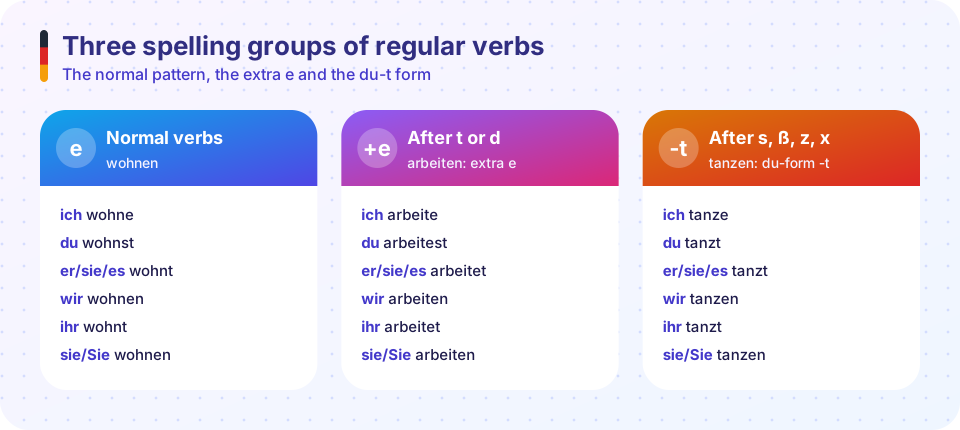
Remove -en from the infinitive and add the ending for the subject. For wohnen (to live) the stem is wohn-:
| Person | Ending | Form | Example sentence |
|---|---|---|---|
| ich | -e | wohne | Ich wohne in Wien. (I live in Vienna.) |
| du | -st | wohnst | Du wohnst in Berlin. |
| er / sie / es | -t | wohnt | Sie wohnt in Zürich. (She lives in Zurich.) |
| wir | -en | wohnen | Wir wohnen hier. (We live here.) |
| ihr | -t | wohnt | Ihr wohnt dort. (You, pl., live there.) |
| sie / Sie | -en | wohnen | Sie wohnen in München. (They / you live in Munich.) |
Pronunciation hints: the -e is a weak "uh" (ich WOH-nuh); -st is crisp (du wohnst); -t is a short final t. Pay attention to wir and sie/Sie: they are always identical to the infinitive, so if you know the infinitive, you already know two forms. The formal Sie uses the same form as plural sie: Wohnen Sie in Berlin? (Do you live in Berlin?) And er, sie (she) and es share the same form, as do ihr and er/sie/es: -t. This overlap means there are only four different endings for six persons: -e, -st, -t, -en.
Spelling adjustment 1: the extra e
If the stem ends in -t or -d, or in a consonant plus -m/-n (as in -chn-, -tm-, -ffn-), the endings -st and -t would be hard to pronounce. German inserts an e before them:
| Infinitive | du | er/sie/es | ihr |
|---|---|---|---|
| arbeiten (to work) | arbeitest | arbeitet | arbeitet |
| finden (to find) | findest | findet | findet |
| warten (to wait) | wartest | wartet | wartet |
| öffnen (to open) | öffnest | öffnet | öffnet |
| rechnen (to calculate) | rechnest | rechnet | rechnet |
| baden (to bathe) | badest | badet | badet |
ich, wir and sie/Sie are not affected: ich arbeite, wir arbeiten. Compare du machst (no extra e) with du arbeitest (extra e). Try saying "du arbeitst" and you will feel why German adds an e.
Spelling adjustment 2: du and stems in s, ß, z
If the stem already ends in an s-sound (-s, -ß, -x, -z, -tz), the -st ending of du would produce a double s sound. German drops the s and uses just -t, so that du and er/sie/es look the same:
| Infinitive | du | er/sie/es |
|---|---|---|
| heißen (to be called) | du heißt | er heißt |
| tanzen (to dance) | du tanzt | er tanzt |
| reisen (to travel) | du reist | er reist |
| sitzen (to sit) | du sitzt | er sitzt |
| mixen (to mix) | du mixt | er mixt |
| lesen (to read; irregular) | du liest | er liest |
Good news: du heißt looks like er heißt, so you can ask "Wie heißt du?" and answer "Ich heiße Lena." without a thought.
Verbs ending in -eln and -ern
For verbs whose infinitive ends in -eln or -ern, wir and sie/Sie take just -n (the infinitive form), and ich drops one e: sammeln (collect) becomes ich sammle, du sammelst, er sammelt, wir sammeln; wandern (hike) becomes ich wandere, du wanderst, wir wandern. They are rare for beginners, but you will see them.
Thirty useful regular verbs
Learn these in groups. Every verb here follows the pattern above (with the adjustments in italics).
| Daily life | Movement and travel | School and work | Free time |
|---|---|---|---|
| wohnen (live) | reisen (travel) | lernen (learn) | spielen (play) |
| kochen (cook) | wandern (hike) | studieren (study at uni) | tanzen (dance) |
| kaufen (buy) | besuchen (visit) | arbeiten (work) | hören (hear) |
| brauchen (need) | machen (do, make) | fragen (ask) | lieben (love) |
| suchen (look for) | zeigen (show) | antworten (answer) | glauben (believe) |
| zahlen (pay) | lachen (laugh) | rechnen (calculate) | telefonieren (phone) |
Some phrases: Ich koche gern. (I like cooking.) Wir spielen Fußball. (We play football/soccer.) Sie arbeitet in einem Büro. (She works in an office.) Ihr lernt schnell. (You learn fast.) Er kauft ein Brot. (He buys a loaf of bread.) The word gern after a verb means "like doing": Ich tanze gern. (I like dancing.)
What the present tense does
German uses this one tense for three things:
- Habits and facts: Ich arbeite jeden Tag. (I work every day.) Wasser kocht bei 100 Grad. (Water boils at 100 degrees.)
- Right now: Ich lerne gerade Deutsch. (I am learning German right now.) The little word gerade ("just now") stresses the moment.
- The near future: Morgen kaufe ich ein Auto. (Tomorrow I will buy a car.) Nächste Woche reisen wir nach Italien. (Next week we are travelling to Italy.)
Adverbs of frequency make it more natural: immer (always), oft (often), manchmal (sometimes), selten (rarely), nie (never), jeden Tag (every day): Ich spiele manchmal Gitarre. (I sometimes play guitar.) And remember the verb-second rule: Manchmal spiele ich Gitarre, not Manchmal ich spiele Gitarre.
Dialogue: weekend plans
Lena: Was machst du am Wochenende? — What are you doing on the weekend? Tom: Ich spiele Fußball mit Freunden und koche am Abend. Und du? — I play football with friends and cook in the evening. And you? Lena: Ich besuche meine Schwester. Sie wohnt in Graz. — I am visiting my sister. She lives in Graz. Tom: Arbeitet sie dort? — Does she work there? Lena: Ja, sie arbeitet bei einer Bank. — Yes, she works for a bank.
Practice: say the whole paradigm
A paradigm is the complete set of six forms of a verb, and saying it aloud is the best way to make the endings automatic. Pick a verb, for example lernen, and chant: ich lerne, du lernst, er lernt, wir lernen, ihr lernt, sie lernen. Do it three times, faster each time. Then add an object to make full sentences: Ich lerne Deutsch. Du lernst Englisch. Er lernt Spanisch. Next, change the position of the verb with a time word: Heute lerne ich Deutsch. Try the same with wohnen, spielen, kaufen, kochen, arbeiten and tanzen, and listen for the spelling adjustments in du arbeitest and du tanzt. Choose one new verb a day and use it in three true sentences about your life. By the end of the week you will have a working vocabulary of seven verbs in all six persons, which is enough for dozens of everyday sentences.
Common misconceptions
"The verb always ends in -en." Only the infinitive, wir and sie/Sie do.
"er and sie need -s like English." The third person singular ends in -t, not -s: er macht.
"du arbeitst is fine." Add the extra e: du arbeitest.
"Ich bin wohnen / I am living." Use Ich wohne. There is no -ing form.
Try it
Press Run (or Ctrl + Enter) to see the result here.
Program input · what you'd type while the program runs
Type the answers before you press Run, one per line. Each time the program reads a line (with input()), it gets the next line from this box.
Check your understanding
Quick check · 5 questions
of 5 answered You scored / 5 · perfect!
-
1. What is the correct form: 'du ___' (arbeiten)?
After a stem ending in t, add an extra e: du arbeitest. -
2. What is the correct form: 'er ___' (wohnen)?
er/sie/es takes -t. -
3. How do you say 'you dance' (du, tanzen)?
After z, the du ending is just -t: du tanzt. -
4. Which two forms are identical to the infinitive?
wir wohnen and sie/Sie wohnen use the infinitive form. -
5. How do you say 'I am learning German right now'?
German uses the present tense with 'gerade' (just now).
Summary
- Remove -en, add -e, -st, -t, -en, -t, -en; wir and sie/Sie equal the infinitive.
- After a stem in -t or -d, insert an e before -st and -t: du arbeitest, er arbeitet.
- After s, ß, x, z, the du form takes only -t: du heißt, du tanzt.
- The present tense covers habits, the present moment and the near future.
- Use gern for "like doing", and keep the verb in second position.
Track your progress
Create a free account to tick off lessons and pick up where you left off on any device.
of German for Beginners lessons completed