


















Lesson 24 of 50 · Present Tense and Word Order
Chapter 4 review: Present tense and word order
Review chapter 4 of German for Beginners: present-tense endings, sein and haben, stem changes, verb-second word order, nicht and kein, and separable verbs.
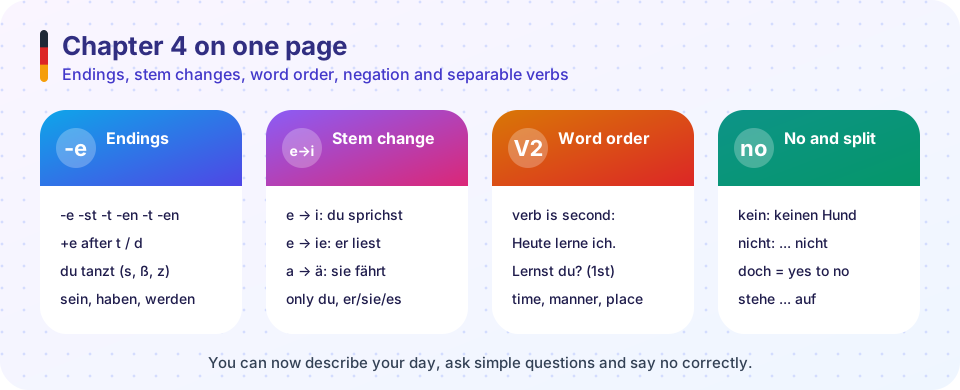
This chapter handed you the engine of German. You can now conjugate verbs in the present, use the key irregular verbs, put the verb in the right place, say no correctly and split separable verbs. With chapters 1 to 4 you are able to introduce yourself, describe your day, ask simple questions and talk about people and things. This review collects everything on one page and then checks it with ten questions. Spend a few minutes reading the poster out loud, then try to write a paragraph about your own day.
What you will learn
- a recap of every lesson in chapter 4
- a checklist of what you should be able to do
- a final self-test and a model paragraph about a daily routine
Key terms
Konjugation: changing the verb ending to match the subject. V2: the conjugated verb stands in second position in a main clause. kein / nicht: negators for nouns / for everything else. Trennbares Verb: a verb with a prefix that goes to the end of the clause.
The chapter in a table
| Topic | What to remember | Example |
|---|---|---|
| Regular endings | -e, -st, -t, -en, -t, -en; extra e after t/d; du-t after s, ß, z | ich lerne, du arbeitest, du tanzt |
| sein, haben, werden | bin/bist/ist/sind/seid/sind; habe/hast/hat/haben/habt/haben; werde/wirst/wird | Ich bin müde. Ich habe Hunger. |
| Stem changes | e→i, e→ie, a→ä only in du and er/sie/es | du sprichst, er liest, sie fährt |
| Verb second | statement: verb in position 2; question: verb first (yes/no) | Heute lerne ich. Kommst du? |
| Time, manner, place | Te-Ka-Mo-Lo as the default order | morgen mit dem Zug nach Berlin |
| Negation | kein for nouns with ein/no article; nicht for the rest; doch for yes | Ich habe keinen Hund. Ich komme nicht. |
| Separable verbs | prefix goes to the end; stressed; inseparable prefixes stay | Ich stehe auf. Ich verstehe. |
Checklist
Tick off each item. If you cannot do it, go back to the lesson.
- Conjugate machen, arbeiten and tanzen in all six persons.
- Say sein and haben from memory, and use Hunger haben and Ich bin ... Jahre alt.
- Give the du and er forms of sprechen, essen, sehen, lesen, fahren, nehmen.
- Put the verb in the right position after morgen, dann, heute.
- Make yes/no questions and W-questions.
- Say I have no time and I am not coming, and answer Kommst du nicht? with Doch.
- Describe your day using three separable verbs.
A model paragraph
Here is a short text that uses almost everything from this chapter. Read it aloud, then write your own version.
Ich heiße Lena und ich wohne in Wien. Ich bin Studentin. Jeden Morgen stehe ich um sieben Uhr auf. Dann frühstücke ich: Ich esse ein Brötchen und trinke einen Tee. Um acht Uhr fahre ich mit dem Bus zur Universität. Der Unterricht fängt um neun Uhr an. Mittags esse ich nicht zu Hause, denn ich habe keine Zeit. Abends koche ich, sehe fern und rufe meine Schwester an. Am Wochenende schlafe ich lange.
Translation: I am called Lena and I live in Vienna. I am a student. Every morning I get up at seven. Then I have breakfast: I eat a roll and drink a tea. At eight I take the bus to the university. Class begins at nine. At noon I do not eat at home, because I have no time. In the evening I cook, watch TV and call my sister. At the weekend I sleep late.
Check the details in the text: Jeden Morgen stehe ich ... auf (inversion, prefix at the end), Dann frühstücke ich (inversion), ich esse nicht zu Hause, denn ich habe keine Zeit (nicht before the place; kein with a bare noun; denn does not change word order), du / er stem changes (isst, sieht fern), and fährt for fahren.
Common misconceptions to leave behind
"I can put the verb anywhere because people understand me." They do, but correct V2 order sounds natural and is the single biggest improvement you can make.
"All verbs change their vowel." Only a group of strong verbs, and only in du and er/sie/es.
"nicht and kein are interchangeable." Kein for nouns with ein or no article; nicht for everything else.
"Separable verbs are rare." They are in nearly every conversation about daily life.
Try it
Press Run (or Ctrl + Enter) to see the result here.
Program input · what you'd type while the program runs
Type the answers before you press Run, one per line. Each time the program reads a line (with input()), it gets the next line from this box.
Check your understanding
Quick check · 10 questions
of 10 answered You scored / 10 · perfect!
-
1. Which form is correct: 'du ___' (arbeiten)?
After a stem ending in t, insert e: du arbeitest. -
2. Which sentence is correct?
Verb second: Heute esse ich Pizza. -
3. What is 'er' + 'fahren'?
a becomes ä in du and er: er fährt. -
4. How do you say 'I am not tired'?
nicht goes before the adjective. -
5. How do you say 'I have no money'?
Geld is neuter: kein Geld. -
6. 'Kommst du nicht?' Your answer 'Yes, I am coming' is ...?
doch contradicts a negative question. -
7. Which sentence is correct?
The prefix goes to the end: Ich stehe um sieben auf. -
8. Which verb is inseparable?
be- never splits. -
9. How do you say 'I am hungry'?
German uses haben with Hunger. -
10. Which pair is correct for 'sein'?
wir sind, ihr seid.
Summary
- Present tense endings: -e, -st, -t, -en, -t, -en, with spelling adjustments; sein and haben are irregular.
- e→i, e→ie, a→ä stem changes appear in du and er/sie/es only.
- The conjugated verb is second in statements; first in yes/no questions; separable prefixes go last.
- kein negates nouns with ein or no article; nicht negates the rest; doch answers a negative question.
- You now have the base of A1 German. In the second half of the course you will learn daily-life topics, the past tenses, modal verbs, adjectives and subordinate clauses.
Track your progress
Create a free account to tick off lessons and pick up where you left off on any device.
of German for Beginners lessons completed