Lesson 39 of 50 · Modal Verbs, Adjectives and Subordinate Clauses
Chapter 7 Review: Modals, Adjectives and Subordinate Clauses
Review German modal verbs, adjective endings and subordinate clauses with a one-page poster, a dialogue, recap table and a ten-question quiz.
You have finished Chapter 7, the chapter that gives your German its flexibility. You can now say what you can, must and want to do, describe things with correct endings, and give reasons with verb-final clauses. This review shows all three tools on one page, lets you read a dialogue that uses them together, and ends with ten questions.
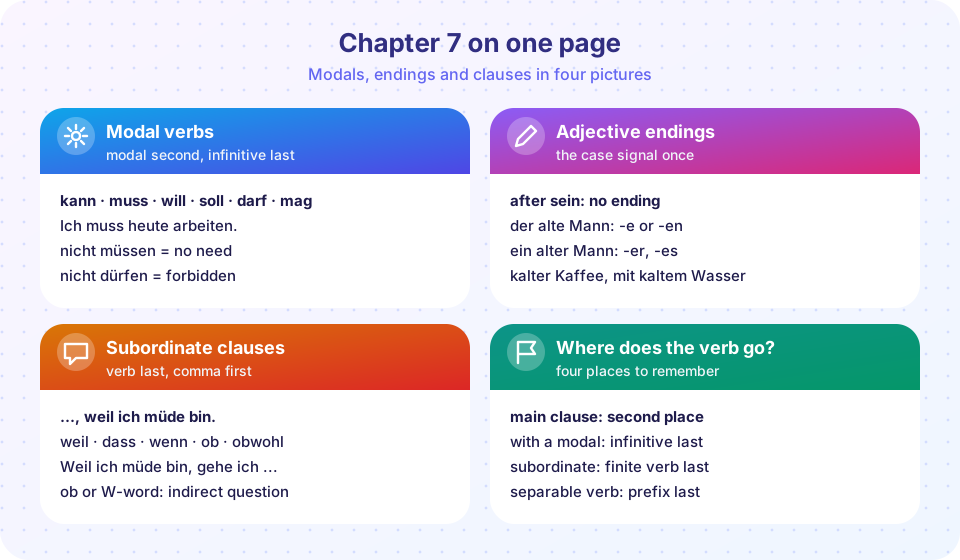
Caption: Chapter 7 in one picture: modal second and infinitive last, the case signal once, and the verb at the end after weil, dass, wenn, ob.
Two friends talk about learning German and moving to a new city.
Anna:Warum lernst du Deutsch?
Ben:Ich lerne Deutsch, weil ich nächstes Jahr in Berlin arbeiten möchte. Ich muss auch eine neue Wohnung finden.
Anna:Das ist toll! Eine große Stadt mit vielen netten Leuten. Kannst du schon gut sprechen?
Ben:Ein bisschen. Ich verstehe, was die Leute sagen, aber ich kann noch nicht schnell antworten.
Anna:Das ist normal. Du darfst keine Angst vor Fehlern haben. Ich glaube, dass du bald besser sprichst.
English: Anna: Why are you learning German? Ben: I am learning German because I would like to work in Berlin next year. I also have to find a new apartment. Anna: That is great! A big city with lots of nice people. Can you speak well already? Ben: A little. I understand what people say, but I cannot answer quickly yet. Anna: That is normal. You must not be afraid of mistakes. I think that you will soon speak better.
Find the three tools: möchte, muss, kannst, kann, darfst (modals), neue, große, netten (adjective endings), weil, was, dass (verb-final clauses).
Mixed practice: fill in the forms, endings and conjunctions.
Chapter 7 mixed practice
<style>:root{--ink:#1e1b4b;--mut:#475569;--acc:#6366f1;--bd:#c7d2fe}*{box-sizing:border-box}body{margin:0;padding:14px;font-family:system-ui,-apple-system,'Segoe UI',sans-serif;color:var(--ink);background:linear-gradient(135deg,#faf5ff,#eff6ff)}.card{background:#fff;border-radius:18px;box-shadow:0 8px 22px rgba(67,56,202,.15);padding:16px}button{font:inherit;cursor:pointer;border:0;border-radius:999px;padding:8px 14px;background:linear-gradient(135deg,#6366f1,#8b5cf6);color:#fff;font-weight:600}button.alt{background:#eef2ff;color:#3730a3}button:disabled{opacity:.5;cursor:default}.row{display:flex;gap:8px;flex-wrap:wrap;align-items:center;margin-top:10px}.mut{color:var(--mut);font-size:.9rem}</style><style>.q{display:flex;gap:8px;align-items:center;flex-wrap:wrap;padding:8px 0;border-bottom:1px solid #eef2ff;font-size:1.05rem}input{font:inherit;padding:6px 10px;border:2px solid var(--bd);border-radius:10px;width:9em}input.ok{border-color:#10b981;background:#ecfdf5}input.no{border-color:#ef4444;background:#fef2f2}.h{font-size:.85rem;color:var(--mut)}</style><divclass="card"><divid="list"></div><divclass="row"><buttonid="chk">Check answers</button><buttonclass="alt"id="rev">Show answers</button><spanid="score"class="mut"></span></div><divclass="mut"style="margin-top:8px">Capitals do not matter. Type ä ö ü ß, or use ae oe ue ss.</div></div><script>var items=[{"s":"Er ___ gut Klavier spielen.","a":"kann","h":"können"},{"s":"Wir ___ heute früh aufstehen.","a":"müssen","h":"müssen"},{"s":"Das ist ein neu___ Auto.","a":"es"},{"s":"Ich kaufe eine rot___ Jacke.","a":"e"},{"s":"Ich helfe dem klein___ Kind.","a":"en"},{"s":"Ich bleibe zu Hause, ___ ich krank bin.","a":"weil"},{"s":"Ich weiß nicht, ___ sie kommt.","a":"ob"},{"s":"Er sagt, dass er nicht kommen ___.","a":"kann"},{"s":"___ ich müde bin, gehe ich ins Bett.","a":"Weil"},{"s":"Du ___ hier nicht rauchen. (forbidden)","a":"darfst","h":"dürfen"}];functionnorm(s){return s.toLowerCase().trim().replace(/\s+/g,' ').replace(/ae/g,'ä').replace(/oe/g,'ö').replace(/ue/g,'ü').replace(/ss/g,'ß');}functionnormAns(s){returnnorm(s).replace(/ß/g,'ß');}var list=document.getElementById('list');
items.forEach(function(it,n){var d=document.createElement('div');d.className='q';var parts=it.s.split('___');
d.appendChild(document.createTextNode(parts[0]));var inp=document.createElement('input');inp.id='i'+n;inp.setAttribute('aria-label','Answer '+(n+1));d.appendChild(inp);
d.appendChild(document.createTextNode(parts[1]||''));if(it.h){var h=document.createElement('span');h.className='h';h.textContent='('+it.h+')';d.appendChild(h);}
list.appendChild(d);});functionok(it,v){var arr=Array.isArray(it.a)?it.a:[it.a];var x=normAns(v);return arr.some(function(a){returnnormAns(a)===x;});}
document.getElementById('chk').onclick=function(){var right=0;
items.forEach(function(it,n){var e=document.getElementById('i'+n);var g=ok(it,e.value);e.className=g?'ok':'no';if(g)right++;});
document.getElementById('score').textContent=right+' of '+items.length+' correct';};
document.getElementById('rev').onclick=function(){
items.forEach(function(it,n){var e=document.getElementById('i'+n);e.value=Array.isArray(it.a)?it.a[0]:it.a;e.className='ok';});};</script>
Then pick the correct sentence.
Which sentence is correct?
<style>:root{--ink:#1e1b4b;--mut:#475569;--acc:#6366f1;--bd:#c7d2fe}*{box-sizing:border-box}body{margin:0;padding:14px;font-family:system-ui,-apple-system,'Segoe UI',sans-serif;color:var(--ink);background:linear-gradient(135deg,#faf5ff,#eff6ff)}.card{background:#fff;border-radius:18px;box-shadow:0 8px 22px rgba(67,56,202,.15);padding:16px}button{font:inherit;cursor:pointer;border:0;border-radius:999px;padding:8px 14px;background:linear-gradient(135deg,#6366f1,#8b5cf6);color:#fff;font-weight:600}button.alt{background:#eef2ff;color:#3730a3}button:disabled{opacity:.5;cursor:default}.row{display:flex;gap:8px;flex-wrap:wrap;align-items:center;margin-top:10px}.mut{color:var(--mut);font-size:.9rem}</style><style>.q{font-size:1.15rem;font-weight:600;margin:6px 0 12px}.opts{display:flex;gap:10px;flex-wrap:wrap}.opts button{background:#fff;color:var(--ink);border:2px solid var(--bd);border-radius:14px;padding:10px 18px}.opts button.good{background:#ecfdf5;border-color:#10b981;color:#047857}.opts button.bad{background:#fef2f2;border-color:#ef4444;color:#b91c1c}.fb{min-height:2.6em;margin-top:10px;font-size:.95rem}</style><divclass="card"><divclass="mut"id="prog"></div><divclass="q"id="q"></div><divclass="opts"id="opts"></div><divclass="fb"id="fb"></div><divclass="row"><buttonid="nx"disabled>Next</button><spanclass="mut"id="sc"></span></div></div><script>var items=[{"q":"I have to work today.","o":["Ich muss heute arbeiten.","Ich muss arbeiten heute.","Ich arbeiten muss heute."],"a":0,"w":"Modal second, infinitive at the end."},{"q":"a big dog (nominative, with ein)","o":["ein große Hund","ein großer Hund","ein großen Hund"],"a":1,"w":"Ein shows nothing here, so the adjective takes -er."},{"q":"because I am tired","o":["weil ich bin müde","weil ich müde bin","weil bin ich müde"],"a":1,"w":"The conjugated verb goes last."},{"q":"You do not have to come.","o":["Du darfst nicht kommen.","Du musst nicht kommen.","Du kannst nicht kommen."],"a":1,"w":"Nicht müssen = no need. Nicht dürfen = forbidden."},{"q":"I know that he is coming.","o":["Ich weiß, dass er kommt.","Ich weiß, dass kommt er.","Ich weiß, das er kommt."],"a":0,"w":"Dass with ss, and the verb last."},{"q":"with fresh bread (no article)","o":["mit frisches Brot","mit frischem Brot","mit frischen Brot"],"a":1,"w":"Dative neuter with no article: -em."}];var i=0,score=0,answered=false;functionshow(){var it=items[i];answered=false;
document.getElementById('prog').textContent='Question '+(i+1)+' of '+items.length;
document.getElementById('q').textContent=it.q;
document.getElementById('fb').textContent='';
document.getElementById('nx').disabled=true;var box=document.getElementById('opts');box.innerHTML='';
it.o.forEach(function(t,k){var b=document.createElement('button');b.textContent=t;
b.onclick=function(){if(answered)return;answered=true;var ok=k===it.a;if(ok)score++;
b.className=ok?'good':'bad';if(!ok){box.children[it.a].className='good';}
document.getElementById('fb').textContent=(ok?'Correct. ':'Not quite. ')+(it.w||'');
document.getElementById('sc').textContent='Score: '+score+' / '+(i+1);
document.getElementById('nx').disabled=false;
document.getElementById('nx').textContent=(i===items.length-1)?'Start again':'Next';};
box.appendChild(b);});}
document.getElementById('nx').onclick=function(){if(i===items.length-1){i=0;score=0;document.getElementById('sc').textContent='';}else{i++;}show();};show();</script>