


















Lesson 43 of 50 · Conversation and Culture
Culture, Etiquette and Regional German
Understand German-speaking culture: du or Sie, greetings by region, Germany, Austria and Switzerland, customs, holidays and everyday etiquette for learners.
Language is not only words and grammar; it is also what people expect from each other. The same sentence can sound friendly or rude depending on who says it, to whom and where. This lesson introduces the cultural side of German: how to choose between du and Sie, how people greet each other in different regions, what changes between Germany, Austria and Switzerland, and some customs that surprise visitors.
A word of honesty first. "German culture" is not one thing. Habits differ between big cities and villages, between generations, and between regions. What follows are general tendencies, not rules. When in doubt, watch what the people around you do, and follow them.
What you will learn
- who speaks German and where
- when to use du and when to use Sie
- common greetings in different regions
- vocabulary that differs between Germany, Austria and Switzerland
- everyday customs, holidays and etiquette
Key terms
- das Hochdeutsch (Standard German): the common written and spoken standard.
- der Dialekt (dialect): a regional variety, like Bavarian or Swiss German.
- duzen / siezen (to say du / to say Sie): the informal and formal address.
- die Höflichkeitsform (polite form): Sie with a capital S.
- die DACH-Region: Germany (D), Austria (A), Switzerland (CH).
Where is German spoken?
German is the main language in Germany, Austria and Liechtenstein, and one of the official languages in Switzerland (alongside French, Italian and Romansh), Luxembourg and Belgium (the German-speaking community in the east). It is also spoken in South Tyrol in northern Italy and in other smaller communities. Roughly 100 million people speak German as a first language, and many more learn it.
Switzerland is special: people speak Swiss German dialects in daily life, but they write Standard German, and they will happily switch to Standard German for a learner. Austria has its own standard variety with its own words. For your own learning, Standard German (Hochdeutsch) is the right target: it is what you hear in the news, in textbooks and in most conversations with strangers.
Du or Sie?
German has two ways to say "you" to one person.
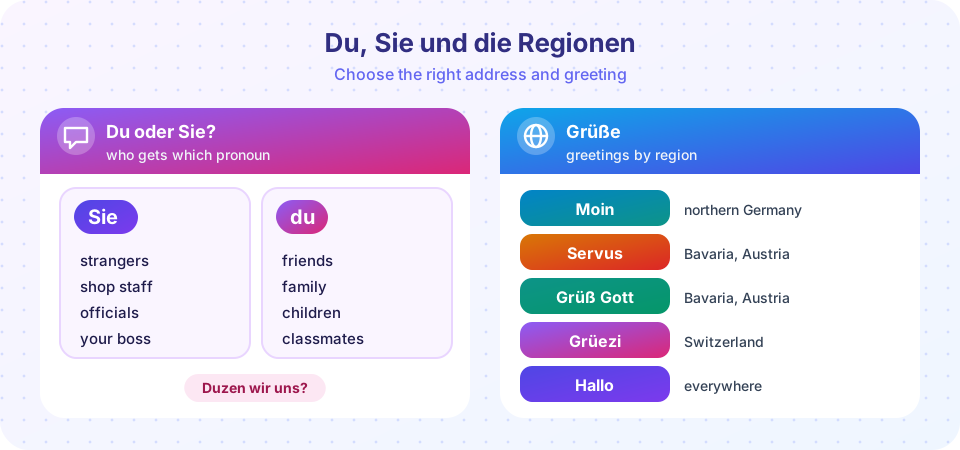
- Sie (always with a capital S, with the third-person plural verb) is formal: Wie heißen Sie? Können Sie mir helfen? It is used with strangers, shop and restaurant staff, officials, doctors, older people you do not know and, at first, with your boss and many colleagues.
- du is informal: Wie heißt du? Kannst du mir helfen? It is used with family, friends, children, young people among themselves, classmates and in many informal groups such as clubs and sports teams.
Some practical points:
- The plural of du is ihr. Sie is used for one person or for several.
- Address formal acquaintances with Herr or Frau plus the surname: Guten Tag, Frau Schneider. (The old Fräulein is no longer used.)
- Switching from Sie to du is a small ceremony. Usually the older person or the one with the higher status offers it: Wir können uns gern duzen. or Duzen wir uns? If you are unsure, start with Sie; nobody will be offended.
- In some workplaces, especially in creative or tech companies, du is the norm from the start. In traditional settings Sie can last for years, even among colleagues who get along well.
- Online and in many shops aimed at young people, du is common. Follow the tone of the text you read.
The safest rule for a learner is: Sie until invited to say du. The reverse (saying du too early) is more likely to cause friction than saying Sie too long.
Greetings around the German-speaking world
| Greeting | Where | Notes |
|---|---|---|
| Hallo | everywhere | neutral and friendly |
| Guten Morgen / Guten Tag / Guten Abend | everywhere | standard and polite |
| Moin | northern Germany | used at any time of day, usually short |
| Servus | Bavaria, Austria | hello and goodbye, informal |
| Grüß Gott | Bavaria, Austria, parts of the south | a traditional greeting, still common |
| Grüezi | Switzerland | the standard Swiss German greeting |
| Tschüss | everywhere | informal goodbye |
| Auf Wiedersehen | everywhere | formal goodbye |
| Ciao | Austria, Switzerland, also Germany | informal goodbye |
A handshake is normal in formal meetings. Among friends, hugs or a quick Hallo are common; cheek kisses vary by region and circle. When you enter a small shop, a waiting room or an elevator with others, it is polite to greet (Guten Tag!), and to say Auf Wiedersehen when you leave.
Words that differ
The same thing has different names in different regions. Both are correct; use the local word when you are there.
| Meaning | Germany (varies) | Austria | Switzerland |
|---|---|---|---|
| bread roll | Brötchen (also Schrippe in Berlin, Semmel in the south, Weck in the southwest) | Semmel | Brötli |
| January | Januar | Jänner | Januar |
| tomato | Tomate | Paradeiser (also Tomate) | Tomate |
| bicycle | Fahrrad | Fahrrad | Velo |
| cream | Sahne | Obers | Rahm |
| Saturday | Samstag (Sonnabend in the north and east) | Samstag | Samstag |
| butcher | Fleischer (north and east), Metzger (south and west) | Fleischhauer | Metzger |
Spelling and money differ, too: Swiss Standard German does not use the letter ß (it writes ss: Strasse), and Switzerland and Liechtenstein use the Swiss franc (Franken), while Germany and Austria use the euro.
Customs and etiquette
These tendencies often surprise visitors. They are not laws.
- Punctuality (Pünktlichkeit) is valued. For appointments, arrive on time or a few minutes early; if you will be late, call or message.
- Quiet times (Ruhezeiten): Sundays and public holidays are traditionally quiet. Most shops are closed on Sundays (exceptions include stations, airports and some bakeries), so plan your shopping on Saturday.
- Recycling is taken seriously. Many households sort waste into several bins: paper, packaging, organic waste and residual waste. Bottles and cans may carry a deposit (Pfand).
- Toasting: when you say Prost! or Zum Wohl!, many people look the other person in the eye. Many Germans also say that it is bad luck to wish someone a happy birthday before the day itself, so wait until the day arrives.
- Directness: people tend to say what they mean and expect an honest answer. Wie geht's? is often a real question, not just a greeting.
- Invitations: if you are invited to a home, bring a small gift such as flowers or chocolate, and take your shoes off if you see others do so.
- Cash: cards are widely accepted, but small shops and cafés sometimes take cash only.
Holidays
| Holiday | When | Notes |
|---|---|---|
| Weihnachten (Christmas) | 24–26 December | the main celebration is often on the evening of the 24th (Heiligabend); Christmas markets (Weihnachtsmärkte) open in late November |
| Silvester | 31 December | New Year's Eve with fireworks |
| Ostern (Easter) | spring | public holidays on Friday and Monday |
| Karneval / Fasching | February or March | carnival season, big in the Rhineland and in Mainz |
| Tag der Deutschen Einheit | 3 October | German Unity Day, the national holiday of Germany |
| Nationalfeiertag | 26 October | the national holiday of Austria |
| Bundesfeier | 1 August | the national day of Switzerland |
| Oktoberfest | late September to early October | the famous fair in Munich |
Holidays differ by federal state, so check the local calendar.
A dialogue: switching to du
Tom: Entschuldigung, darf ich Sie etwas fragen?
Lena: Natürlich. Was möchten Sie wissen?
Tom: Ist hier noch ein Platz frei?
Lena: Ja, bitte. Wir arbeiten hier ja im selben Büro, nicht wahr? Ich bin Lena. Wir können uns gern duzen.
Tom: Sehr gern! Ich bin Tom.
English: Tom: Excuse me, may I ask you something? Lena: Of course. What would you like to know? Tom: Is this seat still free? Lena: Yes, please. We work in the same office, right? I am Lena. We can use du if you like. Tom: With pleasure! I am Tom.
Common misconceptions
- "All Germans are cold or rude." Directness is not rudeness. Warmth often shows more slowly, through reliability and help.
- "Sie is old-fashioned." It is still the default with strangers and in formal settings.
- "Everyone speaks Standard German at home." Many people speak dialects, and Swiss German is very different from Standard German.
- "There is one correct word." Brötchen, Semmel and Schrippe are all correct, depending on the region.
Try it
Decide whether you would say du or Sie.
Match regional words with where they are used.
And greetings and phrases to practice.
Check your understanding
Quick check · 5 questions
of 5 answered You scored / 5 · perfect!
-
1. Which pronoun do you normally use with a shop assistant you do not know?
Sie is the formal address for strangers and service staff. -
2. Which greeting is typical in Switzerland?
Grüezi is the common Swiss greeting; Moin is northern German; Servus is Bavarian and Austrian. -
3. What is the Austrian word for 'January'?
Austria uses Jänner. -
4. Who usually offers the switch from Sie to du?
Normally the older or higher-ranking person suggests it: Wir können uns duzen. -
5. Which language do people usually write in Switzerland?
Swiss people speak dialects but write Standard German.
Summary
- German is spoken in Germany, Austria, Switzerland, Liechtenstein and other regions; Standard German is the learner's target.
- Use Sie with strangers and in formal settings, du with friends, family and children; wait to be invited to switch.
- Greetings vary: Moin, Servus, Grüß Gott, Grüezi, Hallo.
- Vocabulary and spelling differ across the DACH countries (Jänner, Velo, Semmel; no ß in Switzerland).
- Customs such as punctuality, quiet Sundays and recycling are general tendencies; observe and adapt.
Next: Chapter 8 review
Track your progress
Create a free account to tick off lessons and pick up where you left off on any device.
of German for Beginners lessons completed