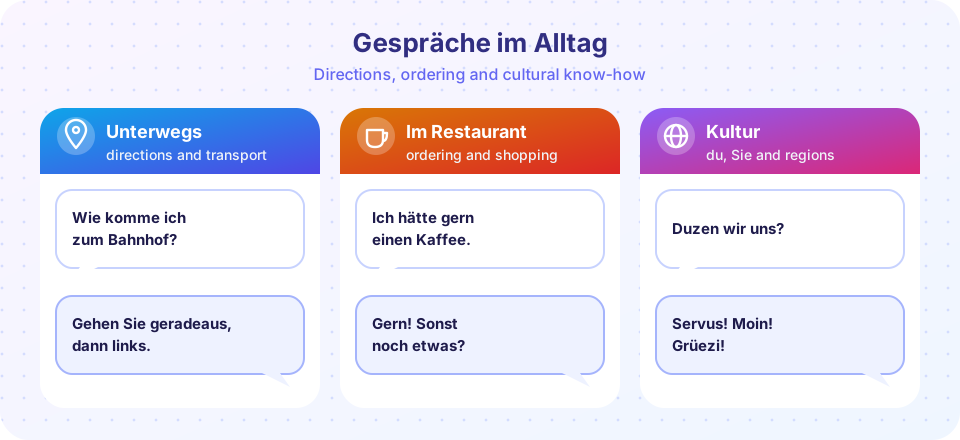
See what Chapter 8 covers: asking for directions, using transport, ordering in restaurants, shopping, and understanding German-speaking culture.
By now you know sounds, cases, verbs, questions, the past tense, modals, adjectives and subordinate clauses. Chapter 8 is where it all comes together in real situations: finding the station, buying a train ticket, ordering a meal, shopping at a bakery, and understanding how German-speaking people greet, address and treat each other.
This chapter is practical on purpose. Each lesson is built around dialogues that you can read aloud, adapt and use on your next trip. It also tells you honestly what varies between regions, because "German" means different things in Hamburg, Vienna and Zurich.
Caption: Three everyday situations in this chapter: directions, ordering, and cultural know-how.
Grammar tables teach you the rules, but conversations teach you the rhythm. A good dialogue shows a whole exchange: someone asks, someone answers, and both use polite formulas. If you learn dialogues as chunks, you do not have to build every sentence from scratch. You can recycle Entschuldigung, wie komme ich zum ...? for any place, Ich hätte gern ... for any food.
Here is a method for each dialogue in this chapter:
Read it silently and look at the translation.
Read it aloud, both roles.
Change one element: another place, another dish, another time.
German speakers are often described as direct, and that is partly true: they say what they mean. But politeness is expressed through small words and forms: bitte, danke, Entschuldigung, Guten Tag, Auf Wiedersehen, the formal Sie and the polite Könnten Sie ...? You will use these in every lesson of this chapter. Greet when you enter a shop or a waiting room, say goodbye when you leave, and use bitte and danke freely.
<style>:root{--ink:#1e1b4b;--mut:#475569;--acc:#6366f1;--bd:#c7d2fe}*{box-sizing:border-box}body{margin:0;padding:14px;font-family:system-ui,-apple-system,'Segoe UI',sans-serif;color:var(--ink);background:linear-gradient(135deg,#faf5ff,#eff6ff)}.card{background:#fff;border-radius:18px;box-shadow:0 8px 22px rgba(67,56,202,.15);padding:16px}button{font:inherit;cursor:pointer;border:0;border-radius:999px;padding:8px 14px;background:linear-gradient(135deg,#6366f1,#8b5cf6);color:#fff;font-weight:600}button.alt{background:#eef2ff;color:#3730a3}button:disabled{opacity:.5;cursor:default}.row{display:flex;gap:8px;flex-wrap:wrap;align-items:center;margin-top:10px}.mut{color:var(--mut);font-size:.9rem}</style><style>.fc{height:150px;display:flex;align-items:center;justify-content:center;text-align:center;font-size:1.5rem;font-weight:700;border-radius:18px;cursor:pointer;padding:12px;user-select:none}.front{background:linear-gradient(135deg,#6366f1,#8b5cf6);color:#fff}.back{background:#fff;color:var(--ink);border:2px solid var(--bd)}</style><divclass="card"><divid="fc"class="fc front"tabindex="0"role="button"aria-label="Flash card, press to flip"></div><divclass="mut"id="cnt"style="margin-top:8px"></div><divclass="row"><buttonclass="alt"id="prev">Back</button><buttonid="flip">Flip</button><buttonclass="alt"id="next">Next</button><buttonclass="alt"id="shuf">Shuffle</button><buttonclass="alt"id="say">Listen</button></div><divclass="mut"id="note"style="margin-top:8px">Click the card to flip it. Listen uses your browser's voice if it is available.</div></div><script>var cards=[["Wie komme ich zum Bahnhof?","How do I get to the station?"],["Gehen Sie geradeaus.","Go straight ahead."],["Biegen Sie links ab.","Turn left."],["Eine Fahrkarte nach Köln, bitte.","A ticket to Cologne, please."],["Ich hätte gern einen Kaffee.","I would like a coffee."],["Zahlen, bitte!","The bill, please!"],["Guten Appetit!","Enjoy your meal!"],["Sie oder du?","Formal or informal?"],["Grüezi","Hello (Swiss German)"],["Servus","Hello / goodbye (south Germany, Austria)"],["Moin","Hello (northern Germany)"]];var i=0,showBack=false;var fc=document.getElementById('fc');functiondraw(){var c=cards[i];fc.textContent=showBack?c[1]:c[0];fc.className='fc '+(showBack?'back':'front');document.getElementById('cnt').textContent='Card '+(i+1)+' of '+cards.length;}functionflip(){showBack=!showBack;draw();}
fc.onclick=flip;fc.onkeydown=function(e){if(e.key==='Enter'||e.key===' '){e.preventDefault();flip();}};
document.getElementById('flip').onclick=flip;
document.getElementById('next').onclick=function(){i=(i+1)%cards.length;showBack=false;draw();};
document.getElementById('prev').onclick=function(){i=(i-1+cards.length)%cards.length;showBack=false;draw();};
document.getElementById('shuf').onclick=function(){for(var k=cards.length-1;k>0;k--){var r=Math.floor(Math.random()*(k+1));var t=cards[k];cards[k]=cards[r];cards[r]=t;}i=0;showBack=false;draw();};
document.getElementById('say').onclick=function(){try{var u=newSpeechSynthesisUtterance(cards[i][0]);u.lang='de-DE';window.speechSynthesis.cancel();window.speechSynthesis.speak(u);}catch(e){document.getElementById('note').textContent='Speech is not available in this preview.';}};draw();</script>
Match places with their English meanings.
Places and transport
<style>:root{--ink:#1e1b4b;--mut:#475569;--acc:#6366f1;--bd:#c7d2fe}*{box-sizing:border-box}body{margin:0;padding:14px;font-family:system-ui,-apple-system,'Segoe UI',sans-serif;color:var(--ink);background:linear-gradient(135deg,#faf5ff,#eff6ff)}.card{background:#fff;border-radius:18px;box-shadow:0 8px 22px rgba(67,56,202,.15);padding:16px}button{font:inherit;cursor:pointer;border:0;border-radius:999px;padding:8px 14px;background:linear-gradient(135deg,#6366f1,#8b5cf6);color:#fff;font-weight:600}button.alt{background:#eef2ff;color:#3730a3}button:disabled{opacity:.5;cursor:default}.row{display:flex;gap:8px;flex-wrap:wrap;align-items:center;margin-top:10px}.mut{color:var(--mut);font-size:.9rem}</style><style>.cols{display:grid;grid-template-columns:1fr 1fr;gap:10px}.it{padding:10px 12px;border-radius:12px;background:#fff;border:2px solid var(--bd);cursor:pointer;font-weight:600;text-align:center}.it.sel{border-color:#6366f1;background:#eef2ff}.it.done{border-color:#10b981;background:#ecfdf5;color:#047857;cursor:default}.it.bad{border-color:#ef4444;background:#fef2f2}</style><divclass="card"><divclass="mut">Click a German item, then its English match.</div><divclass="cols"style="margin-top:10px"><divid="L"></div><divid="R"></div></div><divclass="row"><buttonclass="alt"id="again">Shuffle again</button><spanid="msg"class="mut"></span></div></div><script>var pairs=[["der Bahnhof","station"],["die Post","post office"],["das Rathaus","town hall"],["die Apotheke","pharmacy"],["die Haltestelle","stop"],["die Ampel","traffic light"],["die Kreuzung","intersection"],["das Gleis","platform"]];var left=null,solved=0;functionshuffle(a){a=a.slice();for(var k=a.length-1;k>0;k--){var r=Math.floor(Math.random()*(k+1));var t=a[k];a[k]=a[r];a[r]=t;}return a;}functionbuild(){
solved=0;left=null;document.getElementById('msg').textContent='';varL=document.getElementById('L'),R=document.getElementById('R');L.innerHTML='';R.innerHTML='';var idx=pairs.map(function(_,k){return k;});shuffle(idx).forEach(function(k){L.appendChild(mk(pairs[k][0],k,'L'));});shuffle(idx).forEach(function(k){R.appendChild(mk(pairs[k][1],k,'R'));});}functionmk(text,k,side){var d=document.createElement('div');d.className='it';d.textContent=text;d.style.marginBottom='8px';d.dataset.k=k;d.dataset.side=side;
d.onclick=function(){if(d.classList.contains('done'))return;if(side==='L'){document.querySelectorAll('#L .it').forEach(function(e){e.classList.remove('sel');});d.classList.add('sel');left=d;return;}if(!left)return;if(left.dataset.k===d.dataset.k){left.className='it done';d.className='it done';left=null;solved++;if(solved===pairs.length)document.getElementById('msg').textContent='All matched. Well done!';}else{d.classList.add('bad');setTimeout(function(){d.classList.remove('bad');},500);}};return d;}
document.getElementById('again').onclick=build;build();</script>