


















Lesson 1 of 50 · Getting Started
Course map
Start here: who this German course is for, how the nine chapters fit together, and a study routine that works for English speakers from zero.
Welcome. This course takes you from "I know no German at all" to simple, correct conversations about yourself, your day, your plans and your past. It is written for English speakers, so it keeps pointing at the places where German and English are close cousins (there are many) and at the places where they part ways (there are a few big ones). Every lesson is original, built around short example sentences with translations, small drills you can run in the page, and a quiz at the end.
Before anything else, one honest statement. A course on a website cannot replace speaking with real people. You can learn the sounds, the grammar and thousands of words here, but fluency comes from using them out loud, making mistakes and being corrected. Plan to talk to a tutor, a language partner, a class or a friend as early as you dare, even if you only manage ten sentences. This course is your map, not the journey.
What you will learn
- who this course is for and what level it reaches
- how the nine chapters fit together
- a daily routine that keeps new words in memory
- how each lesson is built, so you know what to expect
Key terms
CEFR: the Common European Framework of Reference, which labels language levels from A1 (beginner) to C2 (near-native). Case: the role a noun plays in a sentence (doer, receiver, and so on), shown in German by the article. Gender: every German noun is masculine, feminine or neuter, which you learn together with the word. Word order: the fixed slots where verbs and other parts of a sentence must stand.
Who this course is for
You need no earlier knowledge of German, and no earlier knowledge of grammar terms either: every term is explained the first time it appears. If you can read English, you can start. The course is meant for teenagers, adults returning to study, travelers, people moving to a German-speaking country, and anyone preparing for an A1 exam.
By the end you will be roughly at level A1 moving into A2 on the CEFR scale. In practice that means you can introduce yourself, order food, ask for directions, describe your family and routine, talk about last weekend, and understand slow, clear speech on familiar topics. It does not mean you can follow a fast news broadcast; that takes months more of listening.
German is spoken in Germany, Austria, Switzerland, Liechtenstein, Luxembourg, parts of Belgium and northern Italy, and by large communities elsewhere. The standard language taught here is Hochdeutsch (standard German). Real life adds accents, dialects and regional words, and the lessons point these out where they matter.
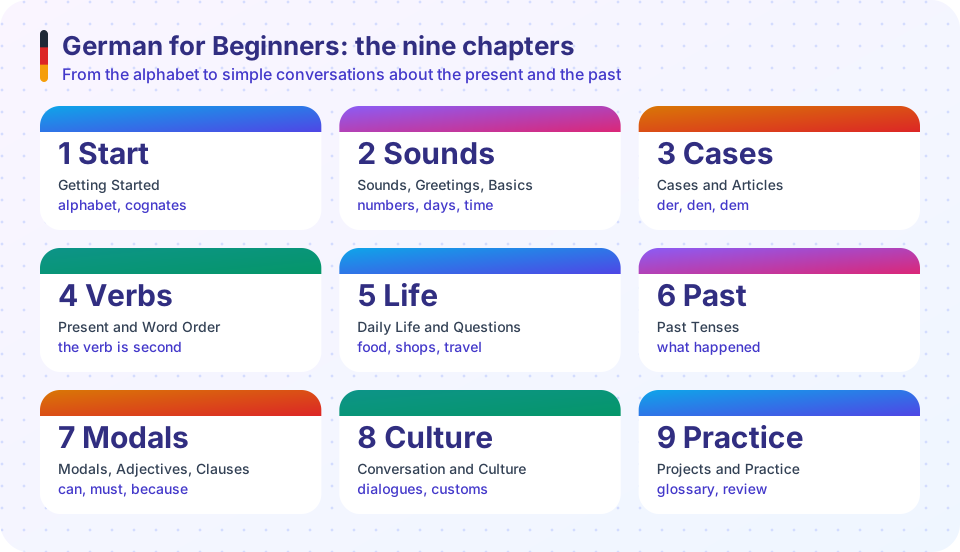
How the nine chapters fit together
German looks like a big tangle at first, but the tangle has a clear order. You cannot use cases before you know nouns, and you cannot build good sentences before you know where verbs go. So the course builds in layers.
- Getting Started shows you what German is, how much of it you already know, and the alphabet.
- Sounds, Greetings and Basics teaches pronunciation, greetings, introductions, numbers, days and the clock.
- Cases and Articles introduces noun genders and the first three cases, plus plurals.
- Present Tense and Word Order teaches verbs in the present, the verb-second rule, negation and separable verbs.
- Daily Life and Questions covers food, shopping, transport, family, home and asking questions.
- Past Tenses gives you the perfect tense and the simple past of the most common verbs.
- Modal Verbs, Adjectives and Subordinate Clauses adds "can, must, want", adjective endings and "because/that/if" sentences.
- Conversation and Culture puts everything into dialogues and explains politeness, regions and customs.
- Projects and Practice closes with mini projects, glossary and revision.
This page, together with chapters 1 to 4, belongs to the first half of the course. The later chapters rely on what you build now, so do not skip the review lessons at the end of each chapter.
Foundations
Cases and articles
Verbs and word order
Daily life
Past tenses
Longer sentences
Real life
A study routine that works
Short, frequent practice beats long, rare practice. Twenty to thirty minutes a day will take you further than three hours on a Sunday, because memory needs repeated, spaced contact. A simple weekly rhythm looks like this:
| Day | What to do | Time |
|---|---|---|
| Mon, Wed, Fri | One new lesson, run every drill, take the quiz | 30 min |
| Tue, Thu | Review yesterday's words aloud, redo the drills | 15 min |
| Sat | Review the whole chapter so far, write five sentences about your day | 25 min |
| Sun | Listen to something German you enjoy (a song, a short video) | 15 min |
Three habits matter more than any clever trick.
- Say everything aloud. Even alone. Your mouth needs to learn the sounds, and spoken sentences stick better than read ones.
- Learn nouns with their article. Never learn "Tisch" (table); learn "der Tisch". You will see why in chapter 3.
- Learn whole phrases, not single words. "Ich hätte gern einen Kaffee" (I would like a coffee) teaches vocabulary, grammar and politeness at once.
How every lesson is built
Each content lesson follows the same pattern, so you always know where you are. It starts with outcomes ("What you will learn"), then key terms, then the explanation with worked examples and a picture. Next come common misconceptions (the mistakes English speakers make most), a "Try it" section with runnable drills, a short quiz with explanations, and a summary. Where the lesson contains German, you will see the translation right next to it. Pronunciation is shown with a simple respelling and, where it helps, IPA (the International Phonetic Alphabet). Because no audio files come with the course, some drills offer an optional Listen button that uses your browser's built-in speech. It may not work in every browser or inside the preview, and nothing depends on it.
Common misconceptions
"German is just English with harder grammar." The two languages share a common ancestor, so thousands of words match, but German keeps a case system that English lost and places verbs in positions English would never use. Expect familiarity and surprise in the same sentence.
"I must master all the grammar before I can speak." No. You will speak from chapter 2 on, with short sentences. Accuracy grows from use.
"Germans all answer in English, so why bother?" In big cities and tourist areas, often yes. Try anyway: people appreciate the effort, and daily life, work and friendships go far deeper in the local language.
Try it
Two warm-ups. The first is a quick check of how much German you can already guess; the second is a plan for your first week.
Press Run (or Ctrl + Enter) to see the result here.
Program input · what you'd type while the program runs
Type the answers before you press Run, one per line. Each time the program reads a line (with input()), it gets the next line from this box.
Check your understanding
Quick check · 4 questions
of 4 answered You scored / 4 · perfect!
-
1. Which level on the CEFR scale does this course aim for?
The course is for beginners and ends at roughly A1 moving into A2: simple conversations about yourself, daily life and the past. -
2. Why should you learn a noun together with its article, such as der Tisch?
Every German noun has a gender, and the article is the easiest way to remember it. You need it for cases and adjective endings later. -
3. What can a website course NOT replace?
Fluency grows from real conversation and correction. This course is your map, but you still need to talk to people. -
4. Which study pattern is best according to this lesson?
Memory needs frequent, spaced contact, so twenty to thirty minutes a day beats one marathon.
Summary
- The course takes you from zero to about A1/A2 in nine chapters.
- Chapters 1 to 4 build the foundation: alphabet, sounds, greetings, cases and the present tense.
- Learn nouns with articles, say everything aloud, and learn phrases, not single words.
- Study a little every day, review each chapter, and talk to real people as soon as you can.
Next: German in the world
Track your progress
Create a free account to tick off lessons and pick up where you left off on any device.
of German for Beginners lessons completed