


















Lesson 25 of 50 · Daily Life and Questions
Chapter 5 Overview: Daily Life and Questions
See what Chapter 5 covers: asking questions, numbers, time and dates, and the verbs of a normal German day, with a lesson-by-lesson map.
Up to now you have met the building blocks of German: sounds, greetings, articles, cases, the present tense and basic word order. Chapter 5 puts those blocks to work. Its theme is the most ordinary thing in the world, an ordinary day. You will learn to ask things, to say how many and when, and to describe what you do from the moment you get up until you go to bed.
This chapter matters because real conversation is mostly questions and small facts: Wie spät ist es? Wann beginnt der Kurs? Was machst du heute Abend? If you can ask and answer those, you can already survive a surprising number of situations in a German-speaking country.
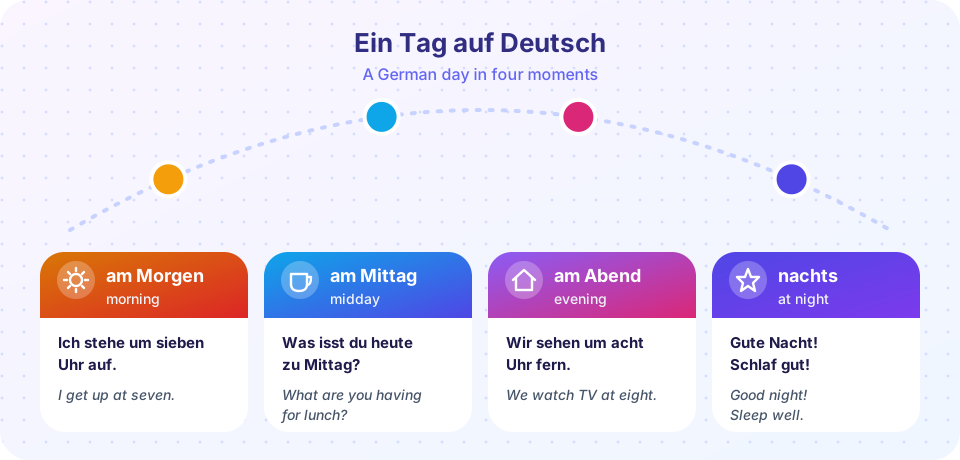
What you will learn
- how this chapter is organized and why the lessons come in this order
- which skills you will be able to use at the end: asking, counting, telling time, describing a routine
- how to study the chapter so the vocabulary stays with you
Key terms
- die Frage (the question): a sentence that asks for information.
- das W-Wort (question word): wer, was, wo, wann, warum, wie and friends. They all start with W in German.
- die Uhrzeit (clock time): the time of day, as in Es ist halb acht.
- das trennbare Verb (separable verb): a verb whose prefix jumps to the end of the sentence, like aufstehen: Ich stehe auf.
- reflexiv (reflexive): a verb that points back to the doer, like sich waschen: Ich wasche mich.
The four lessons of this chapter
Each lesson in this chapter builds on the one before it. Here is the plan.
| Lesson | What it covers | A sample sentence |
|---|---|---|
| Questions: W-words and yes/no | the question words, verb-first questions, doch, polite classroom questions | Woher kommst du? |
| Numbers, time and dates | counting to a million, the clock (formal and everyday), days, months, dates | Es ist Viertel nach acht. |
| Daily routine: separable and reflexive verbs | verbs like aufstehen and sich duschen, frequency words | Ich stehe um sieben auf. |
| Chapter 5 review | a one-page recap and a long quiz | Wann fängt der Film an? |
Ask
Count and tell time
Live your day
Small words, big difference.
Why questions come first
In most beginner courses, learners spend months making statements and only later learn to ask. That is backwards. When you ask a question, the other person does the hard work of producing German, and you get to listen to real, natural sentences. A learner who can ask Wie sagt man das auf Deutsch? (How do you say that in German?) will always improve faster than one who cannot.
German questions are also friendly to English speakers. There are only two kinds. In a W-question, you put a W-word first and keep the verb in second place, exactly as in a normal statement. In a yes/no question, you move the verb to the very front. You will see both in the first lesson.
Numbers, time and dates in everyday life
You use numbers constantly: prices, phone numbers, house numbers, ages, train platforms. German numbers have one famous quirk, they say the units before the tens: einundzwanzig is literally "one and twenty". It feels strange for about a week and then it is automatic. In the second lesson you will build a small program that turns any number up to 999,999 into German words, which is a great way to see the pattern.
Telling time has its own surprises. In everyday speech, 7:30 is halb acht, literally "half eight", meaning half way to eight. If you remember only one thing from the clock section, remember that halb points forward to the next hour.
Verbs that wander
German verbs can do two things that English learners find odd. Some split into two parts (Ich stehe um sieben auf), and some need a little pronoun that mirrors the subject (Ich dusche mich). Both are very common in talk about daily routines, which is why they appear together in lesson 3. They are not hard once you know the pattern, and the lesson gives you a quick conjugator that does the splitting for you.
Try it
Warm up with ten words and phrases from this chapter. Flip the cards, say each German item aloud, and shuffle until you can answer without looking.
A second warm-up: match German question words with their English meanings.
How to study this chapter
- Read the lesson once without stopping, to see the whole picture.
- Say every example out loud. German is a spoken language, and your mouth needs practice as much as your eyes. A course like this cannot replace speaking with real people, so try to find a partner or a tutor as soon as you can.
- Do the drills the next day. Spaced repetition beats cramming.
- Keep a small daily diary in German. Even three sentences ("Heute stehe ich um sieben auf.") will make the verbs feel natural.
Check your understanding
Quick check · 4 questions
of 4 answered You scored / 4 · perfect!
-
1. Where does the verb go in a German yes/no question?
Yes/no questions start with the conjugated verb: Kommst du aus Kanada? -
2. What does the colloquial time 'halb acht' mean?
Halb points forward to the next hour, so it is half an hour before eight: 7:30. -
3. Which sentence uses a separable verb correctly?
In a main clause the conjugated part stays in second place and the prefix goes to the end. -
4. How is the number 21 written in German?
German says the unit first: ein und zwanzig, written as one word.
Summary
- Chapter 5 teaches you to ask questions, count, tell time and describe a daily routine.
- German has W-questions (W-word first, verb second) and yes/no questions (verb first).
- Numbers put the units before the tens, and halb points to the next hour.
- Separable and reflexive verbs are the key to talking about routines.
Track your progress
Create a free account to tick off lessons and pick up where you left off on any device.
of German for Beginners lessons completed