


















Lesson 50 of 50 · Projects and Practice
Further Study: What to Learn Next in German
Plan your next steps in German: the CEFR levels, exams, grammar topics to learn next, ways to practice listening, reading and speaking, and a planning calculator.
You have come a long way. You can ask questions, count, tell time, describe a routine, talk about the past, use modal verbs, form adjective endings, build subordinate clauses, find your way, order a meal and choose between du and Sie. That is real German, and it is enough to handle many everyday situations in a German-speaking country.
This final lesson looks forward. It explains where you are on the international scale of language levels, which grammar topics come next, how to practice listening, reading, speaking and writing without a classroom, and how to plan your study time realistically. It also points to other language courses on this site.
What you will learn
- what the levels A1 to C2 mean
- which grammar to study next
- how to practice the four skills on your own
- which exams exist and how to prepare for them
- how to plan your study time
Key terms
- der Referenzrahmen (reference framework): the Common European Framework of Reference (CEFR) for languages.
- die Prüfung (exam): a test of your level.
- das Hörverstehen (listening comprehension): understanding spoken German.
- das Leseverstehen (reading comprehension): understanding written German.
- der Sprachpartner (language partner): someone who practices with you.
The levels
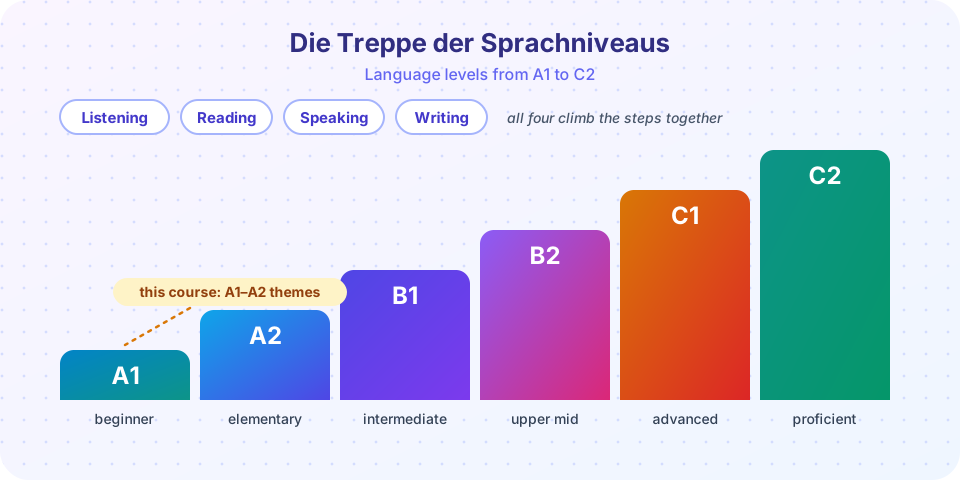
The CEFR describes six levels. They are used by most European exams and by many schools around the world.
| Level | Name | Rough meaning |
|---|---|---|
| A1 | beginner | understand and use familiar everyday phrases; introduce yourself; simple questions |
| A2 | elementary | talk about routine matters, shopping, family, past events in simple terms |
| B1 | intermediate | deal with most travel situations; describe experiences and plans; give reasons |
| B2 | upper intermediate | understand complex texts; talk with native speakers fairly naturally |
| C1 | advanced | express yourself fluently and precisely; understand long, demanding texts |
| C2 | proficient | understand almost everything; express yourself very precisely |
The topics of this course (greetings, questions, numbers, daily life, the past, modals, directions, ordering) belong to A1 and A2 themes. Depending on how much you practice, you may be around the upper end of A1 or in A2. Exams measure your level with real tasks, so the only reliable way to know is to try a practice test.
Grammar to study next
Here is a roadmap for the next stage, in a sensible order.
- Plural forms of nouns: das Kind → die Kinder, der Tag → die Tage. There are patterns, but you must learn each plural with the noun.
- Two-way prepositions (Wechselpräpositionen): in, an, auf, über, unter, vor, hinter, neben, zwischen take the accusative for movement and the dative for position: Ich gehe in die Schule vs Ich bin in der Schule.
- Comparative and superlative: schnell, schneller, am schnellsten; gut, besser, am besten.
- The future with werden: Ich werde morgen arbeiten.
- Verbs with prepositions: warten auf, sich freuen auf/über, denken an, sprechen mit, Angst haben vor.
- Relative clauses: Der Mann, der dort wohnt, ist nett.
- The zu infinitive: Ich habe keine Lust, heute zu arbeiten. Es ist wichtig, früh zu üben.
- Konjunktiv II: Ich hätte gern ..., Ich würde gern ..., Wenn ich Zeit hätte, ... (the polite and hypothetical forms you already used in phrases like Ich hätte gern).
- The passive voice: Das Haus wird gebaut. Das Haus wurde gebaut.
- The genitive case: das Haus meines Vaters, wegen des Wetters.
Learn one topic at a time and use it in your own sentences before moving on.
Practice the four skills
| Skill | Ways to practice |
|---|---|
| Listening | short news in slow German (for example the slowly spoken news that some broadcasters offer), podcasts for learners, children's audiobooks, German songs with lyrics |
| Reading | graded readers at A1 and A2, short news texts, recipes, simple blogs, subtitles in German |
| Speaking | language exchange partners, tutors, conversation groups, reading aloud, talking to yourself, shadowing (repeating what you hear) |
| Writing | a short daily diary, messages to a language partner, descriptions of pictures, summaries of what you read |
Three principles apply to all of them.
- Little and often beats a lot and rarely. Twenty minutes every day is better than three hours once a week.
- Use real German as soon as you can. Choose texts and audio that are slightly above your level, with the help of the context.
- Speak early and accept mistakes. Speaking is a skill that only grows when you do it. A course like this cannot replace speaking with people.
Exams
Exams give you goals and proof of your level. The main international German exams are:
- Goethe-Zertifikat (A1 to C2), offered by the Goethe-Institut.
- telc Deutsch (A1 to C2), a widely used exam family.
- ÖSD (A1 to C2), the Austrian language diploma.
- TestDaF and DSH for university study in Germany.
Each exam has parts for reading, listening, writing and speaking. Sample tests are published by the organizers. Doing a sample test under time pressure is one of the best ways to prepare, because it reveals your gaps. Check the current formats and dates on the organizers' websites.
A study plan
Make a weekly plan that is small enough to survive a busy week. For example:
| Day | Activity (about 20–30 min) |
|---|---|
| Monday | one grammar topic, with examples |
| Tuesday | vocabulary review with flash cards |
| Wednesday | reading or listening to a short text |
| Thursday | writing a short diary entry |
| Friday | a speaking session or reading aloud |
| Weekend | review mistakes, one longer activity |
Use the planning calculator below to see how a daily vocabulary habit adds up. It is simple arithmetic, not a research result: you choose how many new words you learn each day and what share you keep.
Other languages on this site
If you enjoy learning languages, the same approach works for other languages. You can continue with French for beginners or Spanish for beginners. Learning a second foreign language is often easier than the first, because you already know how to study.
Common misconceptions
- "I must master all grammar before I speak." Speak early; the grammar grows with use.
- "Fluency means no mistakes." Fluent speakers make mistakes too. Fluency is communicating smoothly.
- "An app alone is enough." Apps are good for vocabulary, but you also need real texts, real audio and real conversations.
- "I am too old, or too busy." Short, regular study works at any age.
Try it
Review the key phrases of the whole course with a last deck of cards.
Check your understanding
Quick check · 4 questions
of 4 answered You scored / 4 · perfect!
-
1. Which level is called 'elementary'?
A1 is beginner, A2 elementary, B1 intermediate. -
2. Which topic belongs to the next stage of grammar?
Two-way prepositions (accusative or dative) are a typical next topic. -
3. What is a good study habit?
Little and often beats a lot and rarely. -
4. Which exam is organized by the Goethe-Institut?
The Goethe-Zertifikat is offered by the Goethe-Institut.
Summary
- This course touches A1 and A2 themes; exams and practice tests tell you your real level.
- Next grammar topics: plurals, two-way prepositions, comparison, future, relative clauses, zu infinitive, Konjunktiv II, passive, genitive.
- Practice all four skills in short, regular sessions, and speak with real people as soon as you can.
- Viel Erfolg (good luck) with your German!
Track your progress
Create a free account to tick off lessons and pick up where you left off on any device.
of German for Beginners lessons completed