


















Lesson 2 of 50 · Getting Started
German in the world
Where German is spoken, how it relates to English, what standard German is, and how Germany, Austria and Switzerland use it differently.
Before you learn a single verb, it helps to know what kind of language you are walking into. German is the most widely spoken native language in the European Union and one of the major languages of science, engineering, music, philosophy and business. It is also a close relative of English. That second fact is good news: you will meet words that look almost identical in the first week.
This lesson gives you the map: where German lives, how it is related to English, what "standard German" means, and how much variety hides behind the one word "German".
What you will learn
- where German is spoken and how many people speak it
- why German and English share so many words
- what standard German is and how dialects differ
- a few typical differences between Germany, Austria and Switzerland
Key terms
Hochdeutsch: standard German, the written and broadcast form understood everywhere. Dialekt: a regional form of speech, often very different from the standard. Germanic languages: the family that includes German, English, Dutch, Swedish, Danish and Norwegian. DACH: a handy label for Germany (D), Austria (A) and Switzerland (CH).
Where German is spoken
German is the main official language of Germany (about 84 million people), Austria (about 9 million) and Liechtenstein. It is one of four national languages of Switzerland, alongside French, Italian and Romansh; roughly two thirds of Swiss people live in German-speaking regions. It is also an official language in Luxembourg (next to Luxembourgish and French), in the German-speaking community of Belgium, and in South Tyrol in northern Italy. Communities of speakers live in many other countries, from Namibia to Brazil to the United States.
Counting native speakers, a commonly given figure is roughly 90 to 100 million people, and several tens of millions more speak it as a second or foreign language. The exact number depends on how you count dialect speakers and learners, so treat any single figure as an estimate. What matters for you: there are plenty of people to practice with, and plenty of books, films, songs and podcasts to enjoy.
A cousin of English
English and German both descend from a language historians call Proto-Germanic, spoken in northern Europe more than two thousand years ago. English later absorbed huge amounts of French and Latin after 1066, which hides the family resemblance. German absorbed less, so its everyday words often look like English words in a slightly different spelling.
| English | German | What changed |
|---|---|---|
| water | Wasser | t became ss |
| apple | Apfel | p became pf |
| book | Buch | k became ch |
| day | Tag | d became t |
| house | Haus | spelling and vowel sound |
| two | zwei | t became z (pronounced ts) |
These are not random. Around the 6th to 8th century, the dialects of southern Germany went through the High German consonant shift, changing certain sounds in a regular way: English "p" often matches German "pf" or "f", English "t" matches "z" or "ss", English "k" matches "ch", and English "d" matches "t". Once you see the pattern, you can guess words you have never met. English "pepper" becomes "Pfeffer", "ten" becomes "zehn", "make" becomes "machen", "drink" becomes "trinken".
A word of warning: some similar-looking words have drifted apart in meaning ("false friends"), which you will meet in lesson 4. And the grammar has more in common with Old English than with modern English, which is why German seems to have "extra" endings.
Standard German and dialects
When a news presenter in Hamburg, Vienna or Zurich reads the evening bulletin, they all use something close to Hochdeutsch. The word "Hoch" (high) here refers to the highlands of southern Germany, not to prestige. Standard German took shape slowly. Martin Luther's translation of the Bible (the New Testament in 1522, the whole Bible in 1534) was read all over the German lands and helped unify spelling and vocabulary. Later, dictionaries and school systems did the rest. The famous Duden dictionary first appeared in 1880, and a spelling reform in 1996 (with small updates since) tidied rules such as when to write "ss" and when "ß".
Dialects remain strong. A Bavarian farmer, a Berlin taxi driver and a Swiss mountain guide may struggle to understand each other's dialect. Swiss German is the extreme case: in Switzerland people speak local dialects with friends and family but write Standard German, which they call "Schriftdeutsch" (written German). In northern Germany the old language Low German (Plattdeutsch) survives in some places. As a learner, you will learn Standard German. It is understood everywhere, and people will happily slow down for you.
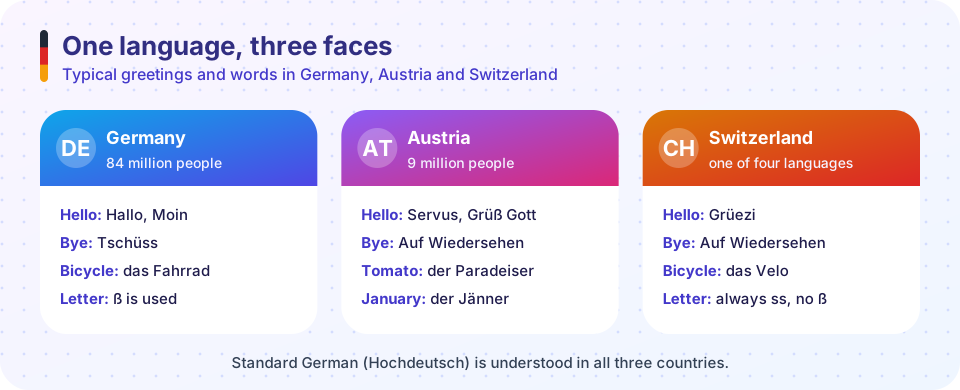
Germany, Austria, Switzerland: the same, only different
Think of it like American, British and Australian English: one language, with regional vocabulary, a few spelling points and plenty of attitude.
| Idea | Germany | Austria | Switzerland |
|---|---|---|---|
| Hello (casual) | Hallo, Moin (north) | Servus, Grüß Gott | Grüezi (dialect) |
| Tomato | die Tomate | der Paradeiser (also Tomate) | die Tomate |
| Bicycle | das Fahrrad | das Fahrrad | das Velo |
| January | der Januar | der Jänner | der Januar |
| Letter ß | used | used | not used (ss instead) |
Both Austria and Switzerland produce their own national variants of the standard language, listed in the official dictionaries. You can use the standard words everywhere. If you hear something unfamiliar, it is almost certainly local colour, not a mistake in your course.
Why people learn German
Learners come for many reasons: studying or working in Germany, Austria or Switzerland; reading philosophy, science, literature and music in the original; connecting with family roots; travel; or simply the pleasure of understanding another culture. German universities are widely known for strong technical programs and low fees for many degrees. Industries such as engineering, cars, chemicals, renewable energy and design employ people from around the world. Whatever your reason, keep it in mind: it is the best fuel for the months ahead.
Common misconceptions
"All Germans speak Hochdeutsch all the time." Most people switch between the standard and their regional speech, depending on whom they talk to.
"Swiss German is the same as German in Switzerland." Spoken Swiss German is a family of dialects; the written language is Standard German.
"German is only spoken in Germany." Germany is the biggest German-speaking country, but five or six other states give the language official status.
"Similar words mean the same thing." Usually, yes. Always check the exceptions (lesson 4).
Try it
First, a tiny Python helper that prints the regular sound correspondences and checks them. Then a greeting picker, because choosing the right hello is your first cultural skill.
Press Run (or Ctrl + Enter) to see the result here.
Program input · what you'd type while the program runs
Type the answers before you press Run, one per line. Each time the program reads a line (with input()), it gets the next line from this box.
Check your understanding
Quick check · 5 questions
of 5 answered You scored / 5 · perfect!
-
1. Which language family do German and English share?
Both descend from Proto-Germanic, which is why so many basic words look alike. -
2. What does 'Hochdeutsch' mean?
'Hoch' refers to the highlands in the south. Hochdeutsch is the standard form used in writing and broadcasting. -
3. Which Swiss word means 'bicycle'?
Swiss Standard German says 'das Velo'. Paradeiser (tomato) and Jänner (January) are Austrian. -
4. English 'water' corresponds to German 'Wasser'. Which shift is shown?
The High German consonant shift turned many English t sounds into z or ss, as in water/Wasser and eat/essen. -
5. Which greeting is typical of Hamburg and northern Germany?
'Moin' is the all-day northern hello. Servus is Bavarian/Austrian and Grüezi is Swiss.
Summary
- German is the main language of Germany, Austria and Liechtenstein, and also official in Switzerland, Luxembourg, Belgium and South Tyrol.
- German and English are Germanic cousins; regular sound shifts such as p to pf and t to z explain many word pairs.
- You will learn Hochdeutsch, the standard that everyone understands; dialects add local colour.
- Vocabulary differs a little between Germany, Austria and Switzerland, but the grammar is the same.
Track your progress
Create a free account to tick off lessons and pick up where you left off on any device.
of German for Beginners lessons completed