


















Lesson 23 of 50 · Present Tense and Word Order
Separable verbs
Learn how German separable verbs work: splitting the prefix to the end, common verbs, inseparable prefixes, questions, commands and a daily routine.
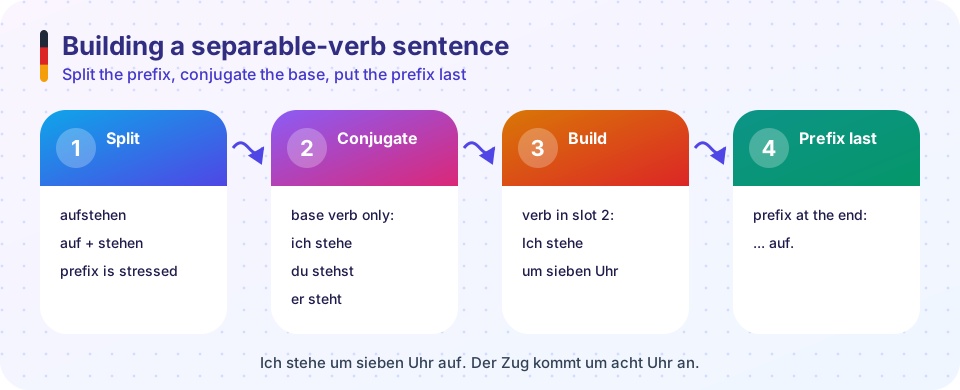
Many German verbs are built from a small prefix plus a base verb: auf + stehen = aufstehen (to get up), an + kommen = ankommen (to arrive), ein + kaufen = einkaufen (to shop). In the present tense these prefixes split off and travel to the end of the sentence: Ich stehe um sieben Uhr auf. English has the same idea in verbs like "to get up" or "to turn on" ("I turn the light on"), but in German the pattern is systematic and extremely common. Learn it once, and you can describe your daily routine, your travel plans and your shopping.
What you will learn
- how separable verbs split in main clauses
- the most common prefixes and about twenty verbs
- the difference between separable and inseparable prefixes
- how to use separable verbs in questions, commands and negation
- a vocabulary set for your daily routine
Key terms
Trennbares Verb: a separable verb, whose prefix splits off (aufstehen). Untrennbares Verb: an inseparable verb, whose prefix never splits (verstehen). Präfix / Vorsilbe: the beginning of the verb, such as auf-, an-, ein-, ver-. Satzklammer (sentence bracket): the frame formed by the verb in position 2 and the prefix at the end.
How separable verbs work
In the dictionary and in the infinitive, a separable verb is one word: aufstehen. In a main clause, the conjugated base verb goes into position 2 (as always), and the prefix goes to the end:
| Infinitive | Sentence | Meaning |
|---|---|---|
| aufstehen | Ich stehe um sieben Uhr auf. | I get up at seven. |
| ankommen | Der Zug kommt um acht Uhr an. | The train arrives at eight. |
| einkaufen | Wir kaufen im Supermarkt ein. | We shop at the supermarket. |
| anrufen | Ich rufe dich morgen an. | I will call you tomorrow. |
| mitkommen | Kommst du mit? | Are you coming along? |
| fernsehen | Sie sieht abends fern. | She watches TV in the evening. |
| abfahren | Der Bus fährt um neun Uhr ab. | The bus departs at nine. |
The sentence forms a frame, the verb at position 2 and the prefix at the end, with all the other information in between. This is called the Satzklammer, the "sentence bracket". It is why German sentences sometimes keep you waiting until the last word: you must wait for the prefix to learn what the verb really means. Ich fange um neun Uhr … an (I begin) is not the same as Ich fange um neun Uhr … ein (I catch).
The stress of a separable verb is on the prefix: AUF-ste-hen, AN-kom-men, EIN-kau-fen, MIT-kom-men, which helps you tell them apart from the inseparable ones.
Common prefixes and verbs
| Prefix | Typical verbs |
|---|---|
| auf- | aufstehen (get up), aufmachen (open), aufräumen (tidy up), aufhören (stop) |
| an- | ankommen (arrive), anrufen (call), anfangen (begin), anziehen (put on) |
| ab- | abfahren (depart), abholen (pick up), abgeben (hand in) |
| aus- | aussteigen (get off), ausgehen (go out), ausmachen (switch off) |
| ein- | einsteigen (get on), einkaufen (shop), einladen (invite), einschlafen (fall asleep) |
| mit- | mitkommen (come along), mitbringen (bring along), mitnehmen (take along) |
| zu- | zumachen (close), zuhören (listen) |
| fern- | fernsehen (watch TV) |
| zurück- | zurückkommen (come back), zurückgeben (give back) |
| vor- | vorbereiten (prepare), vorstellen (introduce) |
| um- | umsteigen (change trains) |
Verbs with a stem change keep it: fangen gives Ich fange an, du fängst an, er fängt an; sehen gives du siehst fern, er sieht fern; einladen gives du lädst ein, er lädt ein; abfahren gives du fährst ab, er fährt ab.
Questions, commands and negation
- Yes/no question: verb first, prefix last: Stehst du früh auf? Kommst du mit?
- W-question: Wann kommt der Zug an? Wann stehst du auf?
- Command: Steh auf! (Get up!) Ruf mich an! (Call me!) Mach die Tür zu! (Close the door!) The formal form: Rufen Sie mich bitte an.
- Negation: nicht goes before the prefix: Ich stehe nicht auf. Er kommt nicht mit.
When the verb stays together (for example, when it appears in the infinitive after another verb, in chapter 7), the prefix does not split: Ich möchte früh aufstehen. (I want to get up early.) You will practice this later. For now, remember: finite verb in position 2: split; infinitive: stays together.
Inseparable prefixes
Some prefixes never split. They are unstressed, and the verb behaves like a normal verb. The most important inseparable prefixes are be-, ge-, er-, ver-, zer-, ent-, emp- and miss-:
| Verb | Sentence |
|---|---|
| verstehen (understand) | Ich verstehe dich. |
| bekommen (get) | Er bekommt ein Geschenk. |
| erklären (explain) | Sie erklärt die Regel. |
| vergessen (forget) | Wir vergessen den Termin nie. |
| besuchen (visit) | Ich besuche meine Oma. |
| entschuldigen (excuse) | Entschuldigen Sie bitte! |
| gefallen (please) | Das gefällt mir. |
| zerstören (destroy) | Der Sturm zerstört das Haus. |
To tell them apart: separable prefixes are stressed and usually are words that exist on their own (auf, an, ab, aus, ein, mit, zu). Inseparable prefixes are unstressed and never stand alone (be-, ge-, ver-, er-). Compare Ich stehe um sieben auf (separable) with Ich verstehe das nicht (inseparable).
A few prefixes can go either way (über-, unter-, durch-, um-, wieder-) with different meanings; you will meet these later.
Your daily routine
Here is a typical day. Notice the prefix at the end of every sentence in which a separable verb appears.
| German | English |
|---|---|
| Ich stehe um sieben Uhr auf. | I get up at seven. |
| Ich frühstücke um halb acht. | I have breakfast at half past seven. |
| Um acht Uhr fahre ich ab. | At eight I leave. |
| Der Unterricht fängt um neun Uhr an. | Class begins at nine. |
| Nach der Schule kaufe ich ein. | After school I shop. |
| Abends sehe ich fern. | In the evening I watch TV. |
| Dann rufe ich meine Freundin an. | Then I call my friend. |
| Um elf Uhr schlafe ich ein. | At eleven I fall asleep. |
Dialogue:
Anna: Wann stehst du normalerweise auf? — When do you normally get up? Ben: Um sechs Uhr. Ich fange früh an. — At six. I start early. Anna: Wann kommst du zurück? — When do you come back? Ben: Gegen fünf. Dann kaufe ich ein und koche. — Around five. Then I shop and cook. Anna: Kommst du am Samstag mit ins Kino? — Are you coming to the cinema on Saturday?
Practice ideas
Make separable verbs part of your routine. Write seven sentences about your day, one for each of these verbs: aufstehen, anfangen, einkaufen, anrufen, fernsehen, abfahren, einschlafen. Check that the base verb is in second position and that the prefix is at the end. Next, turn five of them into questions: Stehst du früh auf? Rufst du oft an? Then make three of them negative with nicht before the prefix. When you read German, circle prefixes at the end of sentences and trace them back to their verbs: this trains you to hold the verb in mind until the sentence is finished. Finally, listen to a German conversation or video and count how many separable verbs you can hear. Everyday speech is full of them: Wir fangen an, Ich rufe dich an, Der Zug fährt ab.
Common misconceptions
"The prefix always stays attached." Only in the infinitive and in a few other forms. In main-clause present tense it goes to the end.
"All prefixes split." Be-, ge-, er-, ver-, zer-, ent- never split: Ich verstehe, not Ich stehe ver.
"Ich aufstehe um sieben." Wrong: Ich stehe um sieben Uhr auf.
"The prefix is optional." It changes the meaning: kommen (come), ankommen (arrive), mitkommen (come along).
Try it
Press Run (or Ctrl + Enter) to see the result here.
Program input · what you'd type while the program runs
Type the answers before you press Run, one per line. Each time the program reads a line (with input()), it gets the next line from this box.
Check your understanding
Quick check · 5 questions
of 5 answered You scored / 5 · perfect!
-
1. Which sentence is correct?
The base verb is in position 2 and the prefix goes to the end. -
2. Which verb is inseparable?
ver- is an inseparable prefix: Ich verstehe. -
3. How do you ask 'Are you coming along?' (du)?
Verb first, prefix last: Kommst du mit? -
4. What is the correct negation of 'Ich stehe auf'?
nicht goes before the prefix: Ich stehe nicht auf. -
5. Which syllable is stressed in 'einkaufen'?
Separable prefixes carry the stress: EIN-kau-fen.
Summary
- A separable verb splits in main clauses: the base verb takes position 2, the prefix goes to the end (Ich stehe um sieben Uhr auf).
- Common prefixes: auf-, an-, ab-, aus-, ein-, mit-, zu-, fern-, zurück-, vor-, um-.
- Inseparable prefixes (be-, ge-, er-, ver-, zer-, ent-, emp-) never split and are unstressed.
- In questions the verb comes first and the prefix last; in negation nicht comes before the prefix.
- Separable verbs are ideal for describing your daily routine.
Next: Chapter 4 review
Track your progress
Create a free account to tick off lessons and pick up where you left off on any device.
of German for Beginners lessons completed