


















Lesson 11 of 50 · Sounds, Greetings and Basics
Chapter 2 review: Sounds, greetings and basics
Review chapter 2 of German for Beginners: vowels, consonants, stress, greetings, du and Sie, numbers, days, months and time, with a 10-question quiz.
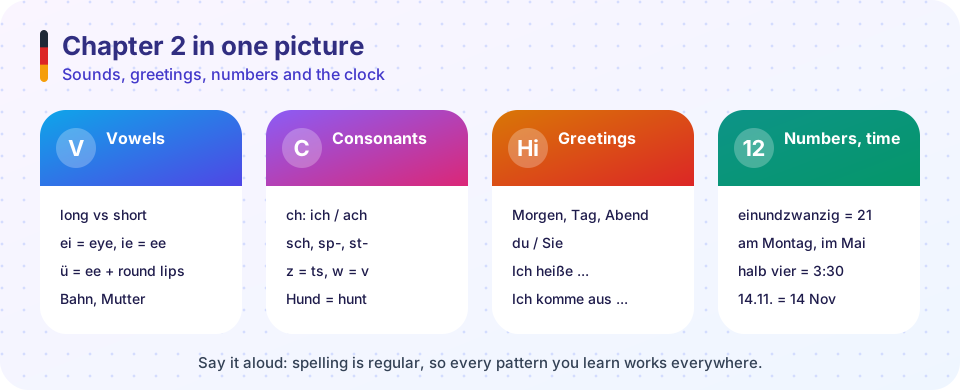
Chapter 2 gave you your voice. You can read German aloud, greet and introduce yourself, count, name the days and tell the time. This review collects the most important rules into one picture and one table, and checks them with a longer quiz. If any answer surprises you, return to the lesson named in the table and say the examples aloud again.
What you will learn
- a quick recap of every lesson in chapter 2
- which pronunciation rules to review before chapter 3
- a self-check on greetings, numbers and time
Key terms
Long and short vowels: spelling tells you the length (double consonant means short). ich-Laut / ach-Laut: the two ch sounds. Final devoicing: b, d, g become p, t, k at the end of a syllable. du / Sie: informal and formal "you". halb: half way to the next hour (halb vier = 3:30).
The chapter in a table
| Lesson | What to remember | Example |
|---|---|---|
| Overview | German spelling is regular; learn eight patterns | ei = "eye", ie = "ee", z = "ts", w = "v" |
| Vowels and umlauts | Long vs short; ü = "ee" with round lips | Staat / Stadt, schon / schön |
| Consonants and stress | ich-sound and ach-sound; sch, sp, st; final devoicing; stress on first syllable | ich, Buch, Sport, Hund = "hunt" |
| Greetings and introductions | Greet by time of day; du vs Sie; Ich heiße ..., Ich komme aus ... | Guten Tag, Wie heißen Sie? |
| Numbers, days and time | Units before tens; days and months are masculine; halb points to the next hour | einundzwanzig, am Montag, halb vier |
Self-check list
You are ready for chapter 3 if you can do these without looking:
- Read Zeit, Wasser, Schule, Brief, Haus, Euro, Vogel aloud with the right sounds.
- Name the two ch sounds and give one example word for each.
- Explain why Hund is said "hunt".
- Greet someone at 8 a.m., 2 p.m. and 7 p.m., formally and informally.
- Say your name, where you come from, where you live and what you do, twice: with du and with Sie.
- Count from 1 to 20, say 21, 34, 57 and 99, and say a price like 2,50 €.
- Name the seven days and say "on Friday" and "in March".
- Say 3:30, 3:45, 3:15 and 14:30 in everyday German.
Study plan for the next days
Pronunciation and greetings are skills, not facts, so they need practice rather than memorization. Spend five minutes a day reading a short German text aloud, such as the dialogues in chapter 2, and focus on one sound at a time: Monday the ch-sounds, Tuesday the umlauts, Wednesday z, w and sch, Thursday final devoicing, Friday the stress. Practice the numbers by counting objects around you: the books on your shelf, the steps on a staircase, the buttons on your phone. Use the clock lesson by saying the time in German each time you look at a clock. Introduce yourself aloud once a day, once with du and once with Sie. After a week, record a thirty-second introduction and listen to it critically. You will hear progress, and that is the best motivation.
Common misconceptions to leave behind
"I can read German like English with a slight accent." Letters have their own rules: w is v, z is ts, ei is eye, ie is ee, v is often f.
"Sie is only for older people." It is for adults you do not know well, whatever their age.
"halb drei means 3:30." It means 2:30.
Try it
Press Run (or Ctrl + Enter) to see the result here.
Program input · what you'd type while the program runs
Type the answers before you press Run, one per line. Each time the program reads a line (with input()), it gets the next line from this box.
Check your understanding
Quick check · 10 questions
of 10 answered You scored / 10 · perfect!
-
1. Which pair is correct for pronunciation?
German w sounds like English v, and z sounds like ts. -
2. Which word has the ach-sound?
After u, ch is the back ach-sound. After i and l it is the soft ich-sound. -
3. What does 'ie' sound like in 'Bier'?
ie is a long ee: BEER. -
4. Which syllable is stressed in 'bekommen'?
The prefix be- is never stressed: be-KOM-men. -
5. Which greeting is correct at 7 p.m.?
Guten Abend is the evening greeting. Gute Nacht is for going to bed. -
6. Which is the correct formal question for a name?
Sie takes the plural-style verb form: heißen. -
7. Which number is 'sechsundvierzig'?
sechs + und + vierzig = 6 + 40 = 46. -
8. How do you say 'on Friday'?
Days take am: am Freitag. -
9. What time is 'Viertel nach drei'?
A quarter past three is 3:15. -
10. Which sentence is correct for a profession?
Professions take no article, and the female form ends in -in.
Summary
- Spelling is regular: learn ei, ie, eu, au, z, w, sch, ch, and long versus short vowels.
- Use the ich-sound and ach-sound correctly; harden final b, d, g; stress the first syllable.
- Greet by time of day, use Sie for formal and du for informal, and introduce yourself with ich heiße/komme/wohne/bin.
- Count with units before tens; use am for days and im for months; halb points to the next hour.
- Next stop: chapter 3, where you learn why nouns have articles and how cases work.
Track your progress
Create a free account to tick off lessons and pick up where you left off on any device.
of German for Beginners lessons completed