


















Lesson 18 of 50 · Present Tense and Word Order
Chapter 4 overview: Present tense and word order
Overview of German verbs in the present tense: endings, irregular verbs, the verb-second rule, negation and separable verbs, with a roadmap of chapter 4.
Nouns, articles and cases tell you who and what is in a sentence. Verbs tell you what happens, and word order tells you how to put it all together. This chapter gives you the engine of German: the present tense of regular and irregular verbs, the most important rule of word order (the verb in second position), negation with nicht and kein, and separable verbs like aufstehen (to get up). With these four tools you can describe your day, your habits and your plans.
What you will learn
- how a German verb changes with the person (conjugation)
- the one verb form you need for both "I eat" and "I am eating"
- the idea of the verb-second rule
- a preview of negation and separable verbs
- what each lesson of chapter 4 covers
Key terms
Infinitive: the basic form of a verb, ending in -en (machen, to make). Stem: the infinitive without -en (mach-). Conjugation: adding endings to the stem to match the subject. Finite verb: the verb form that carries the person and tense. V2 (verb second): the finite verb stands in the second position of a main clause.
One tense for "now"
In English you choose between "I eat" (habit) and "I am eating" (right now). German has only one present tense for both: Ich esse. It can also refer to the future when the context shows it: Morgen fahre ich nach Berlin. (Tomorrow I am going to Berlin.) That is a big simplification: no auxiliary verb ("do", "am", "will"), no -ing form.
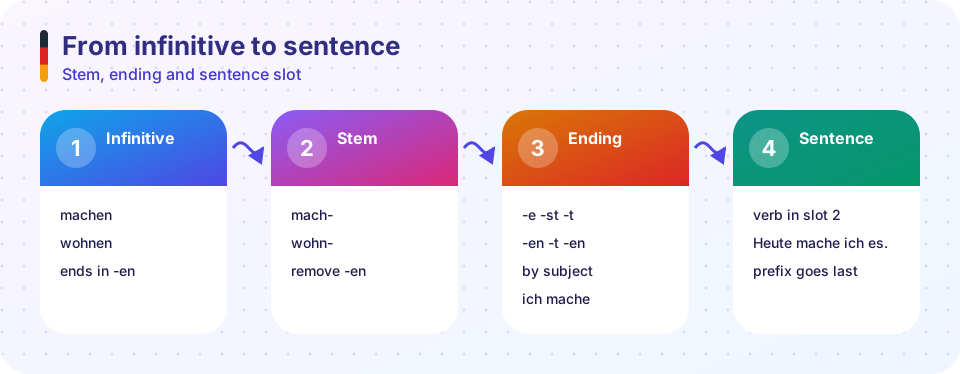
Every verb you meet in a dictionary is listed as an infinitive that ends in -en (a few in -n): machen (make, do), wohnen (live), lernen (learn), sein (be), tun (do). To use a verb in a sentence, you take off -en to find the stem, then add an ending that matches the subject.
| Person | Ending | machen | Meaning |
|---|---|---|---|
| ich | -e | ich mache | I make |
| du | -st | du machst | you make |
| er / sie / es | -t | er macht | he makes |
| wir | -en | wir machen | we make |
| ihr | -t | ihr macht | you (pl.) make |
| sie / Sie | -en | sie machen | they / you (formal) make |
Two things stand out. English adds an ending only for he/she/it ("he makes"), while German marks almost every person. And two of the forms (er/sie/es and ihr) end in the same -t. The wir and sie/Sie forms are identical to the infinitive.
The golden rule: the verb comes second
In a German statement, the conjugated verb is always the second element, never the third or the last. The first element can be the subject or something else, such as time or place, but the verb stays in position two:
- Ich lerne heute Deutsch. (I am learning German today.)
- Heute lerne ich Deutsch. (Today I learn German.)
- Deutsch lerne ich heute. (German I learn today: emphasis.)
When something other than the subject goes first, the subject moves after the verb (Heute lerne ich, not Heute ich lerne). English speakers often forget this: they say "Heute ich lerne". Lesson 3 of this chapter trains you to get it right.
What about negation and separable verbs?
To say "no" or "not", German has two words: nicht negates verbs, adjectives and whole sentences (Ich komme nicht.), and kein negates nouns that would take ein or no article (Ich habe keinen Hund.). Lesson 4 gives you the rules.
Many common verbs have a prefix that splits off and goes to the end of the sentence: aufstehen (get up) gives Ich stehe um sieben Uhr auf. (I get up at seven.) These separable verbs are an everyday feature of German. Lesson 5 shows how they work.
One tense for now
Endings
Verb second
No and not
Separable verbs
Your roadmap through chapter 4
- Regular verbs in the present tense. Endings, spelling changes, vowel changes (du fährst, er isst), and fifty useful verbs.
- Sein, haben and other irregular verbs. Sein and haben in full, werden, and the vowel-changing verbs sprechen, nehmen, sehen, lesen, fahren.
- Word order and the verb-second rule. Subject-verb-object, inversion, time-manner-place and yes/no questions.
- Negation with nicht and kein. When to use which, and where nicht goes.
- Separable verbs. Splitting prefixes, inseparable prefixes and your daily routine.
- Chapter 4 review. A summary poster and a ten-question quiz.
How to practice verbs
Learn verbs in mini-sentences: ich wohne in Berlin, du wohnst in Wien, wir wohnen hier. Say the whole paradigm aloud for each new verb, twice. Then make the verb part of your own life: write five sentences about your day every morning. For the six endings, try a silly rhythm: e, st, t, en, t, en. In a week it will sound like a song.
Common misconceptions
"I need an extra word for 'am doing'." No. Ich lerne means both "I learn" and "I am learning".
"The verb can wait until the end, like in English subordinate clauses." In main clauses the verb stays second. Only in subordinate clauses (chapter 7) does it go to the end.
"All verbs follow the regular endings." Most do. The most common verbs, such as sein and haben, are irregular, and you must learn them as exceptions.
Try it
Press Run (or Ctrl + Enter) to see the result here.
Program input · what you'd type while the program runs
Type the answers before you press Run, one per line. Each time the program reads a line (with input()), it gets the next line from this box.
Check your understanding
Quick check · 4 questions
of 4 answered You scored / 4 · perfect!
-
1. What is the correct form: 'ich ___' (lernen)?
ich takes -e: ich lerne. -
2. Which sentence follows the verb-second rule?
The conjugated verb stays in second position; the subject follows it. -
3. How do you say 'I am eating' in German?
German has no -ing form: Ich esse. -
4. What is the ending of 'er' in the present tense of regular verbs?
er/sie/es takes -t: er macht.
Summary
- German has one present tense for "I eat" and "I am eating".
- Regular endings: -e, -st, -t, -en, -t, -en on the stem.
- The conjugated verb stays in second position in a statement.
- Negation uses nicht and kein; separable verbs split their prefix to the end.
- Chapter 4 teaches regular and irregular verbs, word order, negation and separable verbs.
Track your progress
Create a free account to tick off lessons and pick up where you left off on any device.
of German for Beginners lessons completed