Lesson 37 of 50 · Modal Verbs, Adjectives and Subordinate Clauses
Adjective Endings in German
Understand German adjective endings after der, ein and with no article, with simple tables, spelling changes like hoch and teuer, and a declension machine.
In English, an adjective never changes: "a big dog, the big dog, with the big dog". In German, an adjective that stands before a noun takes an ending: ein großer Hund, der große Hund, mit dem großen Hund. This is one of the topics learners fear most, but the system behind it is simple once you see the logic.
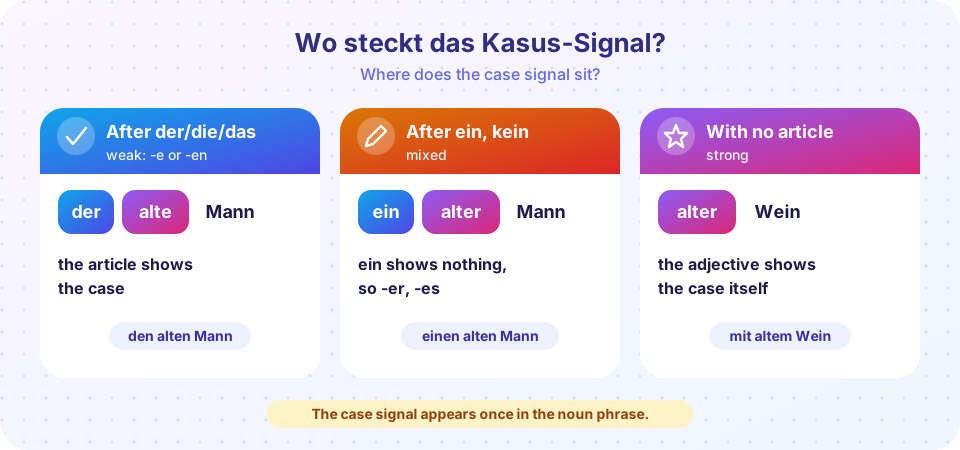
The idea is that a noun phrase must show its case and gender at least once. Sometimes the article already shows it, and then the adjective only needs a plain ending. Sometimes the article has no ending, or is missing altogether, and then the adjective must show it. This lesson gives you three small tables, one for each situation, and a machine that builds the phrases for you.
Caption: The case signal must appear once: after der the article shows it, after ein the adjective shows it, and with no article the adjective shows it.
Only when it stands before the noun (attributive use). After sein, werden, bleiben the adjective has no ending:
Das Haus ist groß. (predicative: no ending)
Das große Haus ist alt. (before the noun: ending)
Ich finde den Film gut. (no ending)
Learn this first, because it removes half the problem: whenever the adjective follows sein, nothing happens.
Type 1: after der, die, das (the weak declension)#
After the definite article, and words that behave like it (dieser, jeder, welcher, alle), the article already shows the case. So the adjective takes only -e or -en:
Case
masculine
feminine
neuter
plural
Nominative
der alte Mann
die alte Frau
das alte Haus
die alten Häuser
Accusative
den alten Mann
die alte Frau
das alte Haus
die alten Häuser
Dative
dem alten Mann
der alten Frau
dem alten Haus
den alten Häusern
Here is the shortcut. -e appears only in the nominative singular (all genders) and in the accusative feminine and neuter. Everywhere else, use -en. Check it: nominative masculine -e, nominative feminine -e, nominative neuter -e, accusative feminine -e, accusative neuter -e; all other cells are -en.
Examples: Der alte Mann wohnt hier. Ich sehe den alten Mann. Ich helfe dem alten Mann. Wir mögen die neue Wohnung.
Type 2: after ein, kein, mein (the mixed declension)#
After ein, kein, mein, dein, sein, ihr, unser, euer, the article has no ending in three places: nominative masculine (ein), nominative neuter (ein) and accusative neuter (ein). In these three places the adjective takes the missing signal. Everywhere else the endings are the same as in Type 1:
Case
masculine
feminine
neuter
plural
Nominative
ein alter Mann
eine alte Frau
ein altes Haus
keine alten Häuser
Accusative
einen alten Mann
eine alte Frau
ein altes Haus
keine alten Häuser
Dative
einem alten Mann
einer alten Frau
einem alten Haus
keinen alten Häusern
Examples: Das ist ein neuer Computer. Ich habe einen neuen Computer. Sie hat ein neues Handy. Wir kaufen eine neue Jacke. The singular ein has no plural, so the table uses kein, which also behaves like ein.
When there is no article, the adjective must carry the case signal. The endings look like the endings of der, die, das:
Case
masculine
feminine
neuter
plural
Nominative
alter Wein
alte Milch
altes Brot
alte Freunde
Accusative
alten Wein
alte Milch
altes Brot
alte Freunde
Dative
altem Wein
alter Milch
altem Brot
alten Freunden
Examples: Ich trinke gern kalten Kaffee. Mit frischem Brot schmeckt es gut. Das sind nette Leute. Sie hat blaue Augen. This pattern is typical with mass nouns (water, bread, coffee), with plurals and after numbers or adjectives like viel and wenig.
(The genitive case works the same way: after der the ending is -en everywhere; this lesson stays with nominative, accusative and dative.)
If you look back at the three tables, you will see that the case signal appears exactly once in the noun phrase: either on the article or on the adjective. The adjective takes -e/-en after a clear article and the strong ending when it must carry the signal. When you are unsure, ask: "Does my article already show the case?"
Reading a description is a good test of the endings. Check each adjective against the tables.
In meinem Zimmer gibt es einen großen Schrank, eine kleine Lampe und ein altes Sofa. An der Wand hängt ein buntes Bild. Der neue Teppich ist weich, und die blauen Vorhänge sind schön.
Translation: In my room there is a big wardrobe, a small lamp and an old sofa. A colorful picture hangs on the wall. The new carpet is soft, and the blue curtains are beautiful.
Why those endings? Es gibt takes the accusative, so einen großen Schrank (masculine, accusative), eine kleine Lampe (feminine) and ein altes Sofa (neuter: ein shows nothing, so the adjective takes -es). Ein buntes Bild is a neuter nominative. Der neue Teppich and die blauen Vorhänge come after der and die, so the adjective takes only -e or -en. And weich and schön stand after ist, so they have no ending at all.
All adjectives before the same noun take the same ending: ein kleiner, roter Wagen; der kleine, rote Wagen; mit kleinen, roten Autos. Put colors close to the noun and size or age earlier: eine große alte Lampe.
The machine below builds the adjective phrase for any article type, case and gender, and highlights the cell in the table. Try the three article types with the same adjective and watch where the case signal goes.
<style>:root{--ink:#1e1b4b;--mut:#475569;--acc:#6366f1;--bd:#c7d2fe}*{box-sizing:border-box}body{margin:0;padding:14px;font-family:system-ui,-apple-system,'Segoe UI',sans-serif;color:var(--ink);background:linear-gradient(135deg,#faf5ff,#eff6ff)}.card{background:#fff;border-radius:18px;box-shadow:0 8px 22px rgba(67,56,202,.15);padding:16px}button{font:inherit;cursor:pointer;border:0;border-radius:999px;padding:8px 14px;background:linear-gradient(135deg,#6366f1,#8b5cf6);color:#fff;font-weight:600}button.alt{background:#eef2ff;color:#3730a3}button:disabled{opacity:.5;cursor:default}.row{display:flex;gap:8px;flex-wrap:wrap;align-items:center;margin-top:10px}.mut{color:var(--mut);font-size:.9rem}</style><style>.q{display:flex;gap:8px;align-items:center;flex-wrap:wrap;padding:8px 0;border-bottom:1px solid #eef2ff;font-size:1.05rem}input{font:inherit;padding:6px 10px;border:2px solid var(--bd);border-radius:10px;width:9em}input.ok{border-color:#10b981;background:#ecfdf5}input.no{border-color:#ef4444;background:#fef2f2}.h{font-size:.85rem;color:var(--mut)}</style><divclass="card"><divid="list"></div><divclass="row"><buttonid="chk">Check answers</button><buttonclass="alt"id="rev">Show answers</button><spanid="score"class="mut"></span></div><divclass="mut"style="margin-top:8px">Capitals do not matter. Type ä ö ü ß, or use ae oe ue ss.</div></div><script>var items=[{"s":"Der alt___ Mann wohnt hier.","a":"e"},{"s":"Ich sehe den alt___ Mann.","a":"en"},{"s":"Wir haben eine neu___ Wohnung.","a":"e"},{"s":"Das ist ein klein___ Kind.","a":"es"},{"s":"Ich helfe dem jung___ Mann.","a":"en"},{"s":"Sie hat einen teur___ Mantel.","a":"en"},{"s":"Ich trinke gern kalt___ Wasser.","a":"es"},{"s":"Mit frisch___ Brot schmeckt es gut.","a":"em"},{"s":"Das sind nett___ Leute.","a":"e"},{"s":"Wir kaufen die rot___ Jacke.","a":"e"},{"s":"Er wohnt in einem groß___ Haus.","a":"en"}];functionnorm(s){return s.toLowerCase().trim().replace(/\s+/g,' ').replace(/ae/g,'ä').replace(/oe/g,'ö').replace(/ue/g,'ü').replace(/ss/g,'ß');}functionnormAns(s){returnnorm(s).replace(/ß/g,'ß');}var list=document.getElementById('list');
items.forEach(function(it,n){var d=document.createElement('div');d.className='q';var parts=it.s.split('___');
d.appendChild(document.createTextNode(parts[0]));var inp=document.createElement('input');inp.id='i'+n;inp.setAttribute('aria-label','Answer '+(n+1));d.appendChild(inp);
d.appendChild(document.createTextNode(parts[1]||''));if(it.h){var h=document.createElement('span');h.className='h';h.textContent='('+it.h+')';d.appendChild(h);}
list.appendChild(d);});functionok(it,v){var arr=Array.isArray(it.a)?it.a:[it.a];var x=normAns(v);return arr.some(function(a){returnnormAns(a)===x;});}
document.getElementById('chk').onclick=function(){var right=0;
items.forEach(function(it,n){var e=document.getElementById('i'+n);var g=ok(it,e.value);e.className=g?'ok':'no';if(g)right++;});
document.getElementById('score').textContent=right+' of '+items.length+' correct';};
document.getElementById('rev').onclick=function(){
items.forEach(function(it,n){var e=document.getElementById('i'+n);e.value=Array.isArray(it.a)?it.a[0]:it.a;e.className='ok';});};</script>
And a deck of adjective pairs.
Adjective pairs
<style>:root{--ink:#1e1b4b;--mut:#475569;--acc:#6366f1;--bd:#c7d2fe}*{box-sizing:border-box}body{margin:0;padding:14px;font-family:system-ui,-apple-system,'Segoe UI',sans-serif;color:var(--ink);background:linear-gradient(135deg,#faf5ff,#eff6ff)}.card{background:#fff;border-radius:18px;box-shadow:0 8px 22px rgba(67,56,202,.15);padding:16px}button{font:inherit;cursor:pointer;border:0;border-radius:999px;padding:8px 14px;background:linear-gradient(135deg,#6366f1,#8b5cf6);color:#fff;font-weight:600}button.alt{background:#eef2ff;color:#3730a3}button:disabled{opacity:.5;cursor:default}.row{display:flex;gap:8px;flex-wrap:wrap;align-items:center;margin-top:10px}.mut{color:var(--mut);font-size:.9rem}</style><style>.fc{height:150px;display:flex;align-items:center;justify-content:center;text-align:center;font-size:1.5rem;font-weight:700;border-radius:18px;cursor:pointer;padding:12px;user-select:none}.front{background:linear-gradient(135deg,#6366f1,#8b5cf6);color:#fff}.back{background:#fff;color:var(--ink);border:2px solid var(--bd)}</style><divclass="card"><divid="fc"class="fc front"tabindex="0"role="button"aria-label="Flash card, press to flip"></div><divclass="mut"id="cnt"style="margin-top:8px"></div><divclass="row"><buttonclass="alt"id="prev">Back</button><buttonid="flip">Flip</button><buttonclass="alt"id="next">Next</button><buttonclass="alt"id="shuf">Shuffle</button><buttonclass="alt"id="say">Listen</button></div><divclass="mut"id="note"style="margin-top:8px">Click the card to flip it. Listen uses your browser's voice if it is available.</div></div><script>var cards=[["alt – neu","old – new"],["groß – klein","big – small"],["teuer – billig","expensive – cheap"],["schnell – langsam","fast – slow"],["heiß – kalt","hot – cold"],["hell – dunkel","bright – dark"],["leicht – schwer","light, easy – heavy, difficult"],["jung – alt","young – old"],["lang – kurz","long – short"],["schön – hässlich","beautiful – ugly"],["gut – schlecht","good – bad"],["rot – blau – gelb","red – blue – yellow"],["grün – schwarz – weiß","green – black – white"],["braun – grau – rosa","brown – grey – pink"]];var i=0,showBack=false;var fc=document.getElementById('fc');functiondraw(){var c=cards[i];fc.textContent=showBack?c[1]:c[0];fc.className='fc '+(showBack?'back':'front');document.getElementById('cnt').textContent='Card '+(i+1)+' of '+cards.length;}functionflip(){showBack=!showBack;draw();}
fc.onclick=flip;fc.onkeydown=function(e){if(e.key==='Enter'||e.key===' '){e.preventDefault();flip();}};
document.getElementById('flip').onclick=flip;
document.getElementById('next').onclick=function(){i=(i+1)%cards.length;showBack=false;draw();};
document.getElementById('prev').onclick=function(){i=(i-1+cards.length)%cards.length;showBack=false;draw();};
document.getElementById('shuf').onclick=function(){for(var k=cards.length-1;k>0;k--){var r=Math.floor(Math.random()*(k+1));var t=cards[k];cards[k]=cards[r];cards[r]=t;}i=0;showBack=false;draw();};
document.getElementById('say').onclick=function(){try{var u=newSpeechSynthesisUtterance(cards[i][0]);u.lang='de-DE';window.speechSynthesis.cancel();window.speechSynthesis.speak(u);}catch(e){document.getElementById('note').textContent='Speech is not available in this preview.';}};draw();</script>
Adjectives before a noun take an ending; after sein they do not.
After der: -e (nominative sg, accusative fem/neut) or -en; after ein: same, but -er, -es where ein shows nothing; with no article: the adjective shows the case like der would.
The case signal appears once in the noun phrase.
Hoch, teuer, dunkel change spelling; colors like rosa and lila never take endings.