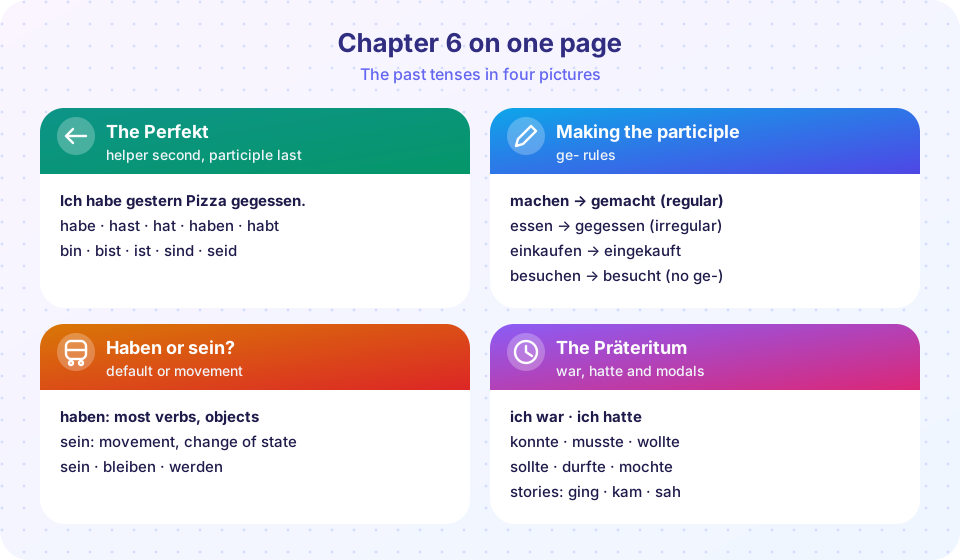
Review the German Perfekt, the choice between haben and sein, participles and the Präteritum of war, hatte and modals with a poster, dialogue and quiz.
Chapter 6 gave you the past. You can now say what you did, where you went, how you felt and what you could or had to do. This review puts the whole chapter on one page, lets you read a dialogue that mixes all the forms, and tests you with ten questions.
Caption: Chapter 6 in one picture: helper in second place, participle at the end, and a few Präteritum forms for speech.
Two friends talk on Monday morning. Look for Perfekt, Präteritum and the helping verbs.
Nina:Hallo Max! Wie war dein Wochenende?
Max:Schön! Ich bin nach Dresden gefahren und habe meine Schwester besucht.
Nina:Toll! Was habt ihr gemacht?
Max:Wir haben viel gegessen und sind durch die Stadt gelaufen. Am Sonntag hatte ich leider keine Zeit mehr, ich musste lernen.
Nina:Oh, schade. Hast du viel geschafft?
Max:Ja, ich habe zwei Stunden gelernt, und danach bin ich eingeschlafen!
English: Nina: Hello Max! How was your weekend? Max: Lovely! I went to Dresden and visited my sister. Nina: Great! What did you do? Max: We ate a lot and walked through the city. On Sunday I unfortunately had no time left, I had to study. Nina: Oh, too bad. Did you get a lot done? Max: Yes, I studied for two hours and then I fell asleep!
Count the forms: war, hatte, musste (Präteritum), bin gefahren, bin gelaufen, bin eingeschlafen (sein), habe besucht, habt gemacht, haben gegessen, habe gelernt, hast geschafft (haben).
Mixed practice: fill in the missing helpers, participles and Präteritum forms.
Chapter 6 mixed practice
<style>:root{--ink:#1e1b4b;--mut:#475569;--acc:#6366f1;--bd:#c7d2fe}*{box-sizing:border-box}body{margin:0;padding:14px;font-family:system-ui,-apple-system,'Segoe UI',sans-serif;color:var(--ink);background:linear-gradient(135deg,#faf5ff,#eff6ff)}.card{background:#fff;border-radius:18px;box-shadow:0 8px 22px rgba(67,56,202,.15);padding:16px}button{font:inherit;cursor:pointer;border:0;border-radius:999px;padding:8px 14px;background:linear-gradient(135deg,#6366f1,#8b5cf6);color:#fff;font-weight:600}button.alt{background:#eef2ff;color:#3730a3}button:disabled{opacity:.5;cursor:default}.row{display:flex;gap:8px;flex-wrap:wrap;align-items:center;margin-top:10px}.mut{color:var(--mut);font-size:.9rem}</style><style>.q{display:flex;gap:8px;align-items:center;flex-wrap:wrap;padding:8px 0;border-bottom:1px solid #eef2ff;font-size:1.05rem}input{font:inherit;padding:6px 10px;border:2px solid var(--bd);border-radius:10px;width:9em}input.ok{border-color:#10b981;background:#ecfdf5}input.no{border-color:#ef4444;background:#fef2f2}.h{font-size:.85rem;color:var(--mut)}</style><divclass="card"><divid="list"></div><divclass="row"><buttonid="chk">Check answers</button><buttonclass="alt"id="rev">Show answers</button><spanid="score"class="mut"></span></div><divclass="mut"style="margin-top:8px">Capitals do not matter. Type ä ö ü ß, or use ae oe ue ss.</div></div><script>var items=[{"s":"Ich ___ gestern einen Film gesehen.","a":"habe"},{"s":"Wir ___ nach Wien gefahren.","a":"sind"},{"s":"Er hat Kaffee ___.","a":"getrunken","h":"trinken"},{"s":"Sie ist früh ___.","a":"aufgestanden","h":"aufstehen"},{"s":"Ich ___ gestern müde.","a":"war"},{"s":"Wir ___ keine Zeit.","a":"hatten"},{"s":"Ich ___ nicht kommen.","a":"konnte","h":"können"},{"s":"Hast du die Rechnung ___?","a":"bezahlt","h":"bezahlen"},{"s":"Er hat Jura ___.","a":"studiert","h":"studieren"},{"s":"Sie ___ zu Hause geblieben.","a":"ist"}];functionnorm(s){return s.toLowerCase().trim().replace(/\s+/g,' ').replace(/ae/g,'ä').replace(/oe/g,'ö').replace(/ue/g,'ü').replace(/ss/g,'ß');}functionnormAns(s){returnnorm(s).replace(/ß/g,'ß');}var list=document.getElementById('list');
items.forEach(function(it,n){var d=document.createElement('div');d.className='q';var parts=it.s.split('___');
d.appendChild(document.createTextNode(parts[0]));var inp=document.createElement('input');inp.id='i'+n;inp.setAttribute('aria-label','Answer '+(n+1));d.appendChild(inp);
d.appendChild(document.createTextNode(parts[1]||''));if(it.h){var h=document.createElement('span');h.className='h';h.textContent='('+it.h+')';d.appendChild(h);}
list.appendChild(d);});functionok(it,v){var arr=Array.isArray(it.a)?it.a:[it.a];var x=normAns(v);return arr.some(function(a){returnnormAns(a)===x;});}
document.getElementById('chk').onclick=function(){var right=0;
items.forEach(function(it,n){var e=document.getElementById('i'+n);var g=ok(it,e.value);e.className=g?'ok':'no';if(g)right++;});
document.getElementById('score').textContent=right+' of '+items.length+' correct';};
document.getElementById('rev').onclick=function(){
items.forEach(function(it,n){var e=document.getElementById('i'+n);e.value=Array.isArray(it.a)?it.a[0]:it.a;e.className='ok';});};</script>
Then decide which sentence is correct.
Which sentence is correct?
<style>:root{--ink:#1e1b4b;--mut:#475569;--acc:#6366f1;--bd:#c7d2fe}*{box-sizing:border-box}body{margin:0;padding:14px;font-family:system-ui,-apple-system,'Segoe UI',sans-serif;color:var(--ink);background:linear-gradient(135deg,#faf5ff,#eff6ff)}.card{background:#fff;border-radius:18px;box-shadow:0 8px 22px rgba(67,56,202,.15);padding:16px}button{font:inherit;cursor:pointer;border:0;border-radius:999px;padding:8px 14px;background:linear-gradient(135deg,#6366f1,#8b5cf6);color:#fff;font-weight:600}button.alt{background:#eef2ff;color:#3730a3}button:disabled{opacity:.5;cursor:default}.row{display:flex;gap:8px;flex-wrap:wrap;align-items:center;margin-top:10px}.mut{color:var(--mut);font-size:.9rem}</style><style>.q{font-size:1.15rem;font-weight:600;margin:6px 0 12px}.opts{display:flex;gap:10px;flex-wrap:wrap}.opts button{background:#fff;color:var(--ink);border:2px solid var(--bd);border-radius:14px;padding:10px 18px}.opts button.good{background:#ecfdf5;border-color:#10b981;color:#047857}.opts button.bad{background:#fef2f2;border-color:#ef4444;color:#b91c1c}.fb{min-height:2.6em;margin-top:10px;font-size:.95rem}</style><divclass="card"><divclass="mut"id="prog"></div><divclass="q"id="q"></div><divclass="opts"id="opts"></div><divclass="fb"id="fb"></div><divclass="row"><buttonid="nx"disabled>Next</button><spanclass="mut"id="sc"></span></div></div><script>var items=[{"q":"I went to Cologne.","o":["Ich habe nach Köln gefahren.","Ich bin nach Köln gefahren.","Ich bin nach Köln gefahren haben."],"a":1,"w":"Movement to a goal: sein, participle last."},{"q":"We ate pizza.","o":["Wir haben gegessen Pizza.","Wir haben Pizza gegessen.","Wir Pizza haben gegessen."],"a":1,"w":"The participle goes to the end."},{"q":"I was tired yesterday.","o":["Ich bin gestern müde gewesen.","Ich war gestern müde.","Ich habe gestern müde gehabt."],"a":1,"w":"In speech, war is the normal choice."},{"q":"She went to bed early.","o":["Sie hat früh ins Bett gegangen.","Sie ist früh ins Bett gegangen.","Sie war früh ins Bett gegangen."],"a":1,"w":"Gehen takes sein in the Perfekt."},{"q":"I called my grandmother.","o":["Ich habe meine Oma angerufen.","Ich habe meine Oma geanruft.","Ich bin meine Oma angerufen."],"a":0,"w":"Separable verb: an + ge + rufen, with haben."},{"q":"We had to wait.","o":["Wir musstet warten.","Wir mussten warten.","Wir gemusst warten."],"a":1,"w":"Wir takes -ten: mussten."}];var i=0,score=0,answered=false;functionshow(){var it=items[i];answered=false;
document.getElementById('prog').textContent='Question '+(i+1)+' of '+items.length;
document.getElementById('q').textContent=it.q;
document.getElementById('fb').textContent='';
document.getElementById('nx').disabled=true;var box=document.getElementById('opts');box.innerHTML='';
it.o.forEach(function(t,k){var b=document.createElement('button');b.textContent=t;
b.onclick=function(){if(answered)return;answered=true;var ok=k===it.a;if(ok)score++;
b.className=ok?'good':'bad';if(!ok){box.children[it.a].className='good';}
document.getElementById('fb').textContent=(ok?'Correct. ':'Not quite. ')+(it.w||'');
document.getElementById('sc').textContent='Score: '+score+' / '+(i+1);
document.getElementById('nx').disabled=false;
document.getElementById('nx').textContent=(i===items.length-1)?'Start again':'Next';};
box.appendChild(b);});}
document.getElementById('nx').onclick=function(){if(i===items.length-1){i=0;score=0;document.getElementById('sc').textContent='';}else{i++;}show();};show();</script>