


















Lesson 33 of 50 · Past Tenses
The Präteritum of sein, haben and Modal Verbs
Learn the German simple past of sein, haben and the modal verbs, when to use it instead of the Perfekt, and how to read story-style Präteritum.
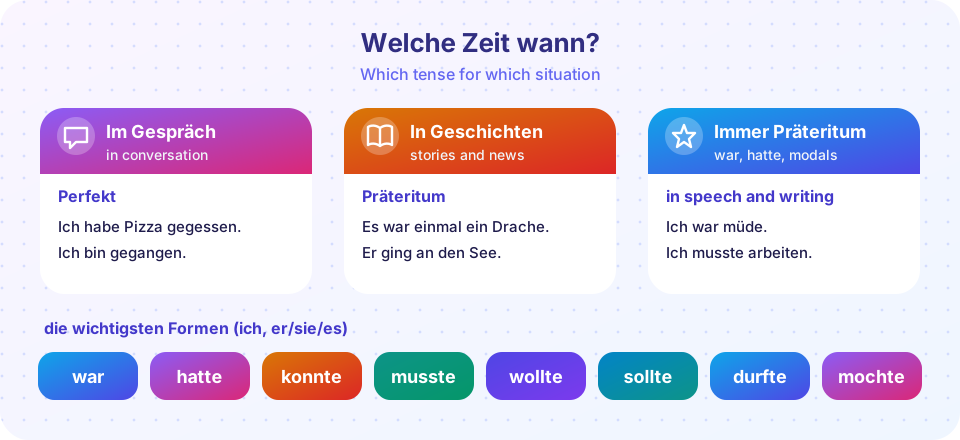
You now know the Perfekt, the everyday German past. There is a second past tense, the Präteritum (or Imperfekt), and it does not disappear from speech. For a small group of verbs it is actually the normal choice, even in conversation: sein (war), haben (hatte) and the modal verbs (konnte, musste, wollte ...).
Ich war gestern krank. Ich hatte Fieber und konnte nicht arbeiten. Ich musste im Bett bleiben. Nobody says Ich bin krank gewesen. Ich habe Fieber gehabt. in a normal chat, although it is not wrong. Learn these few forms and you can describe how you felt or what was possible in the past with ease.
What you will learn
- the Präteritum of sein and haben in all persons
- the Präteritum of können, müssen, wollen, sollen, dürfen, mögen
- why these verbs prefer the Präteritum even in conversation
- how to recognize the Präteritum of regular and strong verbs in texts
- the idea of the Plusquamperfekt
Key terms
- das Präteritum (simple past): ich war, ich ging.
- das Modalverb (modal verb): können, müssen, wollen, sollen, dürfen, mögen.
- die Personalendung (personal ending): the ending that shows the person: -st, -n, -t.
- das Plusquamperfekt (past perfect): Ich hatte gegessen.
- das Märchen (fairy tale): a classic home of the Präteritum.
Sein and haben in the Präteritum
| Person | sein | haben |
|---|---|---|
| ich | war | hatte |
| du | warst | hattest |
| er/sie/es | war | hatte |
| wir | waren | hatten |
| ihr | wart | hattet |
| sie/Sie | waren | hatten |
Notice that ich and er/sie/es have the same form, as in all past tenses: ich war, er war. Examples:
- Gestern war ich in Köln. (Yesterday I was in Cologne.)
- Wir waren müde. (We were tired.)
- Sie hatte keine Zeit. (She had no time.)
- Hattet ihr Hunger? (Were you hungry?)
- Das Wetter war schlecht, und wir hatten keinen Schirm. (The weather was bad and we had no umbrella.)
Useful idioms: Es war einmal ... (Once upon a time ...), Es gab ... (There was/were ..., from es gibt): Es gab viele Leute auf dem Markt.
Modal verbs in the Präteritum
The modal verbs lose their umlaut in the simple past (können → konnte, not könnte; that form means something else) and add the regular past endings -te, -test, -te, -ten, -tet, -ten:
| Person | können | müssen | wollen | sollen | dürfen | mögen |
|---|---|---|---|---|---|---|
| ich | konnte | musste | wollte | sollte | durfte | mochte |
| du | konntest | musstest | wolltest | solltest | durftest | mochtest |
| er/sie/es | konnte | musste | wollte | sollte | durfte | mochte |
| wir | konnten | mussten | wollten | sollten | durften | mochten |
| ihr | konntet | musstet | wolltet | solltet | durftet | mochtet |
| sie/Sie | konnten | mussten | wollten | sollten | durften | mochten |
Some of these look similar to English: could, had to, wanted, was supposed to, was allowed to, liked. Examples:
- Ich konnte nicht kommen. (I could not come.)
- Wir mussten lange warten. (We had to wait a long time.)
- Er wollte schlafen. (He wanted to sleep.)
- Du solltest mehr lernen. (You were supposed to / should have studied more.)
- Sie durfte nicht gehen. (She was not allowed to go.)
- Als Kind mochte ich keinen Fisch. (As a child I did not like fish.)
The modals also appear in the Perfekt (Ich habe nicht kommen können), but that form is clumsy, so in speech almost everybody chooses Ich konnte nicht kommen.
Reading the Präteritum of other verbs
You do not need to speak the Präteritum of ordinary verbs yet, but you should be able to read it, because books, news and stories use it.
Regular verbs add -te to the stem, then the personal endings (-te, -test, -te, -ten, -tet, -ten): machen → machte, wohnen → wohnte, sagen → sagte, arbeiten → arbeitete.
Strong verbs change their stem vowel. In the ich and er/sie/es forms there is no ending: ging, kam, sah, aß, blieb, fuhr. The other persons add endings: du gingst, wir gingen, ihr gingt, sie gingen. You met many of these forms in the table of the last lesson.
Here is a short fairy tale. Underline each Präteritum form as you read.
Es war einmal ein kleiner Drache. Er wohnte in einem Berg und hatte große Angst vor dem Wasser. Eines Tages ging er an den See. Er sah einen Fisch, und der Fisch sagte: „Komm herein, das Wasser ist warm!“ Der Drache blieb stehen, aber dann sprang er hinein.
Translation: Once upon a time there was a little dragon. He lived in a mountain and was very afraid of water. One day he went to the lake. He saw a fish, and the fish said: "Come in, the water is warm!" The dragon stood still, but then he jumped in.
Forms in the story: war (sein), wohnte (regular), hatte (haben), ging (gehen), sah (sehen), sagte (regular), blieb (bleiben), sprang (springen). A weather report in the news sounds the same: Gestern regnete es den ganzen Tag. Am Abend wurde es kälter. (werden → wurde).
When to use which tense
| Situation | Typical choice | Example |
|---|---|---|
| a chat with a friend about yesterday | Perfekt | Ich habe einen Film gesehen. |
| describing how you felt, what you had | Präteritum of sein/haben | Ich war müde. Ich hatte Kopfschmerzen. |
| what you could, had to, wanted | Präteritum of modals | Ich musste arbeiten. |
| novels, fairy tales, news, reports | Präteritum | Er ging nach Hause. |
| an event before another past event | Plusquamperfekt | Ich hatte schon gegessen, als er kam. |
A good example mixes both tenses in one breath: Gestern war ich in Hamburg. Ich bin mit dem Zug gefahren und habe meine Tante besucht. Ich musste früh nach Hause. The Präteritum forms war and musste sit comfortably next to the Perfekt.
The Plusquamperfekt in one minute
The Plusquamperfekt is the past before another past. Take the Präteritum of haben or sein, add the participle at the end:
- Ich hatte schon gegessen, als er kam. (I had already eaten when he came.)
- Wir waren schon gegangen, als es regnete. (We had already left when it started to rain.)
The choice of hatte or war follows the same rule as in the Perfekt. Use als ("when") for a single event in the past.
Common misconceptions
- "Präteritum is the German version of the English simple past, so I should use it for everything." In speech, the Perfekt is the normal past for most verbs. Use the Präteritum for sein, haben and the modals.
- "Konnte and könnte are the same." Konnte is the simple past (could, was able to). Könnte is the subjunctive (could, would be able to). The umlaut matters.
- "Strong verbs always add -te." No. ging, sah, kam have no -te; only regular verbs add it.
Try it
This program prints the Präteritum of sein, haben and all six modals in one table. Change the sentences at the end to describe your own yesterday.
Press Run (or Ctrl + Enter) to see the result here.
Program input · what you'd type while the program runs
Type the answers before you press Run, one per line. Each time the program reads a line (with input()), it gets the next line from this box.
Fill in the right forms.
And flash cards to build speed.
Check your understanding
Quick check · 5 questions
of 5 answered You scored / 5 · perfect!
-
1. What is the Präteritum of 'ich bin'?
Ich war is the simple past of sein and the usual form in speech. -
2. Which form is correct? 'Wir ___ keine Zeit.' (past)
Wir takes the plural: hatten. -
3. What does 'Er musste arbeiten' mean?
Müssen in the past is musste: had to. -
4. Which sentence sounds the most natural in everyday speech?
Sein and haben usually appear in the Präteritum in conversation. -
5. What is the Präteritum of 'gehen' in a story: 'Er ___ nach Hause.'
Gehen is a strong verb: ging.
Summary
- Sein and haben in the Präteritum: war, warst, war, waren, wart, waren and hatte, hattest, hatte, hatten, hattet, hatten.
- Modals drop their umlaut and add -te: konnte, musste, wollte, sollte, durfte, mochte.
- Speech prefers the Perfekt, except for these verbs; writing and stories use the Präteritum.
- Strong verbs show vowel change without ending in ich/er: ging, kam, sah.
- The Plusquamperfekt is hatte/war + participle.
Next: Chapter 6 review
Track your progress
Create a free account to tick off lessons and pick up where you left off on any device.
of German for Beginners lessons completed